
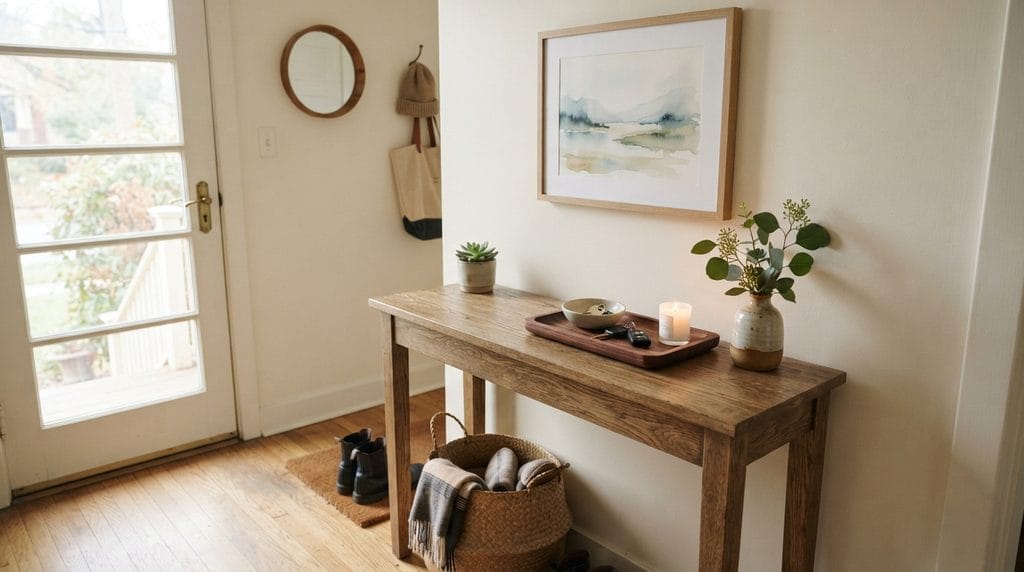
Quick answer: The best small apartment entryway ideas with no closet start with four jobs: a safe place for daily shoes, one spot for keys, a limited number of coats or bags, and a clear route through the door. If your front door opens directly into the living room, a shallow shoe cabinet or basket, a catchall tray and a small rug can define an entry without a foyer. Measure the door swing and walking path before adding furniture.
A tiny apartment entrance often has to function as a hallway, coat storage, shoe station and part of the living room at once. The solution is not to squeeze in a miniature mudroom. It is to create a small, deliberate landing zone that holds only what you actually use. Below are 12 practical options, plus four layout recipes and a checklist to help you choose what fits your rental.
Choose your first fix: Shoes everywhere? Try one low tray before buying a cabinet. No floor space? Try a light-duty key pocket on a compatible surface. Coats piling up? Limit daily hooks and move seasonal layers elsewhere. Need a seat to change shoes? Consider a bench only if it leaves a usable route. You do not need all four.
Before You Buy Anything: The Two-Minute Entryway Test
Stand just inside the front door with a shopping bag in one hand. Can you open and close the door fully, put down your keys, remove your shoes and reach the rest of your home without sidestepping furniture? Notice exactly where things collect. This quick test tells you more than a beautiful entryway photo.
Try before buying: Mark the proposed cabinet or bench footprint with removable painter’s tape, including handles and open drawers. Open the door fully and walk past it while carrying groceries or using any stroller or mobility aid your household needs. Photograph the outline to compare with product dimensions before shopping. Measure the remaining clear route at its narrowest point. This is a practical fit test, not a substitute for applicable fire, accessibility or building requirements.
- Mark the door swing. Open the door completely and note the area it needs. Do not place a rack, mirror or bench in that space.
- Measure the narrowest walking path. Account for coat sleeves and bags hanging from hooks, not just furniture dimensions. Keep the path and any emergency exit unobstructed.
- Count the daily items. Note how many pairs of shoes, jackets, bags and small objects genuinely need to stay near the door. Store occasional and seasonal items elsewhere.
- Check the walls and lease. Look for outlets, vents, electrical panels, door trim and any restrictions on drilling before choosing hooks or shelving.
For a whole-home approach, our small apartment organization checklist helps you work through the rest of the apartment without buying organizers you do not need.
12 Small Apartment Entryway Ideas With No Closet
1. Use a shallow shoe cabinet as the landing station
If shoes are the main source of clutter, start here. A slim cabinet with doors or tilt-out compartments can hide the everyday pairs and provide a small surface for a key tray. Measure its depth against your available walkway rather than choosing by appearance. Look for a smooth, easy-to-clean top and a finish that fits the adjacent room. For wet footwear, compare a closed cabinet with an open washable tray; enclosed storage is less suitable for shoes that have not dried.
Measurement example: If a wall-to-wall entry measures 110 cm and a proposed cabinet projects 25 cm, 85 cm remains before accounting for handles, hanging coats or door movement. This arithmetic helps reject a poor fit; it does not establish that 85 cm is a compliant or suitable escape or accessible route. Check the requirements that apply to your home.
Best for: apartments with a short uninterrupted wall beside the entrance. Skip it when: the cabinet would block the door, a utility panel or the route into the living room. Follow the manufacturer’s installation and anti-tip instructions; some narrow cabinets must be anchored.
2. Make a zero-floor-space key drop
No room for a table? Put a small, securely mounted key hook or lightweight wall pocket within reach of the door. Keep it to keys, sunglasses and one outgoing envelope rather than turning it into a catchall for everything. A magnetic key holder may work on a suitable metal surface, but check that it stays put during normal door use. Put keys within comfortable reach of the people who use them; a tray on existing furniture can be easier than a high hook.
Best for: studio entrances and doors that open straight into a narrow corridor. For renters, use removable products only on compatible surfaces and within their stated weight ratings.
3. Give each person one everyday coat hook
A crowded row of coats can make an entrance look smaller than it is. Assign each household member one daily hook and move off-season jackets to a bedroom wardrobe or another storage area. If your lease allows it, install a properly supported hook rail; otherwise consider a stable freestanding rack or a door-mounted option compatible with the door and its clearances.
Best for: homes where the entry has no coat closet. Common mistake: expecting lightweight adhesive hooks to hold heavy winter coats or full backpacks. Follow the product’s instructions and never use decorative adhesive strips to support heavy shelving. Allow damp coats to dry and keep sleeves and backpacks from projecting into the walking route.
Family example: In a two-adult, one-child household, start with three daily-coat spots at reachable heights rather than a crowded rail for every jacket. Store heavy backpacks on a low, stable surface outside the exit route, and move seasonal coats elsewhere. Check each hook’s rated load and the surface it attaches to.
4. Add a narrow bench only when it earns its space
A bench is useful when someone regularly sits to put on shoes or when the seat includes genuinely helpful storage. Choose a compact model with a stable base, then slide a labeled basket underneath for shoes or cold-weather accessories. If you must turn sideways to pass the bench, remove it: a clear floor is more valuable than a piece of furniture that only looks inviting.
Best for: a wider nook near the door, families with children, or anyone who benefits from sitting while changing footwear. Test the seat height with a stable chair first; check the bench’s rated seating load and whether drawers or baskets can open without blocking the doorway.
5. Define an entryway with a low-profile washable rug
When the door opens into the living room, a rug can quietly say, “this is the entry,” without adding a wall or divider. Choose a size that catches the first steps inside, allows the door to swing freely and does not create a trip edge. A nonslip underlay suitable for your flooring is often more useful than a decorative extra layer. Test the mat with the door fully open and damp footwear; if it curls or slides, try a flatter washable option.
Best for: open-plan apartments with no foyer. A rug creates a visual boundary; it does not need to fill the entire space between the door and sofa.
6. Use the back of the door carefully
Over-door organizers can hold caps, scarves or a few light bags while leaving the wall and floor free. Before buying, check the gap above the door, the door’s full opening angle and whether the organizer would hit the wall, hinges or a door closer. Keep emergency hardware and locks fully accessible. If the entrance is a fire-rated or managed-building door, check the building’s rules and door manufacturer’s instructions before attaching accessories; do not alter the door, closer, seals or latching mechanism.
Best for: renters who cannot drill and have a door that can accommodate an organizer without interfering with its operation.
7. Turn a single basket into a controlled shoe zone
A low, easy-to-clean basket is often enough for the shoes worn this week. Place it against the wall, not in the traffic path, and keep the rest of the shoe collection in bedroom storage. If wet footwear is common, choose a ventilated rack or washable tray instead of a closed fabric basket. Empty any pooled water and let shoes dry before transferring them to enclosed storage.
Best for: tiny entrances where a cabinet will not fit. For more ways to make existing storage work harder, see our small space organization hacks.
8. Pair a small mirror with a key tray
A mirror gives the entrance a useful final-check spot and can reflect available light. Place it where it shows an uncluttered view, not a messy shoe pile. A small mirror above a shallow console can look intentional without extra decor. Use mounting hardware rated for the mirror and wall type; do not leave a heavy leaning mirror unsecured. Check the reflected view before mounting: a mirror facing clutter may make the entrance look busier rather than brighter.
Best for: dark entry corners and apartment doors that open into the living room. For frame and placement inspiration, our mirror wall decor ideas for a small living room cover several compact-room options.
9. Build a “leaving home” basket, not a paper pile
Returns, library books and items that need to go out tomorrow tend to migrate toward the door. Give them one small basket or tote and empty it on a set day. A label such as ‘return this week’ helps shared households, but keep parcels and return boxes out of the door swing. Keep incoming mail in a separate narrow slot so urgent documents are not buried under shoes or reusable bags.
Best for: busy households whose entryway is usually messy even when shoes and coats are under control.
10. Make one piece do two jobs
A compact storage ottoman can provide seating and hold accessories; a shallow cabinet can hide shoes and support a key tray; a stable open shelf can hold a basket and define the edge of a studio living area. Choose the combination that fixes your actual problem rather than adding three matching pieces for a magazine-style look. Check the full usable footprint, including the space needed to open a storage ottoman or cabinet.
Best for: small apartments where every added object needs to justify its footprint. If you rent, these renter-friendly bedroom ideas can help you find secondary storage for belongings that do not need to live at the front door.
11. Try a freestanding entry corner when drilling is off-limits
A compact coat stand with a stable base, a low shoe tray and a key dish on nearby existing furniture can form an entry station without wall holes. Keep the stand lightly loaded, away from the door swing, and choose a model appropriate for the weight of your bags and jackets. Test stability with the daily items hung on it; remove the stand if it rocks or catches people passing. Do not place a tall, unstable shelf where someone might pull it over.
Best for: renters with strict wall rules. Freestanding does not automatically mean safe: the U.S. Consumer Product Safety Commission’s Anchor It! guidance explains why furniture tip-over prevention matters, especially around children.
12. Finish with one affordable detail, not ten decorations
A small framed print, washable runner, ceramic key dish or single plant can make an entry feel welcoming. Keep the practical landing area mostly clear so you can still set down keys or a bag. If you already own a tray, vase or basket, reuse it before shopping for new accessories.
Best for: renters who want the entry to feel like part of the living room. Our cheap DIY home decor ideas offer more low-cost ways to refresh what you already have.
Four Layout Recipes for Apartments Without an Entryway
| Your layout | Start with | Avoid |
|---|---|---|
| Door opens straight into living room | Washable rug, shallow shoe storage, key tray, one mirror | Bulky dividers that crowd the sofa or block the door |
| Narrow hallway with no coat closet | Low-profile hooks, slim shoe rack or cabinet, shallow mail pocket | Deep benches or bags hanging into the walking path |
| Studio with almost no wall space | Door-compatible organizer, low shoe tray, portable key dish | Tall unstable furniture or too many separate organizers |
| Rental with no drilling allowed | Stable freestanding rack, baskets, rug, existing furniture surface | Heavy loads on adhesive hooks or unsecured leaning mirrors |
Studio example: Keep a low shoe tray against the wall and a key dish on furniture you already own. Add a washable mat only if the door can still open fully, and skip any bench that narrows the route into the living area.
Shared-family example: If three people leave at different times, give each person one small labelled shoe spot and one reachable coat location. Keep keys in a shared tray but outgoing school items in a separate basket away from the door swing. Test the setup during the busiest morning; if bags still end up on the floor, reduce what stays at the entry before adding another organizer.
As a real-world example of a no-hallway layout, IKEA’s tiny-entryway inspiration shows how a freestanding coat-and-shoe solution can create a usable zone inside an adjacent living space. Treat inspiration photos as ideas to adapt, not as proof that a particular product will fit your floor plan.
For long, narrow entrances, compare our small hallway layout ideas before choosing deep cabinets.
What Should Stay at the Door—and What Should Move Elsewhere?
Keep daily-use items near the entrance: the current pair of shoes, a coat or bag in rotation, keys, and perhaps an umbrella. Move spare shoes, special-occasion coats, seasonal accessories and rarely used bags to a bedroom closet, under-bed bin or another storage zone. If the entry fills up again after a week, the problem may be the number of items assigned to it rather than the number of organizers.
A useful rule is to give each category a visible limit: one everyday coat per person, a small shoe allowance and one outgoing-items basket. These are flexible starting points, not strict rules for every household. Adjust them for mobility needs, children, weather and how often you leave home. In wet weather, reserve a washable drying spot for footwear instead of packing damp shoes into a closed cabinet.
Renter-Friendly Safety Checks Before Installing Storage
- Keep the exit usable: the door must open and close fully, and no furniture or hanging bags should block the route out.
- Respect weight limits: adhesive hooks, over-door racks and shelves have different ratings; follow the manufacturer’s instructions for the actual surface and load.
- Prevent tip-overs: follow anchoring instructions for tall or narrow cabinets. If anchoring is not permitted, choose a safer low-profile alternative rather than treating an unstable unit as acceptable.
- Check rug movement: use suitable nonslip backing and avoid raised edges that catch shoes or wheels.
- Keep panels accessible: do not cover electrical panels, vents, locks or other building fixtures.
The aim is an entryway that works on a rushed weekday, not just one that photographs well.
Fix Four Entryway Problems Before Buying More Storage
Why do shoes keep spreading beyond the tray?
Answer: The shoe zone is probably holding more pairs than the household needs at the door. Keep only regularly worn footwear there, give wet shoes a washable drying spot, and move occasional pairs to bedroom storage. If shoes still overflow, test a larger tray in the same footprint before buying a tall cabinet that could narrow the exit route.
What if coats and backpacks still crowd the walkway?
Answer: Reduce the load before adding hooks. Assign each person one everyday coat position and move heavy backpacks to a stable, low storage spot away from the door swing. Check the hook’s rated load and mounting surface; a lightweight adhesive hook is not a substitute for properly installed support.
How do I stop the key tray becoming a clutter pile?
Answer: Limit it to keys and one or two genuinely daily items. Put incoming mail in a separate upright holder and empty the outgoing-items basket on a set day. If the tray is always full, remove categories rather than upgrading to a larger tray.
What if the door catches the mat or the cabinet feels too deep?
Answer: Remove the obstacle and retest the fully open door before purchasing a replacement. Try a thinner nonslip mat or a shallower, stable storage option. Measure the narrowest usable path with coats and bags in place, and account for anyone who uses a stroller, walker or wheelchair. A simple width calculation does not establish compliance with local access or fire rules.
A 15-Minute Trial Setup for a Rental With No Coat Closet
- Minutes 0–3: Empty the doorway zone and open the door fully. Mark the swing and the path you need to keep clear.
- Minutes 3–6: Choose one existing tray or basket for current shoes; move spare pairs elsewhere.
- Minutes 6–9: Place keys on an existing stable surface, and keep mail and outgoing items separate.
- Minutes 9–12: Assign a daily coat location without overloading a hook, door or freestanding rack.
- Minutes 12–15: Walk through with a bag and check door operation, rug edges and any access needs. Remove anything that creates an obstruction.
Practical example: In a studio where the front door opens beside a sofa, a low shoe tray and a key dish on the sofa-side table may be enough; a new console is not automatically an improvement. In a shared apartment, individual shoe limits and one outgoing-items basket may solve more clutter than extra furniture. Recheck the setup after a week and adjust what stays at the entrance.
Safety note: Keep doors and windows unobstructed and follow your building’s evacuation plan. The U.S. Fire Administration’s home escape guidance explains why clear exits and a practiced escape plan matter. These organizing examples are not building-code clearance standards.
Test Your Entryway Setup for One Week Before Buying More
Try the arrangement for seven days. Each evening, check four outcomes: door operation (nothing catches), clear route (no shoes or bags in the path), easy retrieval (daily keys and shoes are quick to find), and easy reset (the area can be cleared in about two minutes). Note which one repeatedly fails.
What to adjust: If shoes overflow, reduce the pairs kept at the door or test a washable tray. If hooks are crowded, move spare coats elsewhere. If the walkway feels tight, remove the bench or cabinet before buying anything else. Only add storage after a repeated problem remains and the proposed item’s footprint passes your door-swing and access checks.
Keep the Entryway Clear With a Two-Minute Reset
At the end of each day, put keys back in their tray, move spare shoes and bags to their normal storage, then check that the door and walking route are clear. If the same items pile up repeatedly, adjust their assigned home rather than buying another organizer.
Quick Small Apartment Entryway Checklist
- ☐ I can open the front door completely.
- ☐ The main walking path stays clear, even when coats and bags are hanging.
- ☐ Daily shoes have one defined spot.
- ☐ Keys and small essentials have a reliable landing place.
- ☐ Only current-season outerwear stays at the door.
- ☐ Furniture, mirrors and shelves are stable and installed appropriately.
- ☐ The setup follows my rental rules.
- ☐ I can reset the area in two minutes at the end of the day.
Frequently Asked Questions
How do I create an entryway when my apartment has no foyer?
Choose the first usable wall or corner beside the door, then add a clear place for keys, one solution for shoes and a small visual boundary such as a rug. You do not need a console table if it would crowd the room.
What can I use instead of an entryway closet?
Use a shallow shoe cabinet or tray for footwear and a few properly supported hooks or a stable freestanding rack for current coats. Move the rest of your wardrobe elsewhere rather than trying to store everything at the entrance.
How do I organize an entryway without drilling?
Start with a washable rug, low shoe tray, freestanding storage and a key dish on existing furniture. Over-door organizers or removable hooks can help with light items when they are compatible with the door or wall and used within their rated limits.
Is a bench worth it in a tiny entryway?
Only if you need the seat or its storage and it leaves the walking route clear. Otherwise, a slim cabinet, tray or wall-level storage is usually more useful.
How deep can a shoe cabinet be in a narrow apartment entry?
There is no single depth that fits every entrance. Measure the wall-to-wall space, subtract the cabinet’s full projection including handles, and test the remaining route with the door open and any mobility equipment you use. Choose a low tray or move shoes elsewhere if a cabinet interferes with movement, the exit or applicable clearance requirements.
How can I keep a small entryway usable with a stroller or mobility aid?
Prioritize an unobstructed route, keep shoes in a low tray against the wall, and avoid benches or hanging bags that narrow the path. Measure the equipment and space you actually use, and follow any applicable building-access requirements.
How do I manage wet shoes without an entryway closet?
Place a washable boot tray or ventilated rack against a wall outside the walking path. Let damp shoes dry before moving them to a closed cabinet, and wipe the tray as needed.
Where should parcels and returns go in a tiny entryway?
Keep one small labelled tote on a stable existing surface or in a nearby room, and empty it on a set day. Do not store packages in the door swing or the route out.
Final Thoughts
The most effective small apartment entryway with no closet is the one you can use without thinking. Start by measuring the door swing, decide which items really need to stay nearby, and choose one or two solutions that fit the actual space. A clear route, a dependable key spot and controlled shoe storage will do more for everyday comfort than filling a tiny entrance with furniture.