
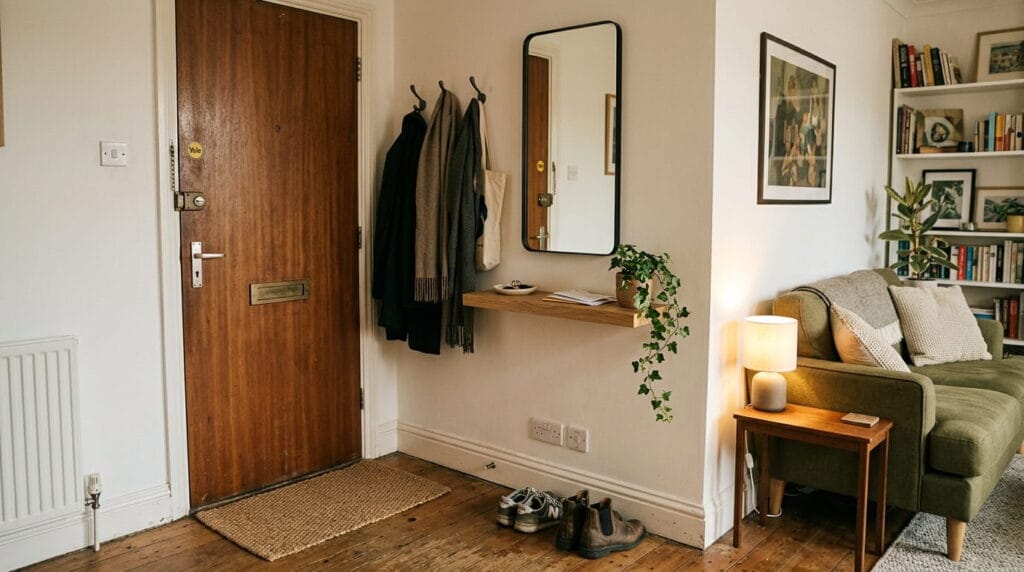
Quick answer: The best small hallway ideas for UK homes keep the walking route clear, give everyday shoes and coats a proper place, and improve the light without bulky furniture. Start with wall hooks or slim shoe storage, then add a mirror or lighting once the layout works. These solutions suit narrow terraces, flats and entrances with stairs or radiators.
Not every narrow hallway can fit a console, bench and cupboard. Before you buy, measure the tightest point, allow for doors and coats, and choose the ideas that solve your household’s actual problems. The 15 options below include renter-friendly updates, budget decorating choices and storage that leaves a safe route through the hall. If you live in a block of flats, distinguish the entrance inside your own home from a shared landing or corridor before planning storage.
Before Decorating: The 10-Minute Hallway Fit Test
A room can look spacious with furniture pushed against the wall yet feel crowded when someone comes through the door with shopping. Test the layout before purchasing anything:
- Measure the pinch point. Find the narrowest usable width, accounting for radiators, skirting, door trim and furniture that projects into the hall.
- Open every door. Check the front door, nearby room doors and any cupboard doors at their full swing.
- Mark the furniture depth. Use masking tape on the floor for a proposed shoe cabinet or bench. Walk past with a bag and with coats hanging at their real depth.
- Count the daily essentials. Keep only shoes, coats, post and bags used regularly at the entrance; relocate spare items before buying more storage.
- Check the exit and the lease. Keep the escape route unobstructed and follow product fixing instructions. Ask permission before drilling in a rental.
There is no universal cabinet depth that suits every home. The right size is the one that leaves enough usable space for the actual people and doors in yours. The UK Fire Kills escape guidance specifically advises keeping halls and exits clear of belongings and furniture.
Private Entrances vs Shared Corridors in UK Flats
Keep shoes, pushchairs and other belongings inside your flat rather than treating a shared corridor as extra storage. Check with your building manager before placing anything in shared areas, and leave access routes unobstructed.
Check your lease and building rules before attaching storage near an entrance.
15 Small Hallway Ideas for Narrow UK Entrances
Before decorating, identify your biggest hallway problem:
| Your hallway problem | Best place to start |
|---|---|
| Extremely narrow hallway | Floating ledge and wall hooks |
| Dark or windowless hallway | Large mirror and layered lighting |
| Too many shoes | Slim closed shoe cabinet |
| Too many coats | Vertical hooks or a peg rail |
| Hallway with stairs | Under-stair storage |
| Radiator occupies much of one wall | Shallow shelf nearby, subject to heat clearance |
| Very small entrance | Keep most of the floor clear. |
| Rental property | Removable hooks and slim freestanding storage |
1. Keep the Walking Route Clear First
Before buying a console table or shoe cabinet, look at how people actually move through the hallway.
The route from the front door to the main rooms or staircase should feel obvious and easy to use. Deep furniture, baskets on the floor, and freestanding coat stands can quickly turn a narrow entrance into an obstacle course.
Where space is limited, prioritize one useful storage piece instead of several smaller ones. Before buying, walk the route with a shopping bag and test the front door at full swing.
This is also a safety issue. UK fire-safety guidance recommends keeping escape routes and exits clear, so avoid allowing furniture or everyday belongings to obstruct the normal route out of the home. Read the GOV.UK fire-safety guidance.
2. Choose a Slim Console or Floating Ledge
A conventional console can be too deep for a tight hallway.
If you only need a key drop, try a tray on an existing surface before buying furniture. For a slim console or ledge, measure its width and projection, mark the footprint with tape and walk past carrying shopping. Renters who cannot drill can choose a small stable freestanding basket rather than an unsupported floating shelf.
A floating ledge is suitable only where drilling is permitted and the wall fixings can support the intended load. If drilling is restricted, use a shallow, stable key tray on an existing surface instead; adhesive hooks are not a substitute for a load-bearing shelf.
A floating surface works especially well in:
- Long, narrow hallways;
- Tiny flat entrances;
- Hallways where several doors open into the same area;
- Spaces where you want to keep more flooring visible.
Mounting storage above the floor also helps a small entrance feel visually lighter. Before drilling, mark the proposed ledge depth with tape and test the walking route.
3. Use Wall-Mounted Shoe Storage
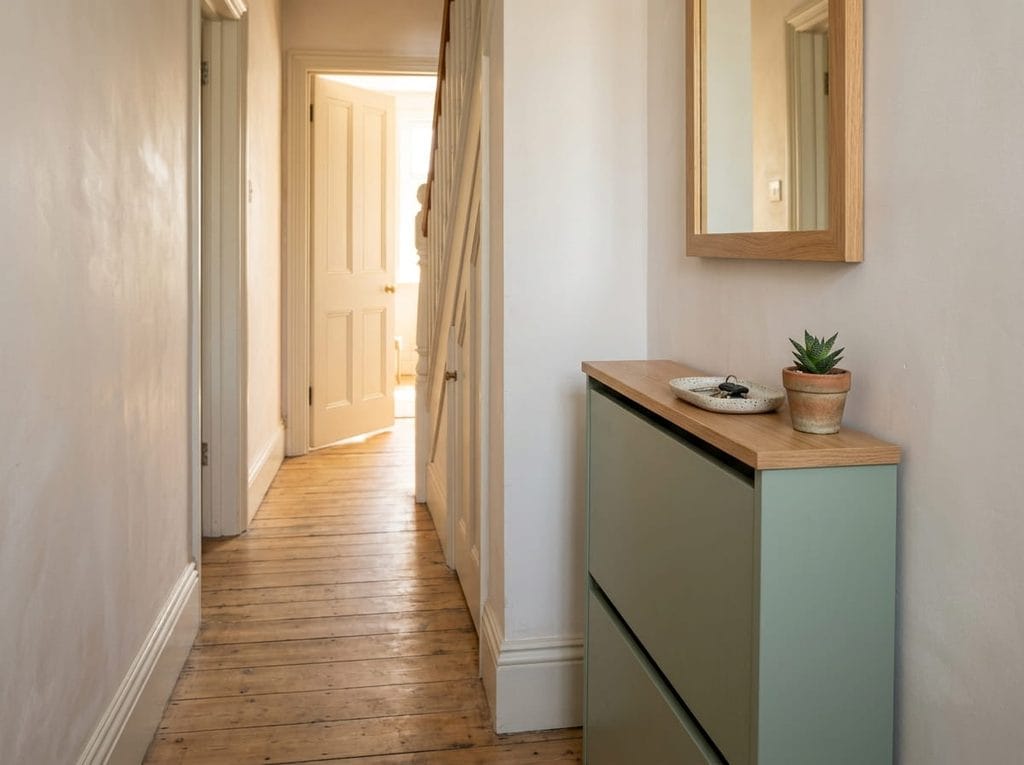
Start by counting the shoes used during a typical week. A cabinet that fits against the wall but blocks the front door when opened is not practical, so test its full open depth before choosing wall-mounted or freestanding storage.
A shallow wall-mounted or slimline shoe cabinet can keep footwear organised while using less floor space than a standard cupboard. Before choosing one, measure the cabinet depth with its doors open, tape the outline onto the floor and check the front-door swing. If a hinged cabinet blocks the route, consider a low shoe tray elsewhere or a shallower, securely fitted design instead.
Count the shoes used every day and compare that number with the cabinet’s actual capacity. Check that doors can open without blocking the exit and follow any wall-anchoring instructions; a narrow cabinet may still tip if it is top-heavy. Keep occasional shoes in another room instead of choosing a larger unit that squeezes the route.
For more ideas on hiding clutter in limited rooms, see our small-space organization hacks.
4. Take Coat Storage Up the Wall
When floor space is scarce, use height.
A simple peg rail or row of hooks can hold everyday coats and bags without a large wardrobe. Before fitting one, check the wall construction, use fixings and hooks rated for the expected load, and place daily-use hooks where household members can reach them safely. Test the depth of a hanging winter coat, not just the depth of the rail.
Give each person one everyday coat hook and move out-of-season jackets to a wardrobe. Hang the bulkiest coat before fixing the rail: sleeves and bags can project much farther than the hooks. If the route feels cramped, reduce what stays here instead of adding more hooks.
5. Add a Large Mirror to Bounce Light
A mirror reflects existing light; it cannot brighten a windowless hall by itself. Test a mirror opposite a brighter doorway or beside a light source, then check what it reflects from the entrance. Choose a size that suits the wall and secure it with fixings appropriate to its weight and wall construction rather than leaning a large mirror where it could fall.
One substantial mirror often works better than several small ones.
Try positioning it:
- above a slim console;
- opposite a brighter doorway;
- at the end of a short hallway;
- near the bottom of the stairs.
If you want more inspiration for using mirrors effectively, see our mirror wall decor ideas for small living rooms.
6. Layer Lighting in a Dark Hallway
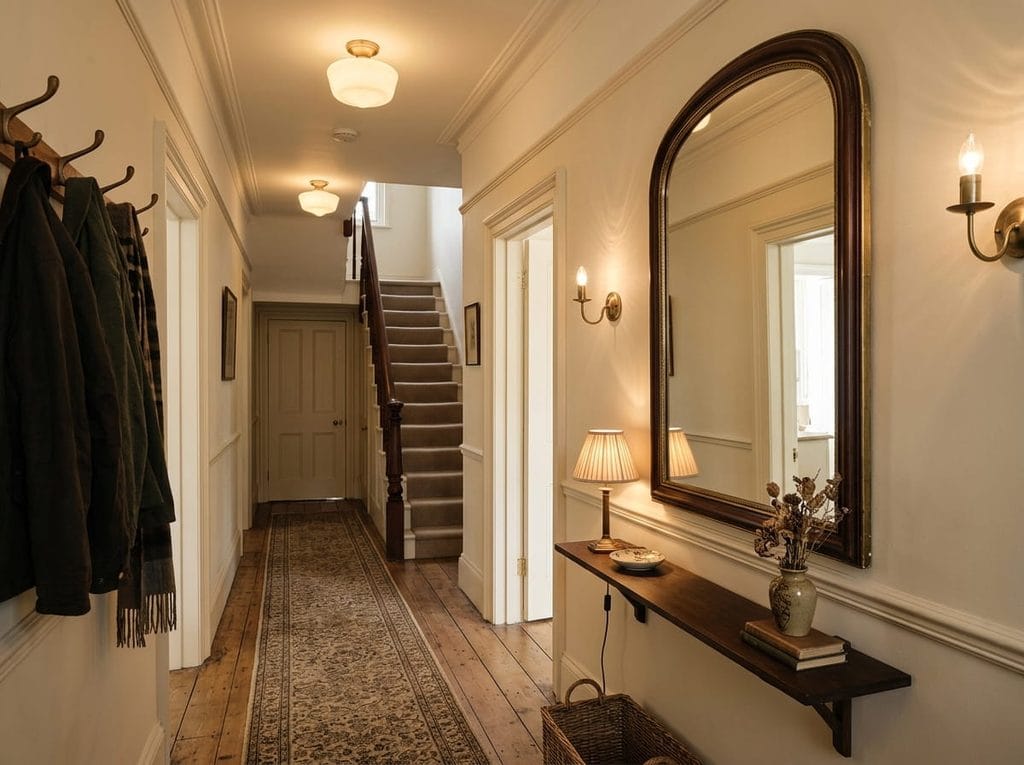
Many UK hallways receive very little natural light, particularly in terraces and flats.
Instead of relying on one central ceiling fitting, combine different light sources where the layout allows.
Consider:
- ceiling or pendant lighting;
- wall lights;
- a small lamp on a console;
- lighting inside or beneath fitted storage.
For a dark entrance, test the lighting at the places people actually use: the key drop, shoe area and steps. A suitable battery-powered or rechargeable light can help renters assess placement before committing to wired fittings. Avoid glare into the front door, keep cables out of the walking route and use a qualified electrician for new hard-wired lighting.
7. Use the Space Beneath the Stairs
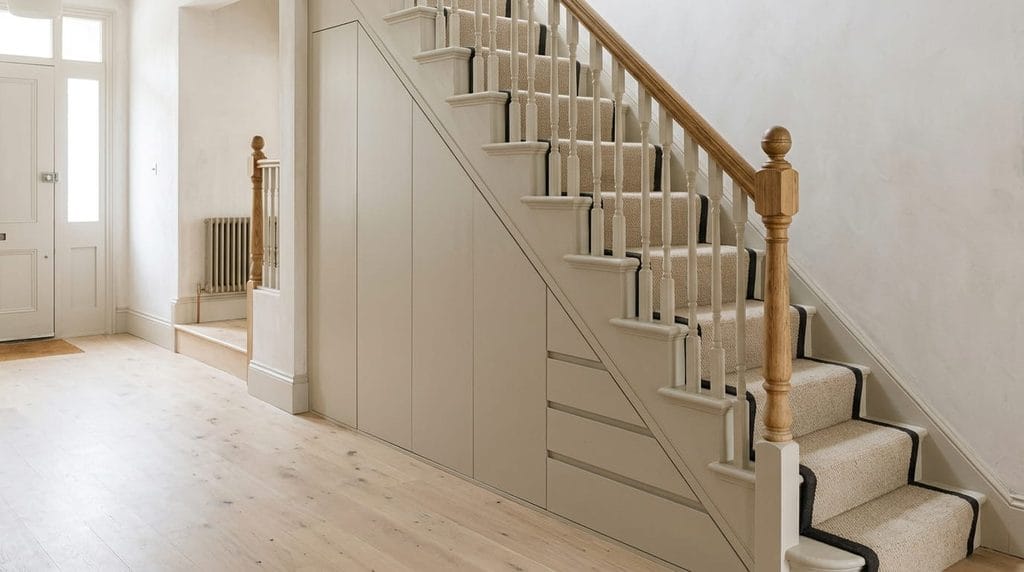
A hallway with stairs can provide some of the most valuable storage space in a small home.
Depending on the available height and depth, the area beneath the staircase can become:
- closed shoe storage;
- coat cupboards;
- drawers;
- shelving;
- a compact bench;
- household storage.
Closed cabinetry is particularly effective because it turns an awkward triangular area into a calm, practical feature. Measure the low and high points and check access panels, electrical meters, consumer units and any ventilation or maintenance access before choosing storage. If the stair enclosure forms part of a protected escape route, consult the building manager or a qualified professional before enclosing the space.
If you are planning structural alterations to stairs, handrails, or guarding rather than simply adding furniture beneath them, consult the relevant Approved Document K guidance for England before making changes. Read Approved Document K on stairs and guarding in England.
You can also see how we approach awkward staircase layouts in our guide to small living room with stairs ideas.
8. Work Around a Hallway Radiator
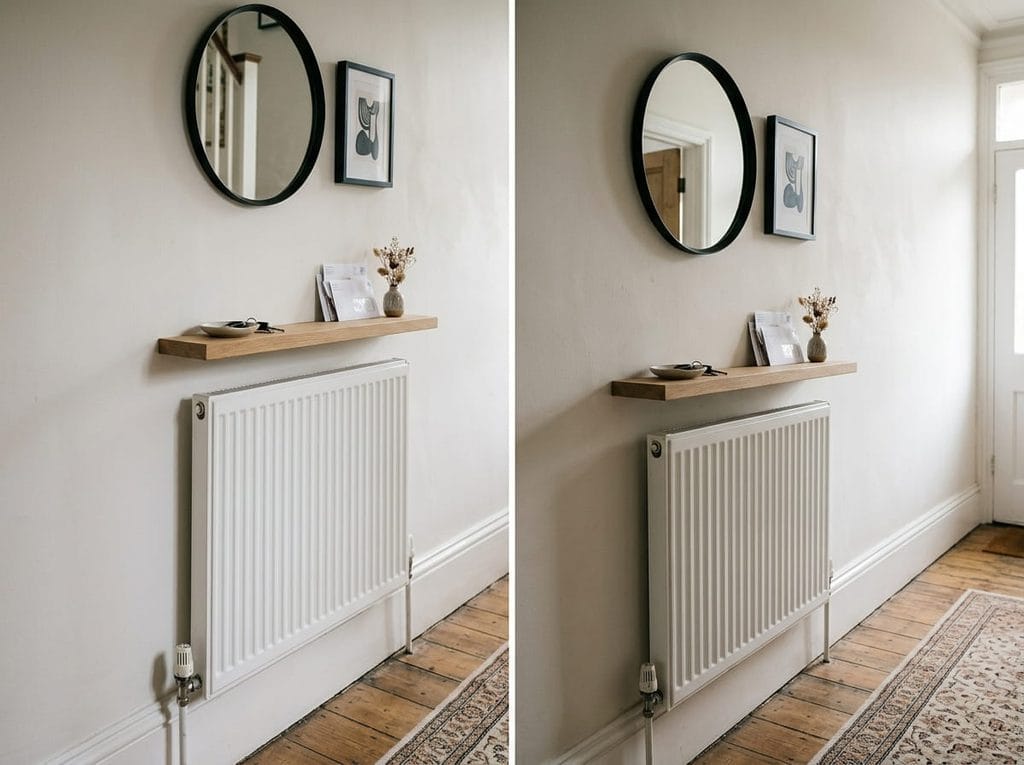
Radiators often occupy exactly the wall where a hallway could otherwise fit storage.
Rather than squeezing deep furniture in front of it, consider whether a shallow surface nearby could provide the function you need.
A shallow shelf on a suitable nearby wall may offer a key drop without blocking the floor. Do not assume a shelf directly above a radiator is safe: check the radiator and shelf manufacturers’ clearance guidance, allow heat to circulate and keep heat-sensitive objects away.
If using a radiator cover, make sure the product and installation are appropriate for your heating system and do not unnecessarily interfere with heat circulation. Keep radiator controls and valves accessible, and avoid storing damp coats or other belongings directly against the heat source.
9. Use a Runner to Visually Lengthen the Hall
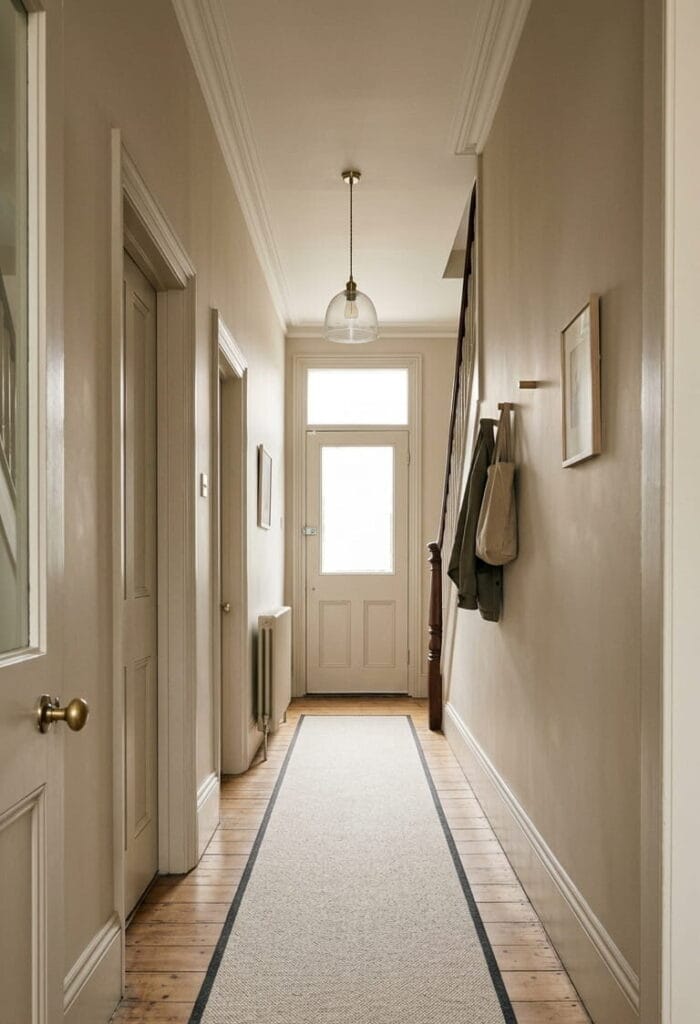
A long runner naturally draws the eye through a narrow hallway.
Choose one that leaves some flooring visible along the sides rather than covering the full width.
In busy entrances, practicality matters as much as appearance. Measure the usable floor width, check that the front door passes over the rug, and leave the edges clear of thresholds and stair nosings. Choose a washable, low-profile runner with a suitable non-slip backing or underlay, then check regularly that the corners stay flat. If someone uses a walking frame, wheelchair or another wheeled mobility aid, test the surface with them before keeping the runner; a clear, slip-resistant floor may be more practical.
A simple pattern can add personality without requiring additional furniture.
10. Use Colour Without Making the Space Feel Smaller
Small hallways do not have to be white.
Warm neutrals, soft greens, muted blues, and other restrained shades can make an entrance feel welcoming while still maintaining a sense of openness.
Choose one main wall colour and a restrained accent for the door, skirting or a single feature rather than painting every small surface differently. Test a sample beside the entrance in daylight and after dark: the same shade can look much cooler under a ceiling light. Renters should check decorating permissions before repainting.
You can also use colour more selectively on:
- The front door;
- Skirting;
- Panelling;
- One end wall;
- A console;
- Artwork.
11. Keep the Floor Clear in Very Narrow Hallways
Some hallways are simply too narrow for traditional furniture.
If a taped outline of a bench or shoe cabinet makes people turn sideways to pass, leave that furniture out. Start with one properly fixed hook rail or a very shallow key pocket, and store extra shoes somewhere beyond the entrance. The goal is a clear, usable route, not squeezing a miniature version of a large hallway into the space.
Check the full projection: Wall-mounted storage still occupies usable space when coats, bags or cabinet doors extend into the route. Test the deepest item before fixing anything.
A combination of hooks, a mirror, narrow shelving, and wall-mounted shoe storage can provide the essentials without sacrificing the passageway.
This is one of the best very small entrance hall ideas because it accepts the limits of the space rather than fighting them.
Visible floor area also makes a hallway feel less crowded. Try keeping the floor clear for a week before deciding whether you need more furniture.
12. Add Closed Storage for Everyday Clutter
Closed hallway storage works best when it has a specific job. Give everyday keys, dog leads, gloves and post separate small return spots, and keep wet umbrellas in a suitable drip-proof place. Store only the shoes and bags used regularly near the entrance; move spare items to another room before buying a larger cupboard.
Before choosing a slim cupboard, check that its doors and drawers can open fully without blocking the route. Use one small bin or divider for each daily category so belongings are easy to return, and follow the manufacturer’s stability and anti-tip instructions before loading it. If the unit cannot be used comfortably with the front door open, choose a shallower solution.
If you use open storage, reserve it for a small number of attractive objects and keep the everyday items behind doors or inside baskets.
13. Make the Front-Door Area Work Harder
Try a one-minute leaving-home test: can each person find their keys, everyday shoes and coat without moving a chair, stepping around a basket or blocking the front door? Put one key tray or wall pocket where it is naturally reached, give coats a limited number of hooks and keep the floor route open. A simple routine matters more than a decorative entryway station.
That might mean:
- A small key tray;
- Wall hooks;
- Umbrella storage;
- A slim shoe cabinet;
- A mirror;
- A tiny bench if space allows.
Avoid creating a bulky “entryway station” simply because it looks good online.
The Fire Kills campaign also advises keeping hallways and doorways unobstructed so people can leave quickly in an emergency. See its escape-route guidance.
14. Draw the Eye Up With Vertical Details
When a hallway has limited width, height becomes useful visually as well as practically.
Choose one vertical feature—such as a securely fixed tall mirror, narrow artwork or peg rail—rather than filling every wall. Position it where doors and coat sleeves will not strike it, and view it from both ends of the hallway before installing. Tall details can draw the eye upward without adding furniture to the floor.
This can help the room feel less dominated by its narrow floor plan.
Choose one vertical focal point and leave the surrounding wall simple. Check its placement from both ends of the hallway.
15. Create an Entrance Zone When You Barely Have a Hallway
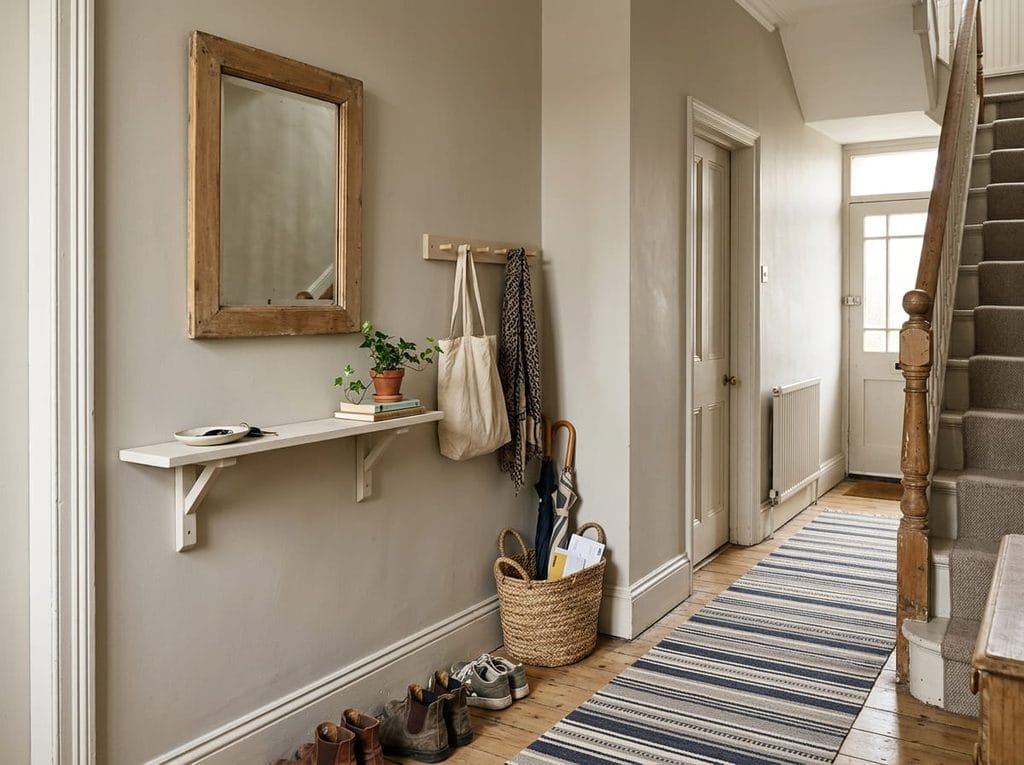
Some flats and compact homes open almost directly into the living space.
You can still create the feeling of a hallway without building a wall.
Try combining two or three elements:
- A small rug;
- Hooks near the entrance;
- One narrow storage unit;
- A mirror;
- Different lighting;
- A change in wall colour.
Together, these cues tell the eye that the entrance is a separate functional zone. Try a washable mat and key tray for one week before buying more furniture.
This approach works particularly well in open-plan flats where every square metre needs more than one purpose.
A Hallway That Works for the Whole Household
Test your hallway during a busy morning, not only when it is tidy. Can everyone find shoes, coats and keys without moving a basket? Do doors open fully when bags are hanging? A pushchair, shopping bag or walking aid may need more clear space than an empty hallway suggests. Measure the usable route with these real needs in mind before adding furniture. Test the space while turning, reaching a handle and carrying a bag, not just when walking straight through; avoid projecting hooks at face or shoulder height.
- Children: keep one daily coat and bag at a reachable height and store extras elsewhere.
- Pushchairs: check folded dimensions and the front-door swing; store them elsewhere if they block the exit.
- Mobility needs: keep the route clear of loose baskets, rug edges and trailing cables.
- Shared homes: agree on how many pairs of shoes stay at the door and assign a labelled place for each person.
Make a Narrow Hallway Work for Everyone
Before fitting new storage, walk through the hallway with the people who use it. A layout that works for one adult may be awkward for a child, someone carrying shopping, or a person using a walking aid or wheelchair. Check the route with coats hanging, drawers open and the front door fully swung. If a pushchair is stored here, test it in its normal parked position as well as when being moved through the entrance.
- For children: keep everyday hooks and shoe storage at reachable heights, without encouraging climbing onto furniture.
- For mobility needs: prioritise an unobstructed route, stable seating only where it genuinely fits, and storage that can be opened comfortably.
- For shared entrances: give each person a labelled return spot rather than adding another cabinet.
Do not treat a generic clearance measurement as proof of accessibility. Test the actual household’s turning and reaching needs, and follow any applicable building or fire-safety requirements. The UK Fire Kills escape guidance also recommends considering people who may need extra help when planning an escape.
A Wet-Weather Hallway Setup Without More Clutter
In a rainy week, wet coats, muddy shoes and umbrellas can overwhelm even a well-organised entrance. Instead of buying a large hall unit, set up one washable boot tray or mat where it does not block the door. Let wet shoes dry before moving them into closed storage, and give damp coats a suitable drying place with airflow away from the main route. Keep umbrellas in a stable container that can catch drips. Let damp items dry in a ventilated spot that does not narrow the walking route.
Try this two-minute test: arrive carrying a bag and a wet umbrella. Can you put both down, take off your shoes and reach the next room without stepping around a tray? If not, move the wet-weather station to a nearby utility area or reduce the items kept by the door. For a flat whose entrance opens straight into the sitting room, compare these front-door living room layout ideas before adding a room divider.
Which Idea Fits Your UK Hallway Layout?
| Layout | Start with | Avoid |
|---|---|---|
| Narrow Victorian terrace hall | Wall hooks, a floating key ledge, and shallow shoe storage | A deep console that squeezes the route |
| Small flat with no separate hall | Washable mat, a key drop and compact shoe storage | A bulky room divider or crowded coat stand |
| Hall with stairs | Existing under-stair cupboards or correctly installed storage | Blocking stair access or casual structural changes |
| Dark hall with a radiator | Mirror and lighting positioned safely clear of the heater | Covering vents or placing unsuitable furnishings against heat |
| Rental with strict fixing rules | Low shoe tray, stable freestanding unit and approved removable accessories | Overloading adhesive hooks or leaving tall furniture unstable |
| Flat with a shared landing | Keep personal storage inside the flat and check building rules | Placing shoes or pushchairs on shared access routes |
Example: If you have a terrace hallway with a radiator on one side and a front door opening inward, do not order a shoe bench just because it appears narrow online. Tape out its depth, test the door and consider moving coats up onto a suitable wall instead. If the route still feels tight, a small tray for shoes in another room may be better.
Modern Small Hallway Ideas UK Homes Can Use
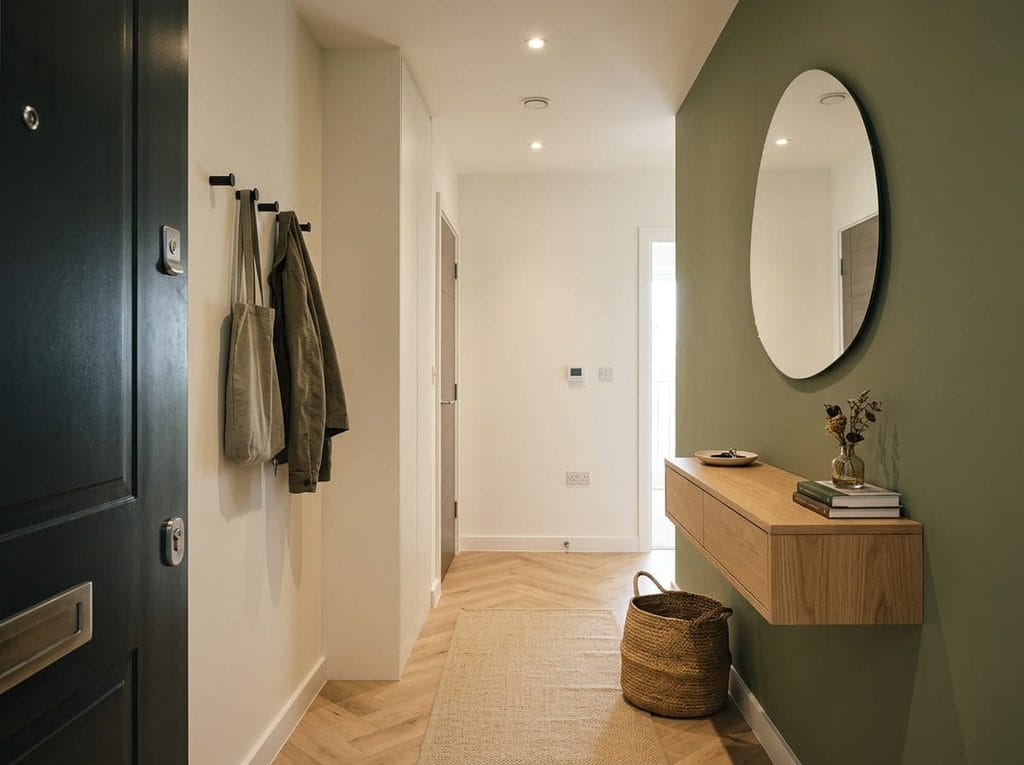
A modern hallway does not need to look stark or minimalist.
The most useful modern approach is usually to reduce unnecessary furniture and let a few practical elements do more work.
A modern small entrance might combine:
- A floating console;
- One oversized mirror;
- Concealed shoe storage;
- Simple wall hooks;
- Warm lighting;
- Pale or natural wood;
- One muted accent colour.
Choose pieces with clean shapes, but add texture through a runner, basket or timber finish so the space still feels welcoming.
Very Small Entrance Hall Ideas
In a very small entrance, prioritise three tasks: put down keys, hang one everyday coat and keep the door route clear. A shallow key pocket and a suitable hook may do more than a bench or console. If shoes cannot be stored without narrowing the route, keep them in a nearby room instead.
Ask yourself what you genuinely need to do there.
If you only need somewhere for keys, shoes and one everyday coat, you may not need a bench, console and coat stand.
Try a one-week setup with a stable key tray, a few correctly fixed coat hooks and a mirror only where it can be securely mounted. Keep occasional shoes in another room. Before adding a shoe cabinet, mark its full open-door depth on the floor and check that everyone can pass without blocking the exit. If drilling is not permitted, use an existing surface for keys instead of an unsupported shelf.
Keeping the arrangement simple can make the entrance easier to use and easier to maintain.
Small Hallway Decorating Ideas on a Budget
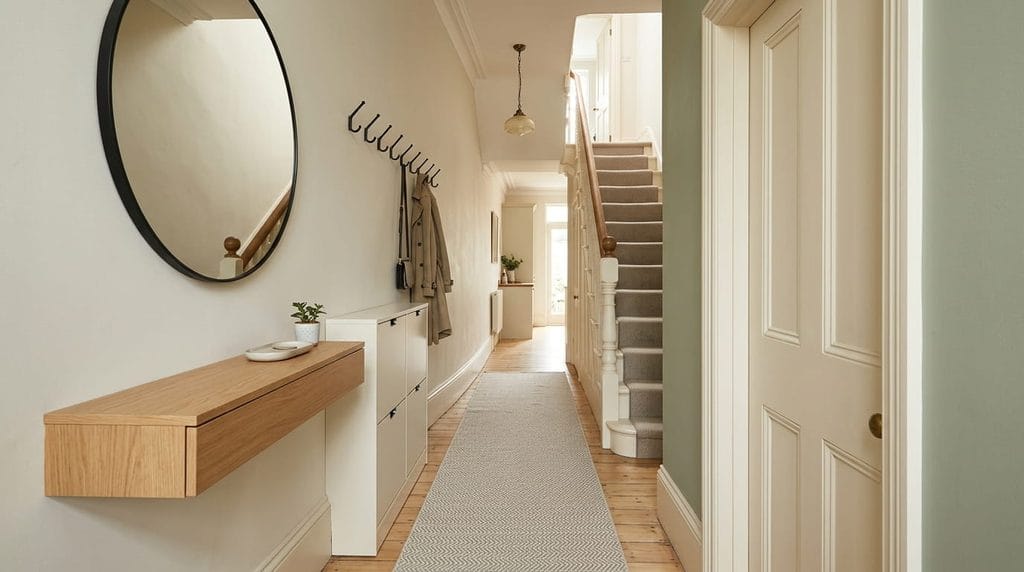
Many small hallway ideas UK renters and homeowners can try do not require expensive fitted furniture or a complete renovation.
Some of the most effective budget updates include:
- Repainting the walls or front door;
- Replacing mismatched hooks;
- Adding a second-hand mirror;
- Using a washable runner;
- Organising shoes into baskets;
- Improving lighting;
- Adding framed artwork;
- Repainting an existing console.
Focus first on the elements that make the hallway feel messy or dark. A modest refresh can start with a second-hand mirror, a washable runner or reorganised hooks—without fitted furniture or a large decorating budget.
Before spending on decoration, try moving rarely used items out of the hallway and adding one well-placed storage solution. A simple organisational improvement may help more than an expensive accessory.
Ideas for Small Hallways and Stairs
When the hallway includes the staircase, treat both spaces as one design.
Repeating the same timber, paint colour or metal finish can help the transition feel intentional.
Use the staircase wall carefully. Artwork or panelling can work well, but avoid creating too much visual detail if the hallway is already narrow.
Under-stair storage is usually the biggest functional opportunity.
Where possible, keep the bottom of the stairs and the route to the front door clear.
What Furniture Works Best in a Small Hallway?
Shallow shoe cabinets, properly installed wall hooks and narrow key ledges are often the most practical small-hallway furniture. A bench earns its place only when someone needs to sit to put on shoes and the remaining route is still comfortable; otherwise use wall storage and keep the floor open. Measure the door swing and the furniture in its open position before deciding.
| Furniture | Best for | Watch out for |
|---|---|---|
| Slim console | Keys, post and small decor | Avoid deep designs |
| Floating ledge | Very narrow hallway | Limited storage |
| Slim shoe cabinet | Hidden footwear | Check door clearance |
| Bench | Seating plus baskets | Needs enough walkway width |
| Wall hooks | Coats and bags | Can look cluttered when overloaded |
| Tall narrow cupboard | Maximum vertical storage | May dominate very small entrances |
| Under-stair cabinet | Hallways with stairs | Often requires careful fitting |
| Freestanding coat stand | Larger entrances | Usually poor for very narrow halls |
Before buying, measure the narrowest usable passage with doors open and winter coats hanging, not just the wall-to-wall width. Compare that real clearance with the furniture’s full depth and open-door footprint; reject a unit that obstructs the exit.
How to Make a Small Hallway Look Bigger
Several small decisions can make the entrance feel more spacious:
Keep sightlines clear. Avoid tall furniture immediately inside the doorway.
Use mirrors strategically. Reflect light rather than clutter.
Limit floor furniture. Use wall-mounted alternatives where appropriate.
Create consistent flooring. Too many visual breaks can make a short hallway feel even smaller.
Improve lighting. Dark corners make boundaries feel more obvious.
Control clutter. Even a beautifully decorated hallway feels small when shoes, bags and coats cover every surface.
Choose furniture to scale. A slim hallway needs slim furniture.
Small Hallway Mistakes to Avoid
Choosing Furniture That Is Too Deep
Always consider the remaining walking space, not just whether the furniture physically fits against the wall.
Filling Every Empty Wall
A small hallway needs some visual breathing space.
Using a Freestanding Coat Stand in a Narrow Entrance
These can consume valuable floor area and become overloaded quickly.
Leaving Shoes on Display Everywhere
Use baskets, cupboards or dedicated storage to contain them.
Depending on One Harsh Ceiling Light
Layered light usually produces a warmer and more useful entrance.
Prioritising Decor Before Storage
Solve the everyday clutter first. Decorating becomes much easier afterwards.
A No-Buy Hallway Reset Before You Spend Money
Before ordering new storage, try a seven-day reset. Remove spare shoes and out-of-season coats, use a tray you already own for keys, and give daily bags one return spot. Then watch what still lands on the floor. If the route stays clear and everyone can find essentials, you may not need a new cabinet. If one problem remains, measure it and choose only the smallest fix that solves it.
- Day 1: clear the exit and move rarely used items to their proper rooms.
- Days 2–3: assign a place for daily keys, coats, shoes and bags using existing storage.
- Days 4–7: check the entrance during busy arrivals and departures. Note what is still hard to reach or put away.
Small Hallway Checklist: What to Do This Weekend
- ☐ Photograph the current entrance to identify the biggest clutter points.
- ☐ Measure the narrowest walking space, door swings and usable wall depth.
- ☐ Move off-season footwear, spare coats and belongings that should live elsewhere.
- ☐ Choose one main storage improvement: shoe cabinet, hook rail, key ledge or under-stair system.
- ☐ Confirm fixings and furniture stability; do not block exits, sockets, radiators or vents.
- ☐ Add one visual improvement—better lighting, mirror, washable runner or restrained colour accent.
- ☐ Test the setup during a busy weekday: can everyone enter, remove shoes, find keys and leave without moving furniture? Adjust what obstructs the route, then repeat the test after one week.
For a wider decluttering plan beyond the entrance, follow our small apartment organisation checklist. If the front door opens directly into your sitting room with no hallway at all, our apartment entryway ideas without a closet tackle that different problem.
FAQs About Small Hallway Ideas UK
How do I make my hallway look nice?
Start by clearing visible clutter and keeping the walking route open. Then improve one or two high-impact features such as the lighting, mirror, runner or wall colour. A tidy hallway with a few intentional pieces generally looks better than one filled with accessories.
What are some modern ways to decorate a small hallway?
Modern small-hallway schemes often combine concealed storage, slim furniture, warm neutrals, natural materials, a well-placed mirror and layered lighting. The most successful ideas still depend on the size and layout of your particular hallway.
What are some good ideas for furniture for a hallway?
Slim consoles, shallow shoe cabinets, compact benches, floating ledges and narrow cupboards generally work best. In particularly tight halls, wall-mounted hooks and shelving may be better than conventional furniture.
What’s on trend for hallways?
Useful storage that looks built into the design is particularly relevant, along with warm colour palettes, natural wood, decorative lighting, large mirrors and more considered entrance zones rather than purely decorative furniture.
What is the most welcoming colour for a hallway?
There is no single most welcoming hallway colour. Warm off-white, muted green, gentle blue and earthy neutrals can all work; the better choice depends on your daylight, flooring and bulbs. Paint a small sample near the entrance, view it by day and evening, and check rental permissions before changing the finish.
What are some creative ideas for a small hallway?
Try a floating shelf instead of a console, vertical peg rails, a large mirror, concealed shoe storage, an under-stair cupboard, a statement runner or a small entrance zone created with lighting and a rug.
Final Thoughts
The most successful small hallway ideas UK homes can use are rarely about adding more. They are about making better use of the space that already exists.
Start with the walkway and everyday storage. Then use lighting, colour, mirrors and a few carefully chosen decorative elements to make the entrance feel warmer and more spacious. Prioritise the everyday routine: a clear route, a key drop and enough storage for belongings that actually stay by the door.
For a narrow terrace, start with a clear walkway and a few well-placed hooks; for a flat without a separate hall, create a simple key-and-shoe landing zone; for a family entrance, make daily items easy to return. Test the layout with doors open and coats hanging before spending on furniture. In flats, check that shared landings stay clear and that household storage does not spread outside your own entrance. A small hallway feels more welcoming when the routine works first and the decor supports it. In a block of flats, keep shared landings and corridors free of personal storage and follow the building’s safety instructions.