
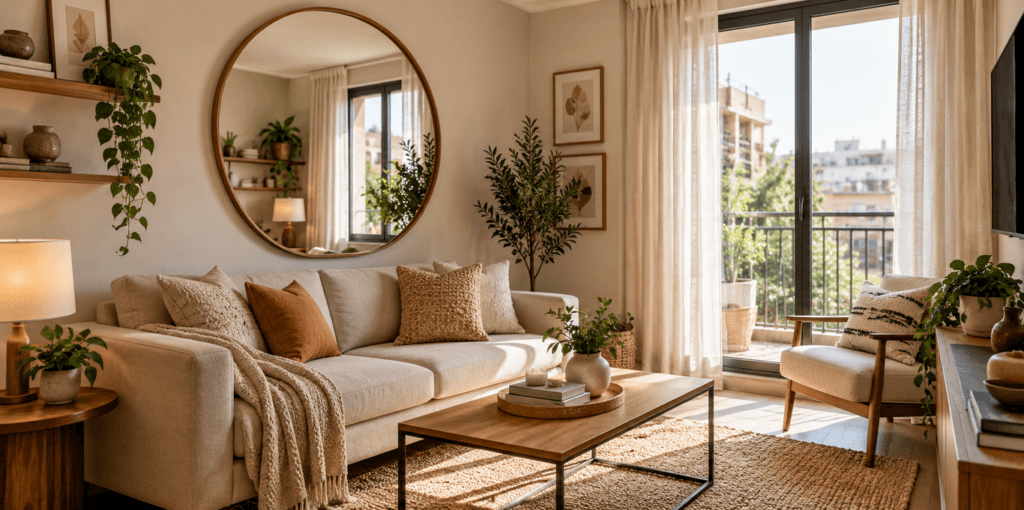
A small living room does not need a wall of mirrors to feel brighter and more open. One thoughtfully placed mirror can reflect daylight, highlight a favourite feature and create a focal point without using floor space.
Choosing mirror wall decor for a small living room starts with the reflection, not the frame. Decide what you want to see from the sofa, measure the usable wall, and check how the mirror can be safely secured. The ten ideas below compare single mirrors, grouped displays, and options for renters, followed by a practical size test and mounting checklist.
Quick Takeaway: The Best Mirror Setup for a Small Living Room
For most small living rooms, start with one securely mounted mirror that reflects daylight or a calm view. Choose a tall shape to emphasize height, a wide shape for a long blank wall, or a small coordinated group when the goal is decoration. Before ordering, check the reflection from your main seat in daylight and after dark; the best-looking shape is not useful if it creates glare.
These 10 mirror wall decor ideas cover compact apartments, rental living rooms, family spaces, and narrow rooms, with options ranging from one statement mirror to a full feature wall.
Which Mirror Arrangement Works Best for Your Room?
Choose by the problem you want to solve, not just the mirror shape. These are practical starting points rather than fixed sizing rules.
| Room or goal | Mirror choice | Placement | Important check |
|---|---|---|---|
| Narrow living room | One wide rectangular mirror | Uncluttered long wall | Reflect a calm view, not a busy passage |
| Dark apartment | Medium-to-large simple mirror | Near or across from a window | Check glare from seats and screens |
| Rental | Lightweight mirror with product-approved mounting | Permitted wall area or above a low console | Check lease rules, weight limits and wall finish |
| Family room with children or pets | Securely wall-mounted framed mirror | Clear of play routes and furniture edges | Use wall-appropriate fixings; avoid unsecured leaning glass |
10 Mirror Wall Decor Ideas for Small Living Rooms
1. Add a Large Round Mirror Above the Sofa
A large round mirror can soften the straight lines of a compact sofa and create one clear focal point. Before buying, mark the mirror’s outline above the sofa with paper, then check its proportions from the doorway and the main seat.
Hang the mirror securely on the wall above the sofa rather than relying on a shelf or furniture for support. Leave enough visual space around the frame so it does not compete with wall art; choose wood, black or metallic finishes to repeat an existing room detail.
A sofa-wall test: compare two paper outlines while seated, then check that neither frame crowds a nearby lamp, shelf, or doorway. Record the finished weight and hanging-point positions before choosing fixings. For related ways to free up the surrounding room, see small-space organization ideas.
2. Create a Small Mirror Gallery Wall
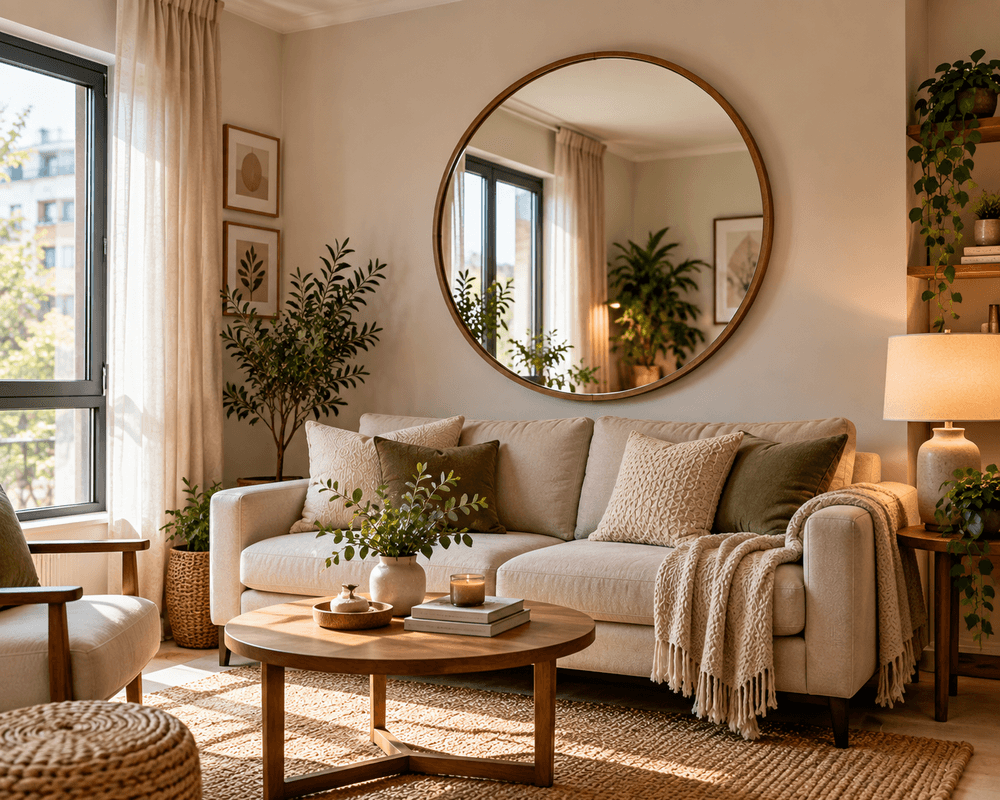
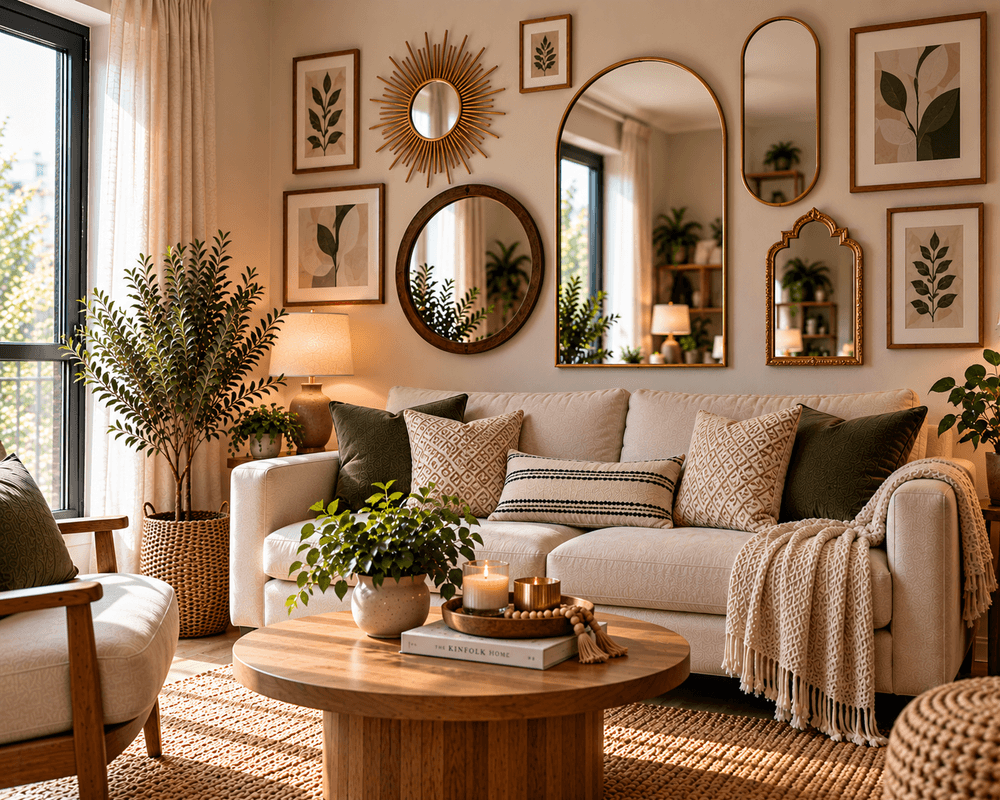
A gallery of smaller mirrors creates a decorative focal point when one large mirror would feel too formal. Start with three to five paper templates, then step back to check the overall arrangement before buying.
Mix round, square and rectangular shapes, but repeat one frame finish or colour so the collection feels intentional. Keep gaps consistent and avoid extending the display beyond the furniture below it.
Number the paper templates to match the mirrors you plan to hang, and mark each hanging point separately. Check frame depth, individual weights, and whether doors or passers-by could bump the display. Use fixings approved for each mirror and wall type. Renters can review these renter-friendly decorating ideas before making holes.
3. Use a Floor-to-Ceiling Mirror
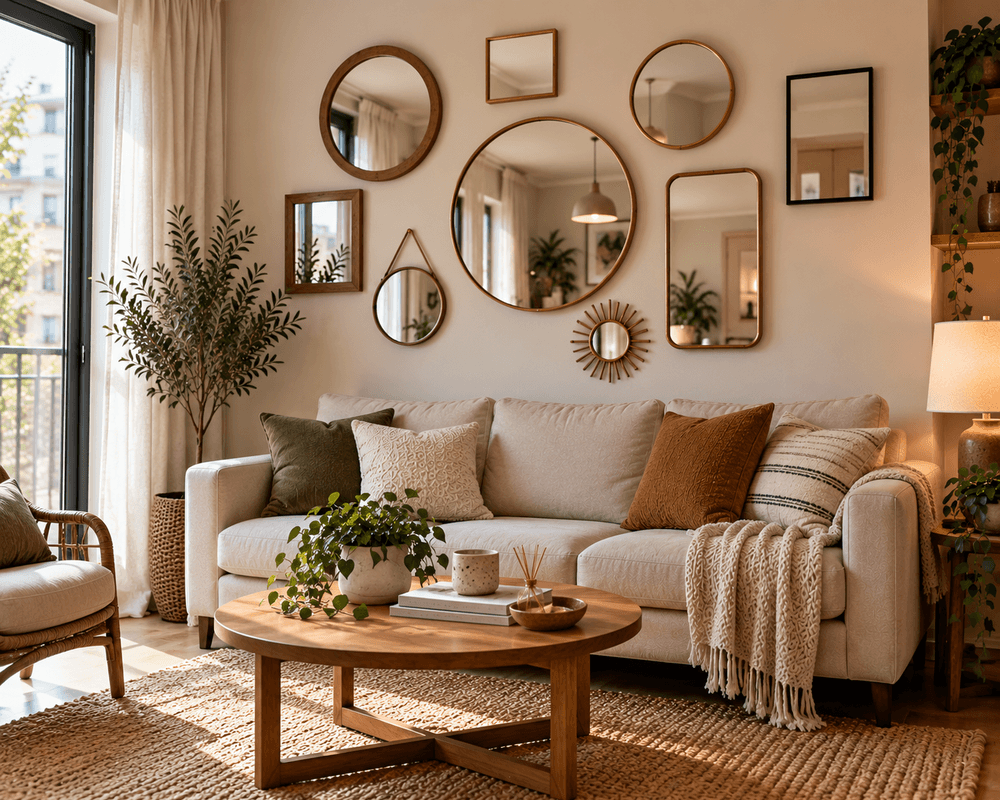
A tall mirror can visually emphasize ceiling height when it reflects an uncluttered part of the room. Before choosing one, tape a tall paper outline to the wall, sit in your usual seat and check whether it reflects a window, doorway or busy storage area. A narrower securely mounted mirror may work better than a full-height panel where floor space and walking routes are tight.
A tall mirror can work on a blank wall or beside a sofa, but full-height glass needs a safe installation plan. A leaning model is not automatically a no-drill rental solution: follow the manufacturer’s anti-tip and mounting instructions, and avoid leaving heavy glass unsecured around children or pets. If the wall cannot safely support it, choose a smaller mirror rather than improvising fixings.
If the room already has patterned cushions, shelves or wall art, choose a slim, quiet frame rather than another ornate focal point. Compare a plain black, wood or metal finish against the furniture you already own before ordering. For related styling examples, explore these living room decor ideas for a cozy and stylish home.
4. Try an Arched Mirror for a Softer Look
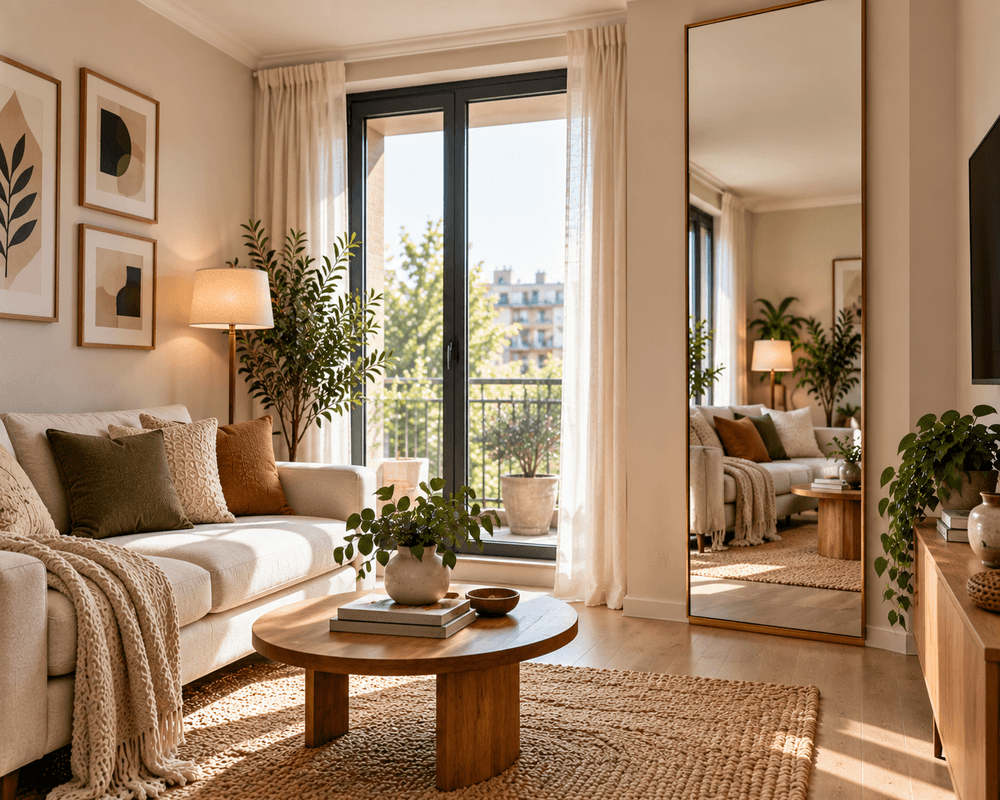
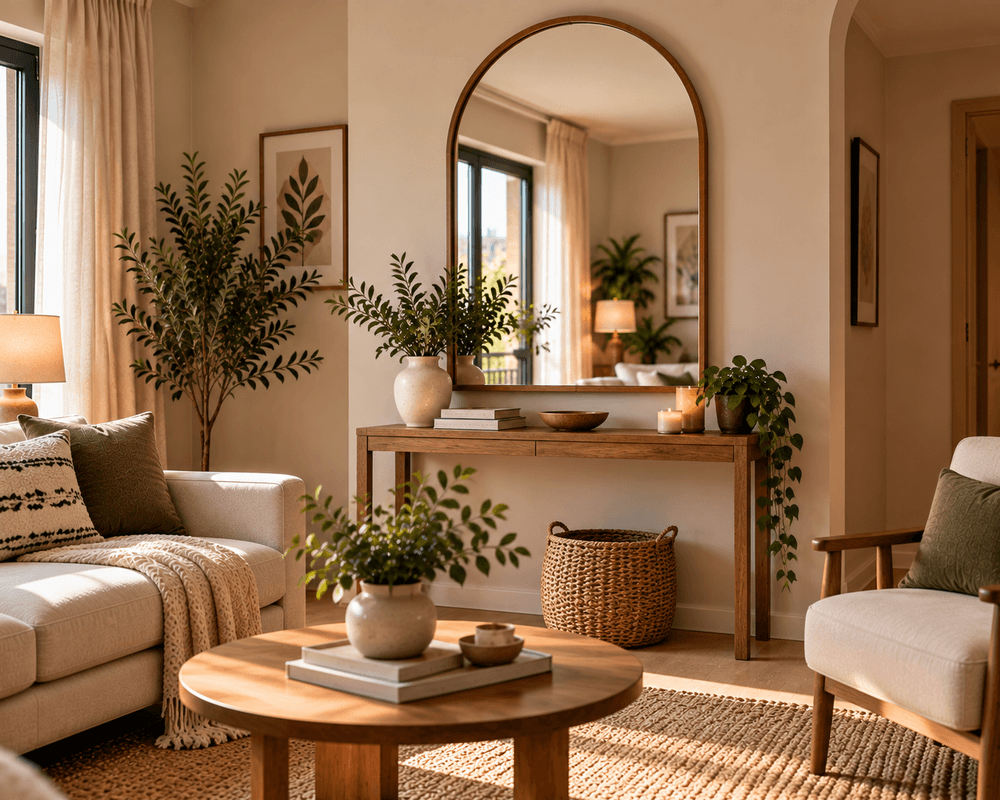
An arched mirror adds a gentle curve to a room filled with rectangular furniture. It works particularly well above a slim console or on a short wall where a wide mirror would feel crowded.
For an arched mirror above a console, mark the arch on paper first and view it from the doorway. Check that the frame does not crowd nearby switches, shelving or a door swing, then use hanging hardware suitable for the mirror’s finished weight and wall material. A single low plant or vase is usually enough; keep the console’s everyday drop zone clear.
Wood or black frames keep an arched mirror understated; an antique-style frame works best as the room’s single ornate accent. Round and curved mirrors can also bring a softer design element to a small room. See these round mirror decorating ideas for more inspiration.
5. Arrange Hexagon Mirrors on the Wall
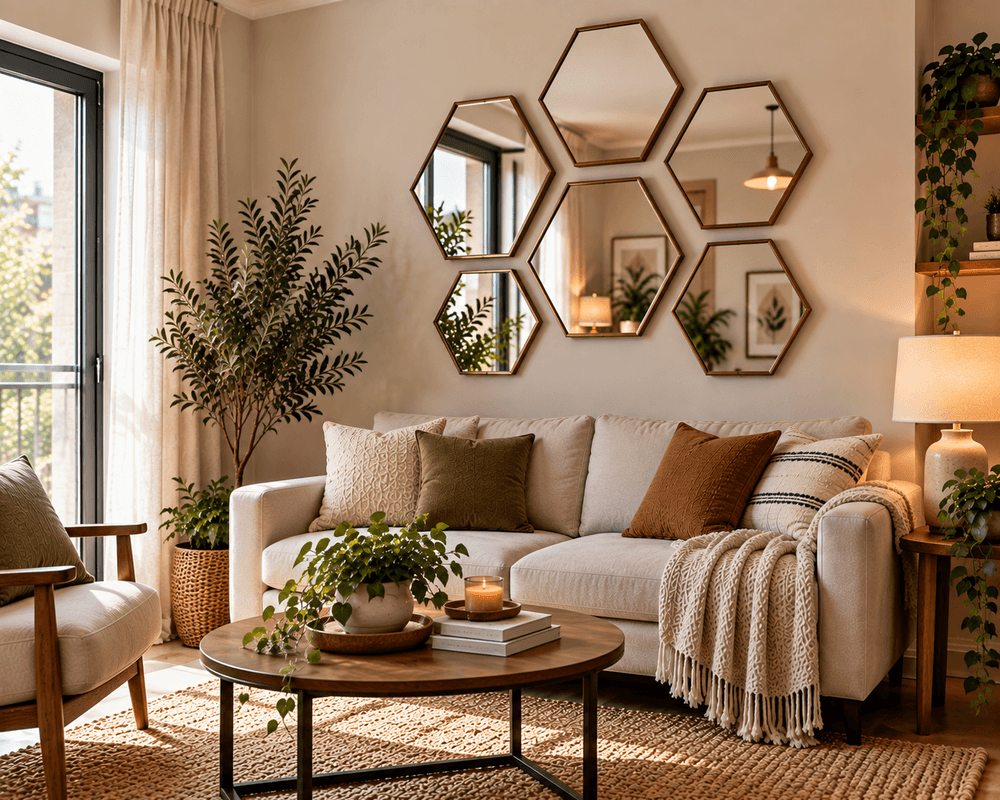
Hexagon mirrors are useful when you want a modular display rather than one large focal point. Start by arranging paper hexagons on the floor; a compact cluster of three, six or nine may suit different wall widths. Choose a layout that stays clear of doorways and furniture edges, and check the mounting requirements for every individual piece.
For a hexagon group, check how the seams look from your usual seat and leave enough space to clean each panel. A cluster reflecting a busy shelf may feel more cluttered than one plain mirror. Verify the weight and maker-approved mounting method for every tile; do not assume decorative adhesive is suitable for glass.
That concept is a good fit for contemporary furniture, neutral wall colors, and simple decor. For more inspiration on using multiple mirrors as decorative features, explore these mirror decor ideas.
6. Choose a Gold-Framed Statement Mirror
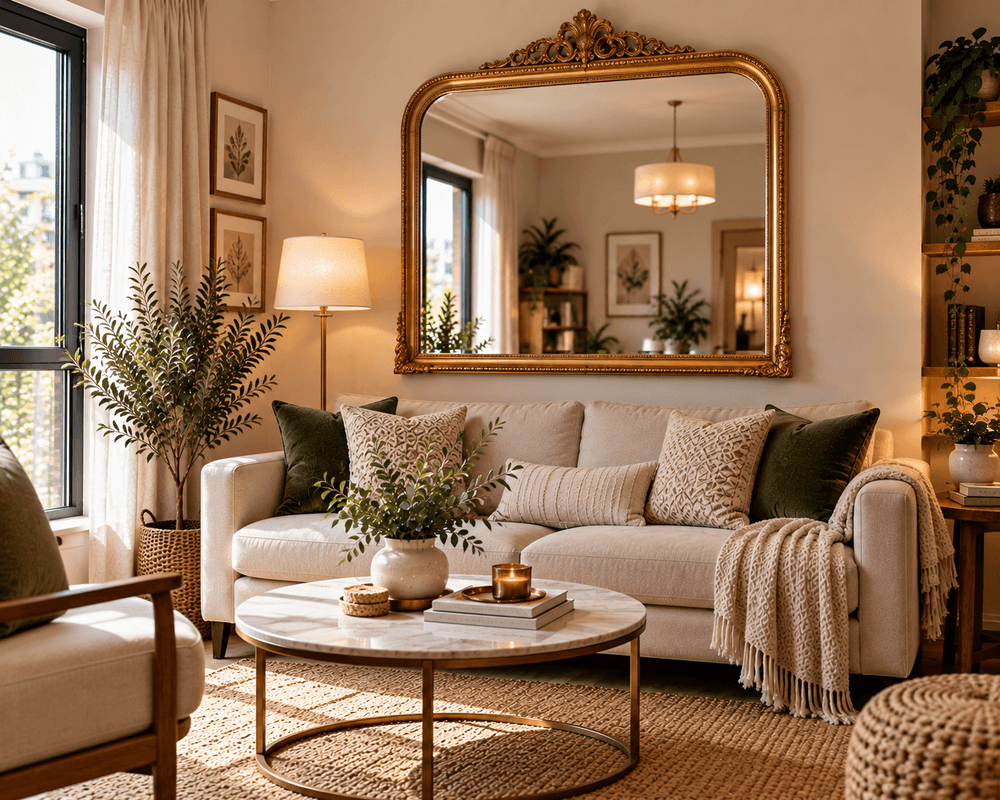
A gold-framed mirror works best when the room needs one warm accent rather than several new decorations. Try repeating the metal finish in a lamp or picture frame, and keep the surrounding wall simple so the mirror stays the focal point.
Before hanging a gold-framed mirror, test its reflection from the sofa in daylight and with the lamps on. A warm frame can tie together existing brass, wood and cream accents, but the mirror should not bounce a bright window into a television or seating area. Above a fireplace, follow the mirror manufacturer’s placement guidance and check heat exposure before installation.
Treat a detailed gold frame as the room’s one decorative highlight. Before buying, compare the frame with your existing lamp or handles and check whether the reflection competes with the television. For additional low-cost styling approaches, see these stunning home decor ideas.
7. Bring Warmth With a Wooden or Rattan Mirror
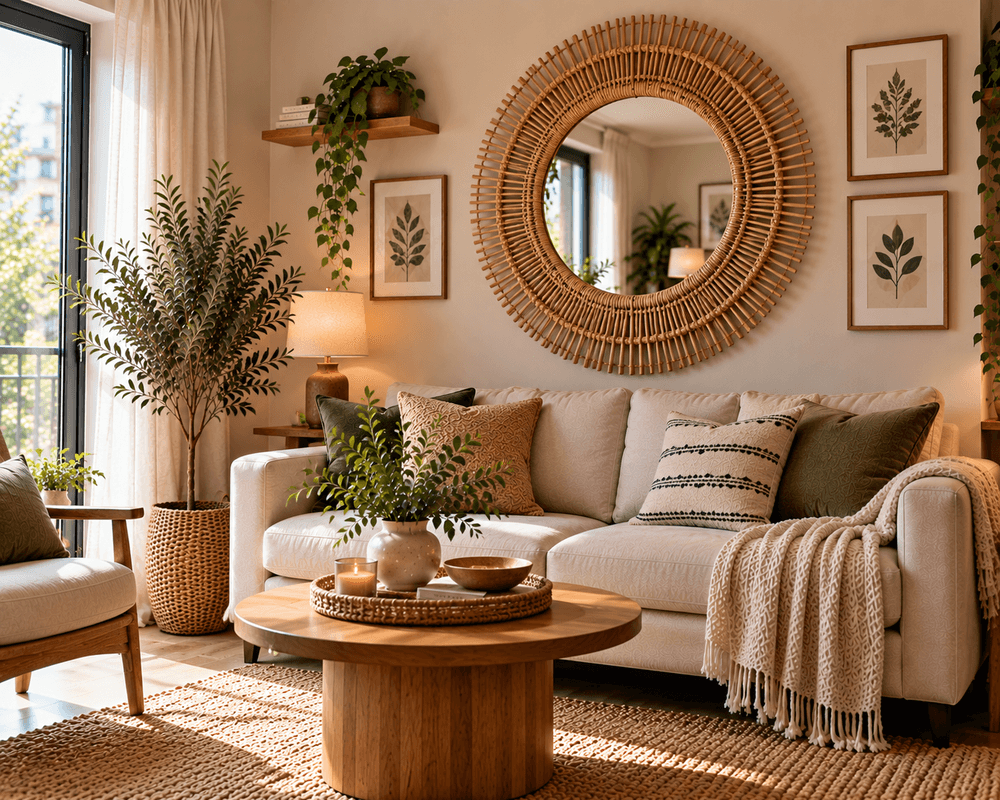
Wood and rattan frames add texture without requiring new furniture. Choose a slim wood frame for a narrow wall or a woven rattan frame when the room already has natural fabrics and plants; repeat one material rather than mixing many competing finishes.
For a renter, test a modest-sized framed mirror above an existing console before buying a large piece. Check the lease, wall type, mirror weight and mounting instructions; decorative rattan does not make a heavy glass mirror suitable for adhesive hooks.
To make a wood or rattan frame feel intentional, repeat that material once in a tray, shelf, or lamp rather than filling the wall with more objects. Leave the mirror accessible for cleaning and keep nearby plants from touching its backing. For other ways to introduce timber accents, explore these unexpected wood wall decor ideas.
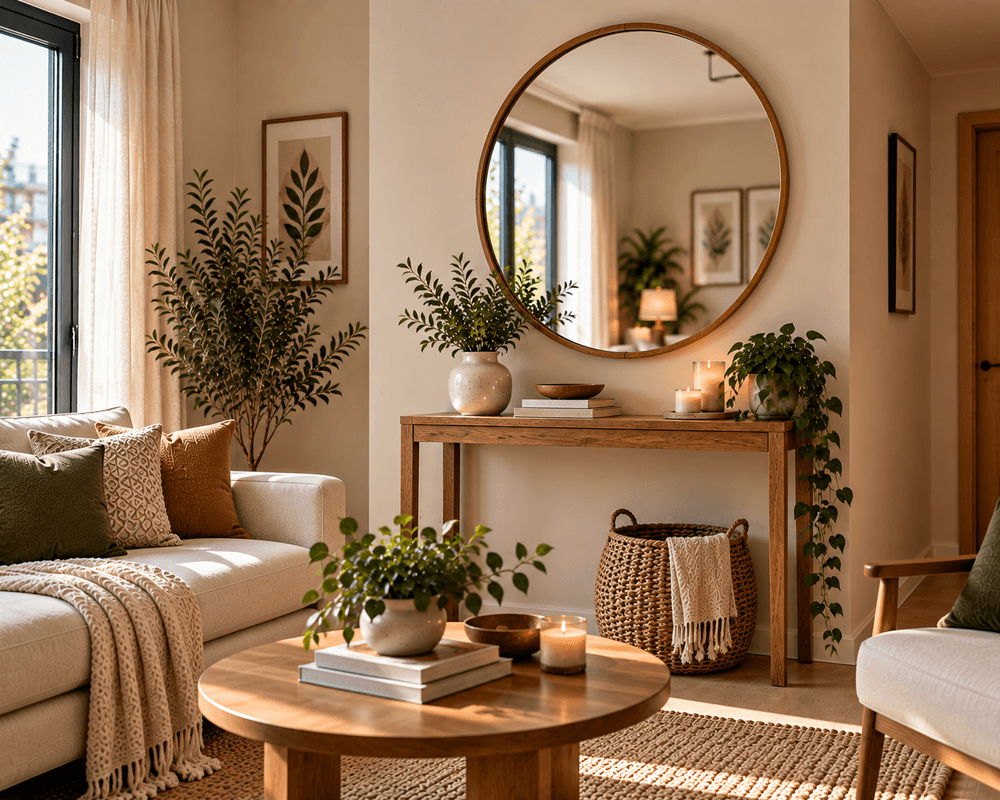
8. Place a Mirror Above a Small Console Table
A wall mirror above a shallow console can make a small living room entry or empty corner feel intentional without adding a bulky cabinet. First measure the remaining walkway and check that the reflected view looks tidy from the sofa.
Choose a shallow console only after measuring the walkway it would leave. Tape its footprint on the floor and open nearby doors to make sure the furniture does not interrupt circulation. Centre the mirror over the console visually, then check the mirror’s weight and use wall-appropriate fixings instead of relying on the furniture to support it.
If the console doubles as an entry drop zone, reserve one clear area for keys and mail instead of styling every centimetre. Keep lamps and their cords away from the walking route, check that the console cannot tip, and mount the mirror independently of the furniture. A paper outline lets you check the balance without drilling.
9. Combine Mirrors With Artwork
Pairing a single mirror with two or three prints creates a focal point without making the wall overly reflective. Keep the frames in a similar finish and leave breathing room between pieces.
Try a simple three-piece arrangement: one round mirror in the centre with two small prints at similar visual height on either side. Trace each frame on paper and test the arrangement from the doorway before making holes. Keep the art and mirror in one visual group rather than spreading small pieces across the whole wall, and secure every frame independently.
Choose one alignment line for the mirror and prints, such as their visual centres, and photograph the paper arrangement from the doorway. For example, a round black mirror with two slim botanical prints gives the eye one group to read; mismatched heights and crowded gaps make a small wall feel busier. Mount each piece separately using its rated hardware.
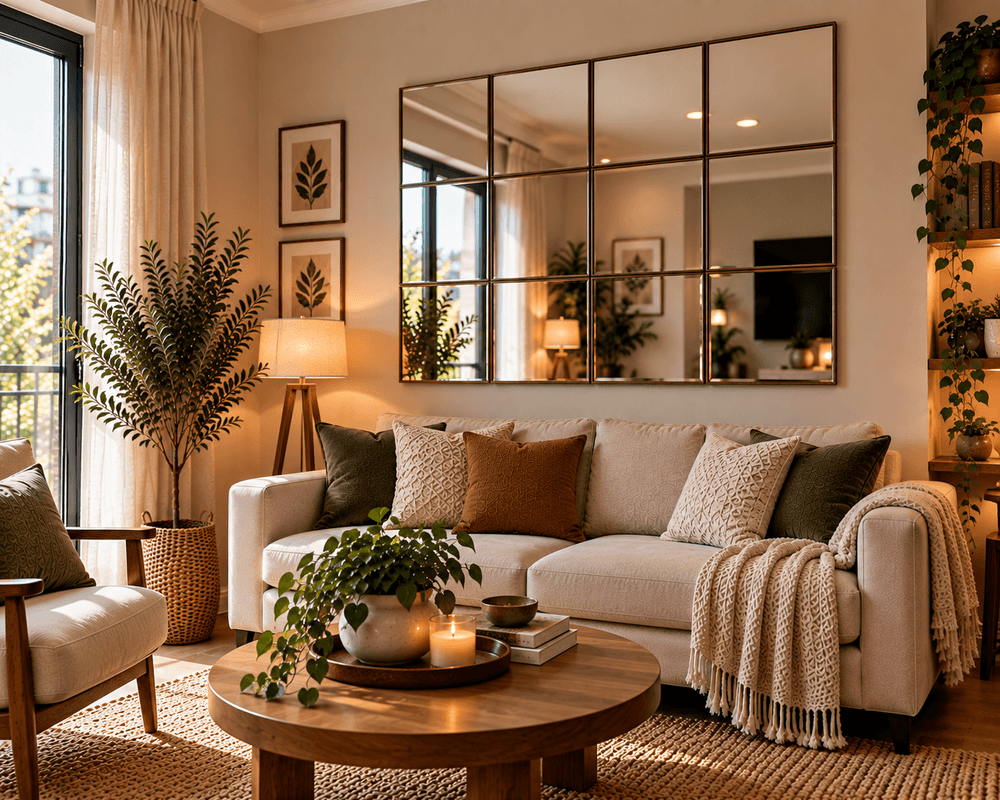
10. Create a Full Mirror Feature Wall
A mirrored feature wall can visually extend a compact room, but it is a high-impact choice. Test the reflected view and glare before committing, and use professional installation for heavy or oversized panels.
You do not need to cover the entire wall with reflective glass. A short run of professionally installed panels can create a feature while leaving breathing room for furniture and artwork. The photo below shows a gallery of individually framed mirrors and artwork, which is a different, less permanent look—not a continuous mirrored wall. For either approach, compare paper mock-ups, assess reflections and glare from each seat, and check the total cost and appropriate wall fixings before committing.
Before committing to mirror panels, ask a qualified installer for the complete cost, including safe glass specification, edge finishing, wall preparation, and future removal. Check the reflection at morning and evening and consider whether cleaning the seams will be practical. If the proposal is too expensive or intrusive for a rental, try one securely mounted statement mirror instead.
Three Real-Room Mirror Layout Examples
- Narrow rental living room: Mark a medium round mirror above a shallow console, then check the walkway and landlord-approved mounting options before buying.
- Family living room: Choose one securely fixed mirror above furniture rather than an unsecured floor mirror, and check the reflected view from children’s seating areas.
- Dim apartment lounge: Test a simple rectangular mirror near a window; move the outline until it reflects daylight without sending glare into the sofa or television.
A 15-Minute Mirror Placement Test Before You Buy
Test mirror wall decor ideas before spending money or drilling. This short exercise helps renters and first-time decorators compare scale, reflections and mounting needs.
- Minutes 0–3: Measure the open wall, the furniture below it and any door swing or walkway.
- Minutes 3–6: Mark two possible mirror outlines using paper; test painter’s tape on an inconspicuous patch first.
- Minutes 6–9: Sit where you normally sit and check daylight, lamp reflections, television glare and what appears in the mirror.
- Minutes 9–12: Photograph both outlines from the doorway and compare how each fits the sofa, console and wall.
- Minutes 12–15: Note the wall material, finished mirror weight and manufacturer-approved fixings. Reject an option that cannot be mounted securely.
Example: In a narrow rented living room, a medium round mirror above a shallow console may feel calmer than several competing frames. In a darker room, a simple rectangular mirror reflecting daylight may be more useful than an ornate mirror reflecting the television.
Mirror Size and Placement: A Practical Paper Mock-Up Guide
There is no single correct mirror width or hanging height for every small living room. Instead of buying by a fixed ratio, compare paper outlines against your actual sofa, console, windows and walking routes. These examples are starting points for visual fit, not mounting specifications.
| Available wall | Paper mock-up to try | Check before buying |
|---|---|---|
| Above a two-seat sofa | One round or horizontal outline centred over the seating area | Leave breathing room around the frame and use wall-rated fixings |
| Narrow wall beside a doorway | A slim vertical rectangle or shallow arch | Check door swing, shoulder clearance and reflected traffic |
| Above a shallow console | A medium round or arched outline that relates to the console width | View it from the doorway and confirm the console does not obstruct the route |
| Near a window in a dark room | A simple rectangle at two alternative positions | Test the reflection from seating at different times to avoid glare |
For example, if your sofa is about 150 cm wide, compare paper outlines that are roughly 70, 90 and 110 cm wide, then photograph each from the main seat. Choose the one that looks balanced and leaves enough clear wall around it; those figures are test sizes, not universal rules. Before buying, check the mirror’s actual weight and hanging points. If a safe fixing method is not available, choose a smaller piece or a different wall. In rooms with awkward routes, see our small living room with stairs layout guide for circulation ideas.
Glass, Acrylic or Mirror Tiles: Which Works in a Small Living Room?
Framed glass provides a crisp reflection but can be heavy; acrylic is lighter but scratches and may distort if unsupported. Mirror tiles allow geometric displays, but their seams remain visible. Check the finished weight, wall material and maker-approved mounting method before choosing.
Two practical examples: In a narrow rented lounge, a modest framed mirror above an existing console may be easier to position than a wall of tiles; check the lease and wall fixings before ordering. For a family room with active children, a securely mounted framed mirror outside play routes is preferable to a large unsecured leaning mirror. In either case, test a paper outline and the reflected view from the main seat before spending money. These are selection examples, not installation specifications.
| Material | Best use | Check first |
|---|---|---|
| Framed glass | One clear focal point | Weight and secure fixings |
| Acrylic | Lightweight accent | Scratching and possible distortion |
| Mirror tiles | Small patterned display | Seams and approved installation |
Is acrylic practical for a rental?
It can be if the product suits the surface and your lease permits it. Compare a sample in daylight and follow the manufacturer’s cleaning and mounting guidance.
Can adhesive strips hold mirror tiles or framed mirrors?
Only when both manufacturers approve the mirror weight, wall finish and conditions. Generic picture strips are not a safe default for heavy glass; choose suitable hardware or professional installation.
How to Choose the Right Mirror for a Small Living Room
- Measure the wall and nearby furniture.
- Check the reflected view from your usual seat.
- Test proportions with a paper outline.
- Follow the mirror maker’s mounting instructions and use hardware appropriate for the wall.
- Check for glare and stability once installed.
When choosing a mirror, consider its size, shape, frame, location, and the view it will reflect. A mirror that looks attractive on its own can still feel wrong if its proportions overwhelm the wall or its placement creates visual clutter.
Quick decision rule: choose one large mirror for the cleanest focal point, a tall mirror when the room feels low, a wide mirror when the wall feels narrow, and a small coordinated group when decoration matters more than maximum visual openness.
Consider the Wall Size
Measure the available wall and the furniture beneath it, then tape a paper outline in place. Check the scale from the doorway and your usual seat: a mirror should read as one deliberate feature, not a tiny dot on a wide wall or an oversized frame crowding the sofa.
For a mirror above a sofa, compare at least two paper widths instead of guessing from an online size chart. View each outline from the main seat and the doorway; the best fit leaves clear wall around the frame and does not crowd nearby shelves or lamps. Use the mock-up to choose proportions, then follow the mirror’s own hanging instructions for safe installation.
Think About Natural Light
One of the most useful reasons to add a mirror to a small room is its ability to reflect available light. Positioning a mirror near or opposite a window can redirect daylight into the room and brighten darker areas.
Check the reflected scene from every seat before drilling: a mirror opposite a window may brighten a dim corner, but it can also bounce direct sun onto a television or into someone’s eyes. Try the paper outline in morning and afternoon light, and move it if it mostly reflects a cluttered shelf, an awkward doorway or a bright screen.
Choose the Right Frame for Your Decor
The frame strongly affects how the mirror fits the room’s overall style.
- Gold frames: Add a warm focal point; repeat the finish in one small accent.
- Black frames: Create a crisp outline against light walls and simple furniture.
- Wood frames: Connect the mirror with timber furniture and natural textiles.
- Rattan frames: Add woven texture to a relaxed room without another bulky item.
- Frameless mirrors: Keep the visual outline quiet when the room is already busy.
- Antique-style frames: Add ornament; balance with plain surrounding wall decor.
Repeat one existing finish—such as the wood of a coffee table or the black of a lamp—so the mirror looks connected to the room. If you prefer a contrasting gold or rattan frame, keep other nearby wall pieces simple. Compare finish samples against the wall in daylight and after dark before buying.
How to Use Mirrors to Make a Small Living Room Look Bigger
You do not need to mirror every wall. Strategic placement matters more than quantity: one mirror reflecting daylight or an uncluttered view can be more effective than several mirrors competing for attention.
A tall mirror can emphasize height, while a wide horizontal mirror may make a narrow wall feel broader. Test each shape with paper outlines at the actual wall position, then sit where you normally relax and check the reflected view. Prioritize a clear reflection and safe mounting over a dramatic size that crowds furniture or causes screen glare.
Mirrors can also be mounted behind or above furniture to add visual depth. The most useful placement reflects daylight, an attractive view, or open space rather than clutter.
Mirror Mounting and Safety: What to Check
Before mounting, record the mirror’s finished weight, wall material, hanger locations, and the manufacturer’s approved hardware. Check for cables or pipes before drilling, obtain landlord permission where required, and use a qualified installer for oversized or unfamiliar fittings. Secure leaning mirrors as directed and keep heavy glass away from play routes. A 2024 U.S. CPSC recall of specific wall mirrors illustrates a falling-glass hazard linked to faulty attachments; it does not mean every wall mirror is unsafe.
Common Mirror Wall Decor Mistakes to Avoid
Too many competing reflections: A gallery of mirrors can make a compact wall look busy. Start with one strong focal point, or repeat a simple frame finish and consistent spacing if you prefer a group.
Ignoring what the mirror reflects: Test the view from the sofa in daylight and after dark. Avoid glare on a television, a direct beam into seating, or a reflection dominated by clutter.
Choosing style before safe mounting: Check the weight, frame attachment, wall material and the maker’s fixing instructions before purchasing. In rentals, choose a smaller securely mountable option rather than assuming removable adhesive can support heavy glass.
Frequently Asked Questions About Mirrors in Small Living Rooms
Where should a mirror go in a small living room?
Place a mirror where it can reflect useful light or an attractive part of the room, such as near a window, above a sofa, or over a console. Avoid positioning it where it mainly reflects clutter, because that can make a compact room feel busier.
What mirror size works best in a small living room?
Choose a mirror that feels proportional to the wall and nearby furniture. One larger mirror can create a cleaner focal point, while several smaller mirrors can work when they are grouped with consistent spacing and a simple arrangement.
Can a mirror make a small living room feel bigger?
A mirror cannot add physical space, but it can reflect light and extend sightlines, which can make a compact room feel brighter and more open. The effect is usually strongest when the mirror reflects a window or an uncluttered part of the room.
How do I avoid glare from a mirror?
Test the reflection from the sofa in daylight and with lamps switched on. Move the paper outline if the mirror would reflect direct sun into seating or a television screen.
Can renters decorate with mirrors without drilling?
Renters can test mirror layouts with removable paper outlines before making holes. For the actual mirror, follow the lease and the mirror and hardware manufacturers’ instructions; only use a removable mounting product if it explicitly supports that mirror’s weight and wall surface. Do not rely on ordinary adhesive hooks for a heavy glass mirror.
How high should a mirror hang above a sofa?
Position the mirror so it reads as part of the sofa grouping without crowding the back cushions or leaving a distracting gap. Mark the outline on paper and judge it from the doorway and normal seating position; there is no safe universal height because frames, furniture and wall construction vary. Use the mirror manufacturer’s hanging points and weight-rated hardware, especially above seating.
Final Thoughts
Bottom line: For a small living room, begin with one mirror that reflects daylight or a calm view, fits the wall and can be securely installed. Round frames soften a sofa wall, tall mirrors emphasize height, and wide mirrors can visually extend a narrow space.
Compare two paper outlines from your usual seat before buying. For renters, prioritize permitted fixings and lighter options; for homes with children or pets, avoid unsecured leaning mirrors and follow the manufacturer’s anti-tip instructions.
Final check: View the mirror from the doorway and your usual seat in daylight and after dark. Confirm that it does not create screen glare, obstruct movement or depend on unsafe mounting.