
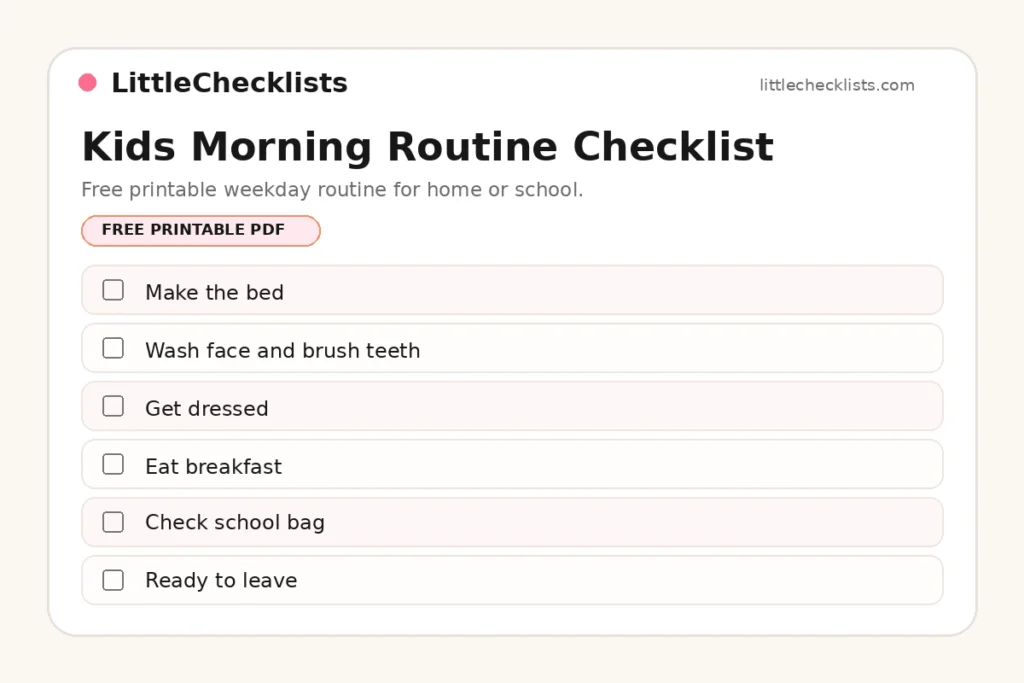
Quick answer: Download this free kids morning routine checklist as a one-page A4 or US Letter PDF. It has nine everyday getting-ready tasks and Monday-to-Friday tick boxes so children can see what comes next. Print it at actual size, choose the steps your family needs and practise together before expecting your child to manage it alone. This PDF is intended for printing and marking by hand, not typing into the boxes.
Best for: families with primary-school children who need a visible weekday getting-ready sequence. Younger children can follow a few rows with an adult; older children can take more responsibility for checking their bags and supplies. Both paper-size versions contain the same nine tasks and Monday-to-Friday tick boxes, so choose the PDF that matches your printer.
Download the Free Kids Morning Routine Checklist
Choose A4 for most UK and international printers or US Letter for common North American paper. Both one-page PDFs are hosted directly on LittleChecklists.com without a sign-up. If your browser previews the PDF instead of saving it, use the download or save button in the viewer.
Printing tip: select portrait orientation, the matching paper size and “actual size” or 100% scale. Check the print preview: the final task and the My morning goal box should appear on the same page. If your printer clips an edge, adjust the printable-area or fit-to-page setting rather than losing a checklist row. The PDF includes name and week fields and Monday-to-Friday tick boxes.
Make the Printable Easier to Read and Use
Print one test copy before making several. Check that the words, weekday labels and tick boxes are legible in your usual lighting. If the boxes are too small for your child to mark comfortably, let them use a sticker, stamp or spoken check-in while an adult marks the sheet.
What Is Included in the Morning Routine?
- Make the bed.
- Wash face and brush teeth.
- Get dressed.
- Eat breakfast.
- Pack lunch or snack.
- Check the school bag.
- Put on shoes and outerwear.
- Do a quick room check.
- Complete a final “ready to leave” check.
The nine printed rows are a starting point, not a rulebook. Cross out tasks that do not apply, such as packing a lunch provided at school, and write a more useful step beside them. If your child needs a shorter routine, circle just three or four essential rows for the first week. A child can tick a step after doing their part, even when an adult has helped. Keep the focus on knowing what happens next rather than earning a perfect score.
Use the “My morning goal” box: Let your child choose one manageable habit to practise for the week, such as finding shoes independently or checking the bag. Write that goal in the box and talk about what helped on Friday. Avoid treating missed ticks as a judgement of effort.
How to Use a Morning Checklist Without Constant Reminders
Start by walking through the checklist together for a few mornings. Keep it somewhere your child naturally sees it, such as near the bedroom door, bathroom mirror, kitchen noticeboard, or school-bag area. Instead of repeating every instruction, point back to the checklist and ask, “What comes next?”
For younger children, focus on three to five core tasks first. Older children can manage the full sequence and take more responsibility for packing their school bag, checking homework, and preparing what they need for the day.
Try a point–pause–help prompt: Point to the next box, allow a moment for your child to start, then offer only the help needed. For example, instead of repeating “Get dressed,” ask “Which clothes are next?” and place the outfit nearby. If the step remains difficult, simplify it on tomorrow’s checklist.
Make the Checklist Fit Your Child
| Age or stage | Useful approach |
|---|---|
| Early primary | Keep the list short, use the same order each morning, and check it together at first. |
| Older primary | Let the child tick tasks independently and take responsibility for their bag and water bottle. |
| Middle school and beyond | Use the printable as a starting point, then replace basic tasks with homework, sports kit, devices, keys, or transport checks. |
If independence is the bigger goal, our guide to teaching kids independence gives practical ways to hand over responsibility gradually. You can also pair this printable with our daily habits that help kids learn at home and a kid-friendly study space.
A Five-Minute Night-Before Reset
Prepare what you can before bedtime: check tomorrow’s school messages, put completed work in the bag, choose weather-appropriate clothes and place shoes where they are easy to find. Invite your child to help with one safe task, such as filling a water bottle. Keep medicines and sharp tools under adult control.
- Check for a PE kit, library book, homework or special event.
- Set out clothes and shoes together.
- Put school essentials at one bag station near the exit.
- Prepare breakfast basics, refrigerating anything that needs chilling.
- Agree on the first step after waking up.
When the Morning Routine Keeps Getting Stuck
| What happens | Try this first |
|---|---|
| Getting dressed takes too long | Choose clothes the evening before and keep them together. |
| School supplies go missing | Use one bag station by the exit. |
| Repeated reminders cause arguments | Point to the next checklist row and offer help with one step. |
| The list feels overwhelming | Start with three essential rows and add more gradually. |
The CDC’s guidance on routines and rules explains why predictable, age-appropriate sequences can help younger children know what to expect. The American Academy of Pediatrics’ independence advice recommends preparing clothes ahead of time and praising effort. These are flexible suggestions, not a promise that every school morning will run smoothly.
Adapt the Printable for Different Needs
For early readers, draw a toothbrush, clothes or school bag beside three important rows. For children who need extra processing time, point to one box, allow time to respond and offer a first–then picture cue if helpful. For children with motor or writing difficulties, use stickers, a stamp, a spoken check-in or a caregiver’s mark instead of requiring a pencil tick. For busy shared homes, label each child’s bag station and stagger bathroom turns. Adapt the routine with your child and relevant professional guidance when needed; the checklist should support participation, not measure obedience.
Three Realistic School-Morning Checklist Examples
Younger child: Begin with four visible tasks: get dressed, brush teeth, eat breakfast and collect the school bag. Put the sheet at eye level and complete the first box together. A child can tick a task after doing their part, even when adult help is needed. Add more rows only after the shorter sequence feels familiar.
Older child: Use the full weekday list, but replace a less relevant row with “check timetable and PE kit” or “pack homework and water bottle.” Let the child check their bag at a consistent station while an adult handles medication and travel arrangements. Review forgotten items without treating a missed tick as failure.
Two children sharing a bathroom: Give each child a separate printed sheet and stagger bathroom steps. One can dress while the other brushes their teeth. Keep labeled bags near the exit and finish with a shared departure check instead of calling repeated instructions across the home.
Plan a Realistic Morning by Working Backwards
A checklist shows what to do; a departure-time plan helps you decide when. Start with the time you must leave, allow a small buffer for shoes and bags, then work backwards through breakfast and getting dressed. These times are an illustration, not a recommended schedule for every child.
- 7:45 a.m.: Leave home with the school bag.
- 7:35 a.m.: Put on shoes, collect outerwear and make the final check.
- 7:15 a.m.: Sit down for breakfast; an adult handles food preparation and any medication.
- 7:00 a.m.: Get dressed and complete bathroom basics with appropriate help.
- 6:50 a.m.: Wake up and allow a gentle transition into the routine.
Test the plan for two or three mornings. If breakfast consistently takes longer, move the start earlier or prepare safe items the night before rather than rushing your child. Adjust the order for your family’s hygiene routine, transport and support needs. Keep the printed nine tasks as a visual guide; you do not need to write a strict time beside every box.
A Three-Step Backup Plan for Rushed Mornings
- Choose the essentials: Prioritize hygiene, weather-appropriate clothes, breakfast or food to take, required medication handled by an adult, and safe travel. Skip optional room-tidying boxes when time is short.
- Give one clear next step: Point to the most important unfinished row and help your child start it. If frustration rises, use a calm voice and a brief pause instead of adding several instructions at once.
- Reset later: After school, ask what caused the delay—missing shoes, a busy bathroom or a step that took longer than expected. Adjust tomorrow’s setup. The checklist is a planning aid, not a scorecard.
When rushed transitions repeatedly cause distress, these practical ways to support an emotional child may help caregivers adapt the routine without adding pressure.
Review the Printable After Five School Mornings
At the end of the week, look for one step your child completed more independently and one that still needed repeated help. Ask whether the sheet was easy to see, whether the order matched your actual morning, and whether any row should be removed. Change just one thing for next week: move a bag check to the night before, shorten a difficult step or draw a picture cue. A useful checklist can change as your child grows.
Keep the Checklist Useful Across Different Caregivers
If grandparents, co-parents or childcare providers help with school mornings, agree on the same few essential steps: breakfast, getting dressed, the school bag and a safe departure check. Share a photo of the marked-up checklist or keep a copy in each home, but allow different wake-up times and layouts. Make sure the responsible adult handles transport plans, medication and any special school instructions; those should not depend on a child’s tick box.
For changing school schedules, add a handwritten note for library day, sports kit or an earlier bus. Review the note the evening before rather than adding too many permanent rows to a simple weekday sheet.
A Simple Way to Start Tomorrow Morning
- Print the checklist in the paper size you use.
- Write your child’s name and the week at the top.
- Cross out any task that does not apply.
- Place the sheet where the routine actually happens.
- Use the tick boxes for one school week before deciding what to change.
Download and Print Troubleshooting
PDF opens but does not save? Use the browser’s download icon or Save As option; on a phone, check Downloads or Files. Boxes look too small? Confirm you selected A4 or Letter to match your paper and printed at actual size. No printer? Use the PDF as a visual reference and copy the three most useful steps onto paper or a reusable whiteboard. This is a fixed-layout printable, so crossing out and rewriting tasks on paper is simpler than trying to edit the PDF itself.
FAQs About Kids Morning Routine Checklists
What should be on a morning routine checklist for kids?
Include the tasks your child genuinely needs before leaving home: getting dressed, bathroom basics, breakfast, school-bag checks, shoes or outerwear, and one final ready-to-leave check. Keep the list shorter for younger children.
Should I use rewards for completing the checklist?
You do not need a reward system for the printable to be useful. Many families simply use the visible sequence to reduce forgotten steps and repeated instructions. If you use rewards, keep them simple and avoid making every routine task depend on a prize.
Can I laminate the printable?
Yes. You can laminate it or place it in a reusable plastic sleeve and use a dry-erase marker. You can also print a fresh copy each week if your child enjoys ticking paper boxes.
Can I type into or edit this PDF?
The downloadable PDF is a fixed-layout printable, not an editable form. Print it and cross out, relabel or mark the tasks that fit your household. If you need a different routine entirely, use a blank sheet or a reusable whiteboard with your own steps.
What age is this morning checklist for?
It is designed mainly for school-age children, but younger children can follow three or four steps with pictures and adult help. Older children can use the full list and replace basic tasks with school-specific checks.
Can I use this morning checklist on weekends?
This version has Monday-to-Friday columns for school mornings. For weekends, copy the relevant tasks onto a separate sheet or use the daily checklist template linked below. Keep only the steps your child actually needs that day.
Looking for more downloadable resources? Visit our free printable checklists library for home and family routines.
For a flexible day-to-day planning sheet, use our free daily checklist template with priorities, tasks, reminders and notes.