

Some children feel everything deeply. Even a small setback can bring tears. Losing a game may feel huge. A small slip can spark an emotional reaction. If this feels familiar, you may wonder how to help an emotional child without dismissing their feelings or allowing unsafe behaviour to go unchecked. These practical strategies are for parents and carers of toddlers, preschoolers and school-age children; adapt them to your child’s communication style and developmental needs.
Quick takeaway: When big feelings hit, keep the sequence simple: connect, name the feeling, validate it without removing a reasonable boundary, help your child calm, then teach or problem-solve later. Look for recurring triggers and practise coping skills when your child is calm.
The goal is not to stop a child from feeling. Children need to learn that sadness, anger, frustration, disappointment, and worry are normal feelings, and they also need to learn safe ways to express them. Young children are still developing language, impulse control, and self-regulation, so they often need adult support while those skills grow. The American Academy of Pediatrics’ guidance on healthy emotional development encourages listening, connection and open conversations about feelings. Parents can model calm responses, name emotions and offer age-appropriate choices.
What to Do When Your Child Is Emotional Right Now
When your child is already crying, shouting, or overwhelmed, do not try many techniques at once. Start with a simple sequence: Connect, Name, Validate, Calm, Teach. For example, move close enough for safety, say “You seem frustrated,” acknowledge why, offer quiet space or comfort, and discuss solutions only after they settle.
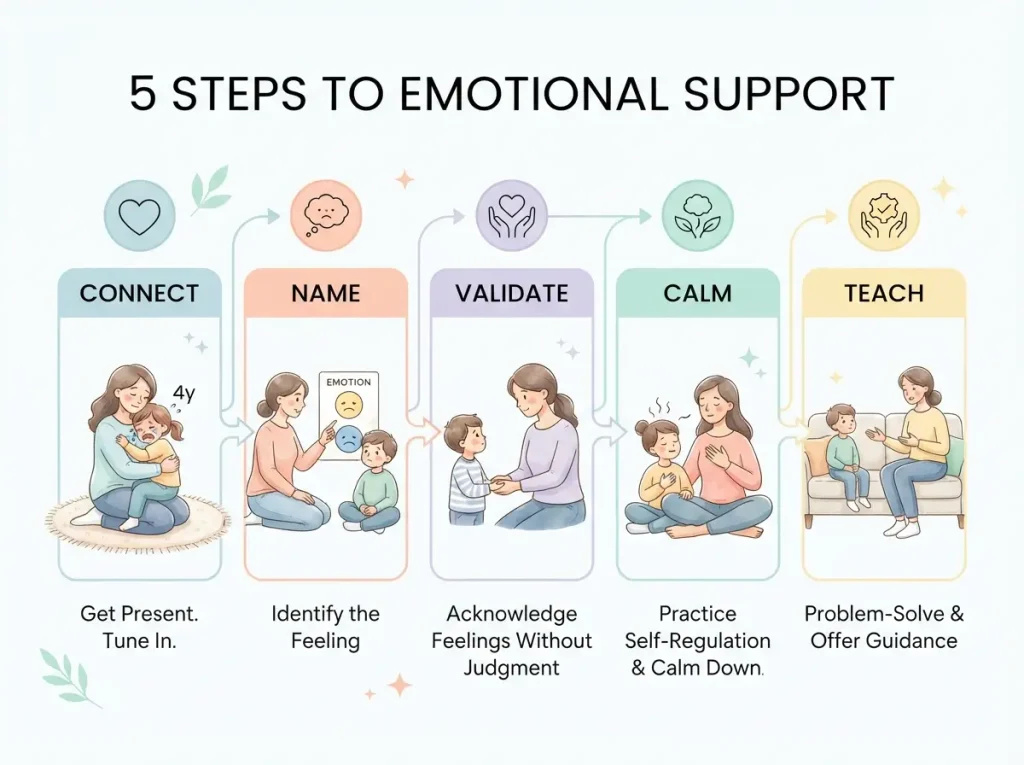
Stay close enough to keep your child safe. Identify what they may be feeling, acknowledge the emotion without changing the boundary, and give them time to settle. After the initial emotional response has subsided, discuss what happened and what they might do differently next time. Raising Children Network’s emotion-management guidance describes a similar five-step process: notice the emotion, name it and link it to the event, pause, support the child while they calm down, and then address the issue.
For example, if your child is crying because screen time ended, try saying, “I can see you are upset because tablet time finished.” Then pause. Your child does not need a long explanation of the rule or lots of questions right away. When your child is calmer, discuss the transition and decide whether a warning or another routine could help next time.
If the reaction becomes unsafe: Prioritise immediate safety over the five-step script. Calmly prevent hitting or throwing, move other children out of harm’s way where possible, and seek urgent help if someone is at immediate risk. If your child becomes quiet or withdraws instead of shouting, offer a gentle check-in and time to respond rather than assuming they are fine.
What Does It Mean to Be an Emotional Child?
The term “emotional child” is descriptive rather than diagnostic. It can refer to a child who cries easily, becomes very frustrated, takes longer to calm down after being upset, struggles with disappointment, or finds changes in routine difficult. Temperament varies from child to child, making some kids more emotional than others. Reactions may also increase in intensity when children are tired, hungry, overstimulated, or in a situation that they are not coping with.
It is more useful to look for patterns than to focus on one incident. Notice how often strong reactions occur, what tends to trigger them, how long they last, and whether they affect school, friendships, family life, or daily routines. Children’s understanding of emotions is still developing, so they may need help naming feelings and calming down. Younger children may not yet be able to explain their emotions clearly.
Why Is My Child So Emotional?
There is rarely one reason. Frustration, disappointment, fatigue, hunger, overstimulation, embarrassment and difficulty expressing needs can all play a part. An adult may see a minor change as insignificant, but for a child with fewer coping skills and less experience handling disappointment, the same change can feel significant.
Look for repeated patterns before choosing a strategy. If distress often starts when leaving the playground, beginning homework or ending screen time, the transition itself may be difficult. Try an advance cue and rehearse the change when your child is calm; if the same situation remains difficult, adjust the demand, environment or support instead of repeating longer explanations.
Before Big Feelings: Prepare Your Child
1. Identify Triggers and Patterns
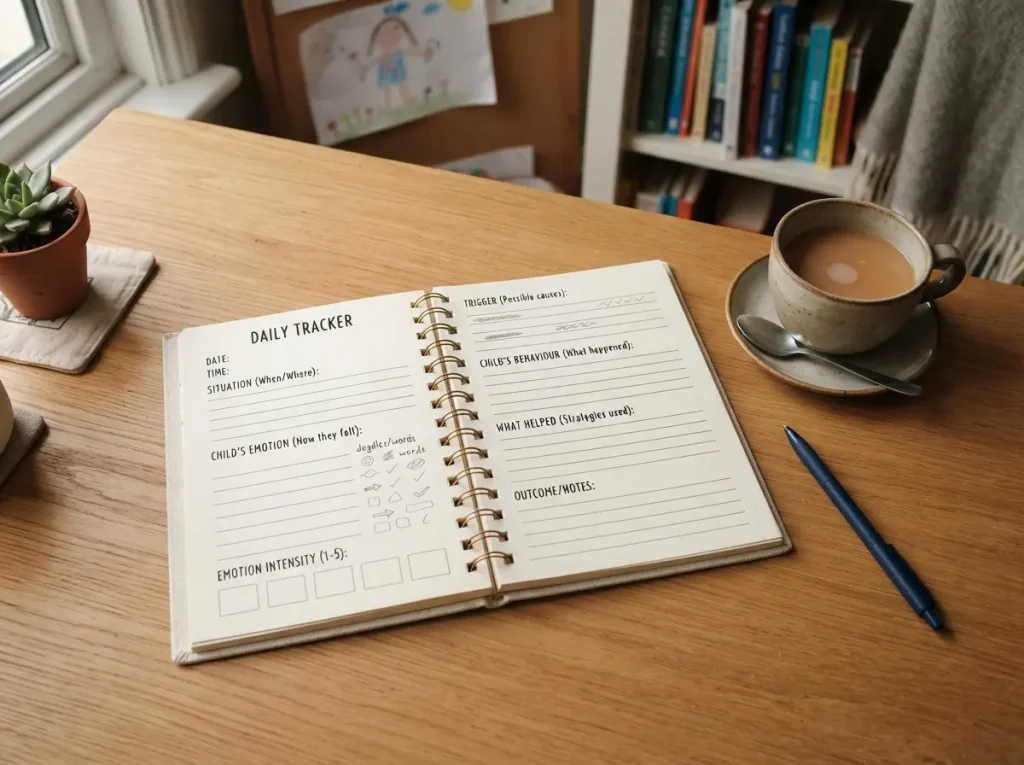
Think about what happened before the emotional reaction. Was your child hungry, tired, rushed, overstimulated, or asked to stop something they were enjoying? Did your child make a mistake, lose a game, or feel left out? YoungMinds’ guidance for parents recommends considering what happens before and after challenging behaviour and looking at factors such as sleep, hunger, illness, routine changes, relationships, and overwhelming environments.
You can keep a simple record for a few days:
| Situation | Possible trigger | What happened | What helped |
|---|---|---|---|
| Leaving the park | Sudden transition | Crying and refusing to leave | Advance warning |
| Homework | Difficult task | Shouting and giving up | Smaller steps |
| Losing a game | Disappointment | Crying and quitting | Break, then retry |
| Busy shop | Too much stimulation | Crying and covering ears | Quieter area |
| Screen time ending | Preferred activity stopped | Shouting | Warning and choice |
You are not trying to monitor your child constantly. The purpose is to spot repeated patterns that can be prepared for.
2. Create Predictable Routines and Clear Boundaries
Transitions are easier for children when they have some advance warning. You don’t have to follow a rigid timetable, but predictable routines for mornings, meals, school, homework, play, screen time and bedtime can help. Give a brief warning before a change, especially when ending a preferred activity regularly leads to distress. For bedtime, show a simple sequence such as wash, pyjamas, story and lights out, using pictures or a short spoken reminder if that is easier for your child. Give extra processing time when needed; do not promise a countdown you cannot keep.
Boundaries still matter when your child is emotional. Your child can be disappointed about leaving the park and still need to leave. Your child can feel angry toward a sibling and still keep their hands to themselves. Raising Children Network highlights that feelings are OK even when some behaviours are not. For a broader approach to calm, consistent limits, see these positive parenting techniques.
3. Use Emotional Scaffolding
Emotional scaffolding works like temporary support around a building: you help your child through a challenging situation without doing everything for them. Break the challenge into smaller steps, provide help where needed, and gradually expect more independence. For more ideas on building independence step by step, see how to teach kids independence.
If homework becomes overwhelming, help your child start with one manageable question, then let them try the next step and pause briefly if frustration rises. A simple “first one question, then a short break” cue can be easier to follow than repeated instructions. If speaking is easier than writing, invite your child to explain an answer aloud before recording it; use any accessibility supports agreed with their teacher. If the same assignment repeatedly triggers distress, ask the teacher whether the task or amount of support needs adjusting. For difficult transitions, rehearse with a less exciting activity first. The aim is achievable practice, not pushing through escalating distress.
4. Practice Difficult Situations Before They Happen
Do not wait for the next meltdown to teach a new skill. Practise when your child is calm. You can role-play leaving the playground, losing a game, stopping screen time or asking a sibling for a toy.
For example, pretend that playtime is ending. Give a five-minute warning, practise finishing the activity and then offer two acceptable choices. Praise your child for completing the transition. Practising when calm gives children a chance to rehearse a behaviour before the real situation. The Child Mind Institute’s guide to self-regulation explains how adults can model and practise coping skills.
How to Help an Emotional Child During Big Feelings
5. Stay Calm and Keep Your Words Simple
Your child does not need a long lecture while they are overwhelmed. Young children often need a calm adult presence during big emotions; the AAP also suggests that an adult can take a brief pause before re-engaging if necessary.
Try:
“I can see that you’re really upset. I’m here.”
If the behaviour is unsafe:
“You can be angry. I won’t let you hit.”
Use a calm tone and keep the message brief. The detailed teaching can be done at a later time when your child is ready to hear it.
6. Validate the Feeling Without Giving In
Validation means acknowledging the emotion without necessarily giving the child what they want. If your child cries because you said no to another biscuit, you could say: “I know you were hoping for another one. You’re disappointed.”
The answer can still be no.
This is an important distinction: feelings can be accepted while boundaries remain in place. Acknowledge the disappointment without treating tears as misbehaviour; keep the boundary clear, and revisit the problem once your child has settled.
7. Name the Emotion
Encourage your child to communicate what they are feeling. A child who cannot yet find the words for embarrassment may cry, withdraw, or get angry. Use simple language appropriate to the circumstances:
“You’re not happy about the puzzle not working out.”
“You’re disappointed that your friend can’t come over.”
“You seem worried about what will happen tomorrow.”
Through books, play and talking, children can develop their emotional vocabulary. Raising Children Network suggests emotion recognition practice in a relaxed state, rather than when children are feeling overwhelmed.
8. Offer Two Acceptable Choices
A small, appropriate choice can give a child some control without removing the parent’s boundary. One strategy recommended by the AAP for children to process strong emotions is to give them a choice.
Instead of:
“Get dressed.”
Try:
“Do you want the blue top or the green one?”
Instead of:
“Get in the car.”
Try:
“Would you like to walk to the car or hold my hand?”
Both options should be acceptable to you. The choice gives your child some control, but it does not turn a boundary into a negotiation.
9. Give Time and Space to Calm Down
When a child is upset, some want a hug. Others do not like to be touched. Be ready and take direction from your child. Stay calm and close enough to keep your child safe, while allowing a little more space when that helps them settle and it is safe to do so, as recommended by Raising Children Network.
You could say:
“I’m here. You can have some space. I’ll stay nearby.”
Avoid asking for a detailed explanation while your child is at the peak of the emotional reaction. Your immediate goal is to help the child become calmer. Problem-solving comes later.
10. Teach Calming Skills During Calm Moments
Practising calming techniques will be easier when your child is calm. Slow breathing, moving to a quieter place, stretching, drawing, counting slowly or using a comfortable quiet space may be used depending on the age and preference of the child. The AAP suggests developing soothing rituals and offering children coping tools to manage their emotions.
Avoid using calming as a command, such as “Calm down now.” Instead, show your child what calming can look like. Practise together when there is no crisis. If a method makes your child more frustrated, switch to another approach rather than insisting. Aim to practise two or three coping strategies your child actually likes, so they can use them more independently over time. Drawing, movement, or a familiar indoor game may work better than breathing exercises for some children; see these hands-on indoor activities for kids for low-pressure options.

After Big Feelings: Teach the Skill
11. Praise the Behaviour You Want Repeated
After your child has settled, have a quick conversation about what happened and look for any positive behaviour that they exhibited. When a child uses words instead of hitting or shouting, notice the specific skill they used. The American Academy of Pediatrics encourages supportive communication and emotion coaching; specific feedback is more useful than a vague “Good job.”
Try: “You were really upset, but you told me that you needed a break.”
Or:
“You were angry, but you used words instead of your hands.”
Or:
“That homework was frustrating, but you kept trying.”
This shows your child which behaviour you want them to repeat.
12. Teach Recovery From Mistakes and Disappointment
Don’t attempt to remove all of the difficult experiences. Children must have the opportunity to practice their responses when they are frustrated and disappointed. If a puzzle is too difficult, help the child notice frustration, take a short break and try again later rather than immediately solving the puzzle for them.
You can temporarily redirect your child to an activity they can manage, then return to the original challenge later. The aim is not to teach avoidance; it is to give your child enough time to recover and make another attempt. The same applies to losing. Your child will not always win, finish first, or get what they want. You can say, “You really wanted to win, and losing is disappointing. Let’s pause, then decide what you want to do next.” Over time, children can learn that disappointment feels uncomfortable but is manageable.
Practical Responses for Everyday Emotional Situations
What to Say to an Emotional Child
Parents often hear that they should “validate feelings” but still wonder what that sounds like in real life. The best phrases are usually short, calm and specific. You are trying to communicate that the emotion is recognised while the appropriate boundary remains.
| Instead of saying | Try saying |
|---|---|
| “Stop crying.” | “I can see you’re upset.” |
| “It’s not a big deal.” | “It feels like a big deal right now.” |
| “You’re too sensitive.” | “You’re having a strong feeling. I’m here.” |
| “Calm down.” | “Let’s take a moment together.” |
| “You’re fine.” | “Something has upset you. We can talk when you’re ready.” |
| “Why are you crying?” | “You seem disappointed. Do you want to tell me what happened?” |
| “Get over it.” | “It’s hard when things don’t go the way you expected.” |
| “Stop being angry.” | “It’s okay to feel angry. It’s not okay to hurt someone.” |
During the emotional peak, use fewer words. Later, when your child is calm, you can have the longer conversation. NHS guidance encourages parents to talk about feelings while also recognising that children may need another opportunity to talk if they are not ready at that moment.
Common Emotional Situations and What to Do
Different situations require slightly different responses. A child crying because a toy is missing needs something different from a child who is overwhelmed in a noisy environment or angry enough to hit. The basic sequence remains the same, but the practical response should match the situation.
| Situation | What to try |
|---|---|
| Cries over a small disappointment | Validate the feeling and keep the boundary |
| Gets upset after losing | Acknowledge disappointment, allow a break, practise recovery |
| Becomes frustrated by mistakes | Ask what they could try next rather than taking over |
| Struggles to leave the park | Give a warning and offer two choices |
| Becomes overwhelmed in public | Reduce stimulation and move somewhere quieter |
| Does not want a hug | Respect the preference while staying nearby |
| Says “Nobody likes me” | Listen and ask what happened before trying to reassure |
| Hits when angry | Keep everyone safe and set a clear boundary |
| Melts down when screen time ends | Prepare in advance and use a predictable transition |
| Gives up during homework | Break the task into smaller steps and allow a short pause |

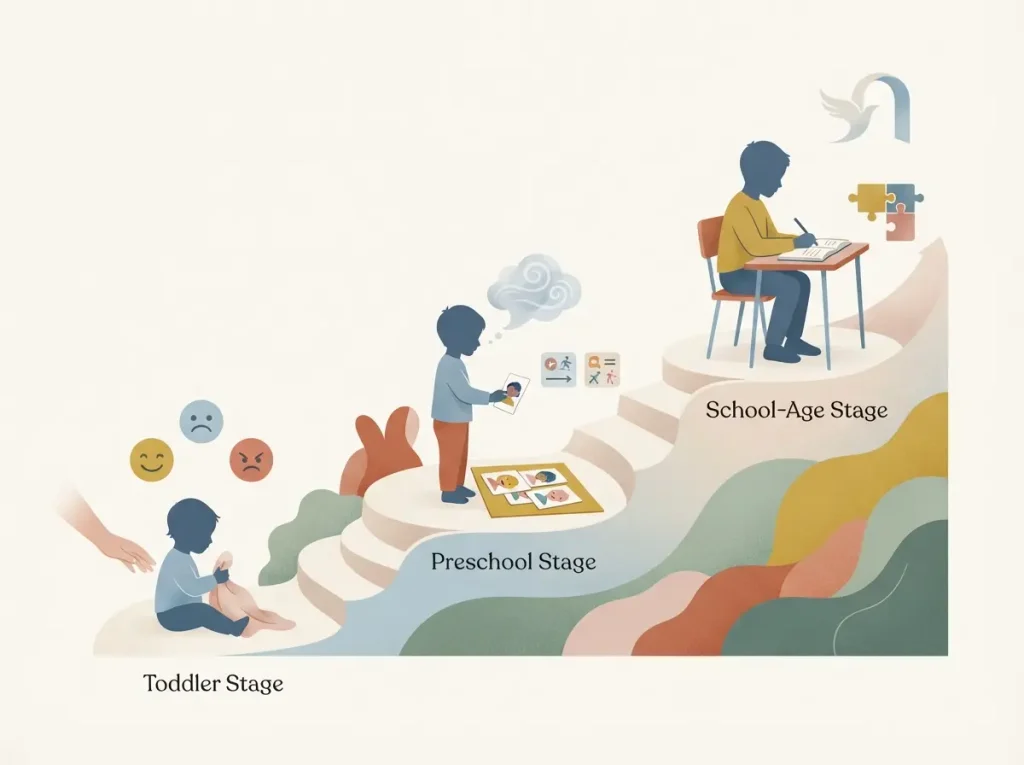
How to Help an Emotional Child at Different Ages
The same principles can look different depending on your child’s development. The AAP guidance on big emotions focuses on children aged 2 to 6, while Raising Children Network provides guidance for children around 3 to 8 years.
| Age or stage | Useful focus |
|---|---|
| Toddlers | Simple emotion words, safety, short instructions and close adult support |
| Preschoolers | Naming feelings, choices, calming routines and practising transitions |
| School-age children | Problem-solving, reflection, coping plans and greater independence |
These are general guides, not strict milestones. Children develop at different rates, so adjust the language and expectations to your child’s individual abilities.
Feelings Are Allowed, Unsafe Behaviour Is Not
A child can be angry without being allowed to hit. They can be disappointed without getting everything they want. They can cry without being shamed for crying. Separating emotion from behaviour allows you to be compassionate while still maintaining clear boundaries.
| Feeling | Boundary |
|---|---|
| Anger | “You can be angry. You cannot hit.” |
| Frustration | “You can be frustrated. We do not throw things.” |
| Disappointment | “You can be disappointed. The answer is still no.” |
| Jealousy | “You can feel jealous. You cannot hurt your sibling.” |
| Sadness | “You can cry. I’m here with you.” |
Raising Children Network specifically recommends helping children understand that emotions are okay even when particular behaviours are not.
A Simple Emotional Regulation Plan for Parents
If the same situation keeps happening, write down a simple plan:
Common trigger: ____________________
Early warning signs: ____________________
Emotion my child may be feeling: ____________________
Words I can use: ____________________
Boundary I need to maintain: ____________________
Two choices I can offer:
- Choice 1: ____________________
- Choice 2: ____________________
Calming strategy we practice: ____________________
Behaviour I will praise: ____________________
What we can practice before the next difficult situation: ____________________
A simple record can also help you see whether your approach is changing the pattern over time. YoungMinds recommends observing triggers and what happens before and after challenging behaviour when parents are trying to understand recurring difficulties.
A Five-Minute Practice Plan for This Week
Pick one predictable challenge, such as leaving the park or starting homework. Practise when your child is calm, and adapt the exercise to their age and communication needs.
- Minute 1: name the situation and invite your child to describe a feeling.
- Minutes 2–3: role-play the transition with two acceptable choices.
- Minute 4: practise a coping option your child prefers, such as drawing or taking a short break.
- Minute 5: praise one specific effort and agree on what to try next time.
Repeat on a few calm days instead of expecting instant results. If practice increases distress, shorten it or try a different approach. Use the worksheet above to notice what helps.
A Seven-Day Check-In: What Is Improving?
Choose one recurring situation rather than tracking every emotion. For seven days, note what happened before the upset, whether everyone stayed safe, what support helped, and how your child recovered. Look for small changes in the routine or your response—not a target of zero tears. For example, a child might still feel disappointed when screen time ends but begin accepting a two-minute warning and asking for a break. If distress becomes more frequent, severe or disruptive, share your observations with a qualified professional.
- Days 1–2: Identify one trigger and write down what happened before and after.
- Days 3–5: Practise one calm-time strategy and use the same short supportive phrase.
- Days 6–7: Review whether recovery, communication or safety improved; keep or adjust the plan.
How to Adapt Emotional Support for Different Needs
A child who finds spoken instructions difficult, dislikes touch or becomes overwhelmed by noise may need a different kind of support. These adjustments can help families of children with sensory sensitivities, communication differences or disabilities. Keep the core approach—safety, connection, a clear limit and time to recover—but make it accessible to your child.
When Talking Makes Things Harder
Use one short sentence, a picture card, a familiar gesture or a written choice instead of repeated questions. For example, show two options—“quiet corner” and “sit beside me”—and let your child point. Give processing time. When they are calm, ask which cue helped and agree on a signal they can use next time.
When Touch, Noise or Crowds Increase Distress
Do not insist on a hug or eye contact. Offer a quieter location, reduce competing sounds where possible, and keep a safe distance while remaining available. In a shop, for example, move away from the busiest aisle before discussing the boundary. Keep exits and walkways clear; never leave a child unsupervised when safety is at risk.
When a Strategy Works One Day but Not the Next
Check for changes in sleep, health, hunger, transitions and task difficulty. Keep one helpful routine but adjust the amount of support. The American Academy of Pediatrics’ emotional-development guidance describes the value of nurturing relationships and predictable routines. A simple daily learning routine can help make transitions easier to anticipate, without expecting perfect behaviour.
How to Handle Big Feelings at School or in Public
Children may need different support outside the home, where adults have less control over noise, timing and space. Plan a brief response before a predictable challenge and share it with other caregivers so your child receives similar messages.
Example: A Difficult School Transition
Before school, agree on a short goodbye routine and one predictable next step. If separation is difficult, ask the teacher which handover approach works within school policy. After school, talk about what felt hardest and whether a visual timetable, earlier preparation or a familiar object would help. Avoid promising that your child will never feel upset; focus on a manageable routine.
Example: Overwhelm in a Busy Public Place
First check safety. Move to a quieter spot if practical, use a calm sentence such as “It’s loud here; let’s step aside,” and offer a break or two acceptable choices. Save explanations for later. If a child repeatedly struggles in one environment, note the pattern and discuss reasonable adjustments with their school or a qualified professional.
For calm-time practice, playful turn-taking and listening games can help some children rehearse waiting, asking for a break and recovering after a mistake. See these age-friendly attention and listening activities. They are practice opportunities, not a treatment or a test of emotional regulation.
A One-Minute Handover Plan for Other Caregivers
If a child regularly struggles with a particular transition, agree on one short response with the adults who support them. A shared plan is easier to follow than several different instructions. Keep it practical, avoid labelling the child, and ask what has worked for them before. This is a communication aid for families and schools, not a diagnosis or a substitute for individual professional advice.
| Share this | Example for a difficult school drop-off |
|---|---|
| Early signs | Clings to the adult, becomes quiet or starts crying at the gate. |
| Helpful words | “Goodbyes feel hard. Your teacher is here, and I will see you after school.” |
| Agreed support | Use the same short goodbye, then offer a familiar first activity with staff. |
| Safety and preferences | Ask before touching; allow processing time; follow the school’s safeguarding procedures. |
| Review | After a week, compare what helped and adjust one step together. |
How to use it: Write down the child’s preferred calming option and one boundary that must stay consistent. Share only the information needed with the relevant caregiver, respect the child’s privacy, and check whether the plan fits the setting’s policies. For a child who communicates without speech, agree on a gesture or picture cue. If separation distress is persistent or significantly disrupts daily life, discuss it with a qualified professional rather than simply extending the plan indefinitely.
When Your Usual Approach Is Not Working
What If You Lose Your Calm as a Parent?
Parents and carers have strong feelings too. If you shout, prioritise everyone’s safety, take a brief pause when your child is safely supervised, and return to repair the moment. A useful script is: “I raised my voice. That was not okay, and I’m sorry. The rule about not hitting still stands. Next time I will pause before speaking.” Name your own action without blaming the child, then listen if they want to explain how it felt. Offer a small reconnection, such as sitting together or reading, but do not demand a hug or immediate forgiveness. Agree on one concrete next-time plan, such as an adult pause signal or a quieter place to talk. An apology models responsibility; it does not remove a necessary safety boundary.
If you frequently feel close to losing control, ask another trusted adult for practical support and speak with a healthcare professional. A sustainable plan may include shorter transitions, a shared caregiving routine and time to recover. You do not need to manage escalating situations alone.
When Your Child Goes Quiet Instead of Crying
Not every child shows distress by crying or shouting. Some become silent, turn away, avoid conversation or struggle to explain what is wrong. Treat quietness as a reason to check in gently, not proof that the child is fine or deliberately ignoring you. YoungMinds’ parent guidance also discusses withdrawal and difficulties communicating when distressed.
Start with safety and a low-pressure invitation. You might say, “You seem quieter than usual. I’m here when you’re ready.” Offer sitting nearby, quiet space, drawing or a gesture instead of words. Do not demand eye contact, a hug or an immediate explanation. If the child is safe, give them time and check in again later. Persistent withdrawal or a sudden change that affects daily life deserves discussion with a qualified professional.
When to Seek Help: UK and Other Countries
Strong emotions are common in childhood. Consider extra support when emotional or behavioural difficulties persist, cause significant distress, interfere with school, friendships, sleep or family life, or create safety concerns. NHS guidance on children’s mental health recommends seeking professional support when concerns are serious or persistent.
In the UK, a GP is a useful starting point. You can also speak with a teacher, school nurse, mental health lead, SENCO or health visitor (for children under 5 years). These professionals can help families understand available support and, where appropriate, refer children to specialist services such as CAMHS. Outside the UK, ask your child’s paediatrician, family doctor, school counsellor or local child mental health service about the appropriate pathway. If there is immediate danger, contact your local emergency service rather than waiting for a routine appointment.
There is no need to self-diagnose your child. Strong emotional reactions can be influenced by development, relationships, environment, and other factors, while a professional assessment can consider the broader picture. If there is an immediate risk of serious harm, seek urgent professional help.
Conclusion
Helping an emotional child is not about suppressing emotions. It is about helping them identify what they feel, express those feelings safely, and gradually recover from frustration, disappointment, and other challenging experiences. Start with one repeated trigger this week, practise one supportive phrase or calming option when your child is settled, and review what helped after several days. A safer response or quicker reconnection is meaningful progress even if tears do not disappear.
When emotions get intense, remember the simple sequence: connect, name, validate, calm, and teach. Stay composed, maintain appropriate boundaries, allow your child time to settle, and revisit the problem later. Before difficult situations, use predictable routines, appropriate choices, practice, and emotional support. Afterwards, reinforce the positive behaviour you want to see again and give your child another chance to practise it.
The goal is not to prevent crying, anger or disappointment. You are helping your child learn that strong emotions are manageable, that unsafe actions have limits, and that difficult moments can be repaired with support and practice.
FAQs About Helping an Emotional Child
Why is my child so emotional?
Strong feelings can be linked to tiredness, hunger, frustration, disappointment, sensory overload, changes in routine, or difficulty communicating a need. Look for recurring situations rather than assuming there is one cause.
How do I calm an emotional child?
Stay calm, make sure everyone is safe, identify and validate the emotion, and give your child time to settle. Avoid lengthy explanations during the peak of the reaction. Problem-solve after your child has calmed down.
How do I help my child who cries over small things?
Don’t dismiss the feeling, and don’t assume you must change your decision. It’s okay to say, “I know you’re disappointed,” and maintain the boundary. Support your child to think of an acceptable alternative and encourage their recovery if they manage the disappointment in a constructive way.
Should I give an emotional child space?
Sometimes. Stay nearby and let your child show whether they want touch, conversation, or a little space. Some children need more time before they are ready to be comforted. The priority is to keep your child safe while respecting their need for comfort or space.
How do I teach my child emotional regulation?
Practise emotional skills when your child is calm. Help them identify feelings, rehearse challenging situations, practise calming strategies, and think about what they could do differently next time. Consistency and repetition help build emotional regulation, so do not expect perfection overnight.
How can I help a child who struggles with words or sensory overload?
Keep your child safe, reduce overwhelming input when possible, and offer a gesture, picture or simple choice instead of many questions. Respect preferences around touch and eye contact. Practise a familiar calming option when your child is settled, and seek individual advice if distress frequently disrupts daily life.