
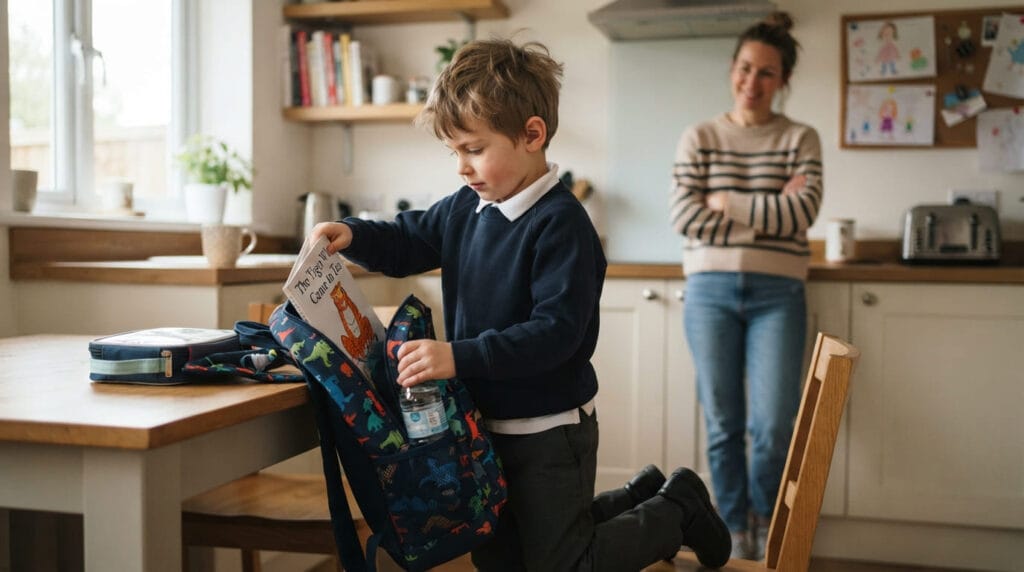
Watching your child do something for the first time without your help can bring a surprisingly big smile to your face.
Quick takeaway: To teach kids independence, choose one safe task your child is nearly ready to manage, show the steps, let them try and gradually reduce reminders. Independence means growing responsibility with dependable adult support—not leaving a child to manage alone.
Maybe they finally put their shoes on themselves. Maybe they packed their school bag, made a simple snack, tidied their toys or solved a small problem without immediately calling for you.
These moments may look small, but they are important. Children develop independence gradually through everyday opportunities to try, practise, make decisions and take responsibility.
If you are wondering how to teach kids independence, you do not need to hand over lots of responsibility all at once. The better approach is to start with manageable tasks and gradually reduce the amount of help you provide.
Independence and confidence also grow together. When children discover that they can handle age-appropriate tasks, they have more opportunities to develop confidence in their own abilities. Children develop confidence through everyday experiences, encouragement and supportive parenting. If you want more practical strategies, see our guide to positive parenting techniques.
Here are 12 practical ways to encourage independence while helping your child become more confident.
Which Independence Skill Should You Start With?
Choose a task based on your child’s abilities and what is difficult today, not a rigid age deadline. Supervise activities involving heat, sharp objects, roads or other hazards.
| Situation | First task to try | How to support |
|---|---|---|
| Rushed mornings | Put shoes and bag in one place the night before | Use a short checklist and check together |
| Child says “I can’t” | Do one small step, such as finding a needed item | Demonstrate once, then offer a clue |
| Chores cause arguments | Choose one predictable job, such as putting cups away | Agree when it happens and notice effort |
| Child asks for more responsibility | Choose between two safe jobs | Set boundaries, supervise and review afterwards |
For example, if a preschooler freezes when asked to tidy a whole room, start with only the blocks. If an older child packs their bag but forgets one item, try a short checklist instead of repacking it for them.
Why Confidence and Independence Go Together
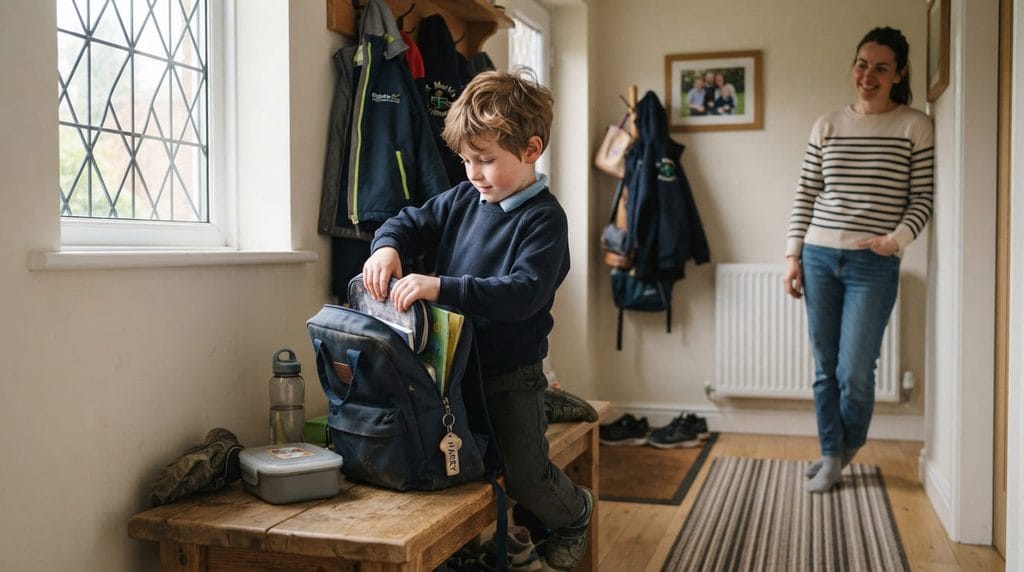
Confidence grows through supported practice, not praise alone. For example, let your child zip a coat while you hold the bottom steady, then reduce that help as the skill becomes easier.
Children can develop confidence through experience.
When a child tries something, struggles a little, receives appropriate support and eventually succeeds, they learn something valuable:
“I can try things myself.”
That belief can encourage them to attempt the next challenge.
Early years guidance in England places importance on children’s confidence, independence, self-care, decision-making and opportunities to learn through exploration and appropriate support. It also emphasises that development happens at different rates, so age ranges should be treated as guidance rather than strict deadlines.
This is why teaching independence is not about making children do everything alone.
It is about gradually helping them become capable of doing more for themselves.
12 Practical Ways to Teach Kids Independence and Build Confidence
Start with manageable choices and safe practice, then encourage effort and persistence. Before focusing on chores and responsibilities, build the mindset that makes independence possible.
1. Praise Effort, Progress and Persistence
It is tempting to say:
“You’re so clever!”
But try to be more specific about what your child actually did.
For example:
- “You kept trying even when that was difficult.”
- “You worked out how to put that together.”
- “You remembered what you needed.”
- “You tried a different way when the first one didn’t work.”
- “You managed that by yourself today.”
Specific encouragement helps children notice the behaviours that helped them make progress.
Try this at home
Instead of:
“Well done!”
Try:
“You didn’t give up when your tower fell down. You tried again and made it stronger.”
The goal is not to praise every little action. It is to help children recognise effort, persistence and problem-solving.
2. Give Children Age-Appropriate Choices
Independence begins with small decisions.
You do not need to give a young child complete control over their day. Instead, offer a small number of reasonable choices.
For example:
“Would you like the red jumper or the blue jumper?”
“Would you like to brush your teeth before your story or after your pyjamas?”
“Would you like to tidy the blocks first or the books?”
This allows your child to practise making decisions while you still provide appropriate boundaries.
For toddlers especially, limited choices can be more manageable than open-ended questions.
Avoid turning every decision into a negotiation
You can still make the important decision as the parent while allowing your child control over a smaller part of it.
For example:
Parent decision: It is time to get dressed.
Child’s choice: Which of these two outfits would you like?
That is a simple way to encourage independence without removing boundaries.
3. Let Children Solve Manageable Problems
One of the easiest ways to accidentally discourage independence is to solve every problem immediately.
Your child cannot reach something?
You get it.
Their toy does not work?
You fix it.
They cannot find something?
You immediately find it.
Sometimes help is appropriate. But when the problem is safe and manageable, give your child a chance to think first.
Instead of:
“I’ll do it.”
Try:
“What could you try?”
Or:
“What do you think we should do?”
Or:
“Let’s look at the problem together.”
If a puzzle piece will not fit, ask your child to rotate it or compare its edges before stepping in. Offer one clue at a time, and help directly when the task is beyond their current skills.
Early years guidance also recognises the importance of children learning through exploration, trial and error, with adults providing appropriate support.
4. Let Children Make Safe Mistakes
Independence does not develop when everything is done perfectly.
Children need opportunities to discover what happens when something does not work.
A child may:
- put their shoes on the wrong feet
- forget something from their school bag
- spill some water
- build something incorrectly
- choose an outfit that is not suitable for the weather
- forget part of a routine
If the situation is safe, resist the urge to immediately correct everything.
You might say:
“Have another look. Does anything seem different?”
Or:
“What could you change?”
A safe mistake might mean repacking a forgotten pencil or wiping up a small spill together. Step in immediately for traffic, hot surfaces, sharp objects or serious distress; learning never requires avoidable danger.
It means giving them enough space to notice, think and try again.
Build everyday responsibility: Once your child has practised the first four confidence-building skills, introduce one manageable job at a time. Demonstrate it, stay nearby for safety and reduce prompts as the child becomes ready.
Teach independence one routine at a time: demonstrate, practise together, let your child try with prompts, then step back when they are ready.
5. Start With Small Everyday Responsibilities
Do not begin by saying:
“You need to be independent now.”
Instead, choose one task your child can almost manage already.
For example:
Toddlers
- putting toys into a basket
- carrying a cup to the kitchen
- choosing between two clothes
- helping put shoes away
Preschool children
- putting dirty clothes in the laundry basket
- putting books away
- getting dressed with limited help
- helping prepare a simple snack
School-age children
- packing their school bag
- putting belongings away
- helping prepare lunch
- completing an age-appropriate household task
- following a morning routine
Choose one job your child can almost complete: put two toys in a basket, lay out tomorrow’s clothes or check one item off a bag list. Keep the same job for several days before adding another.
6. Use the “Try, Guide, Step Back” Method
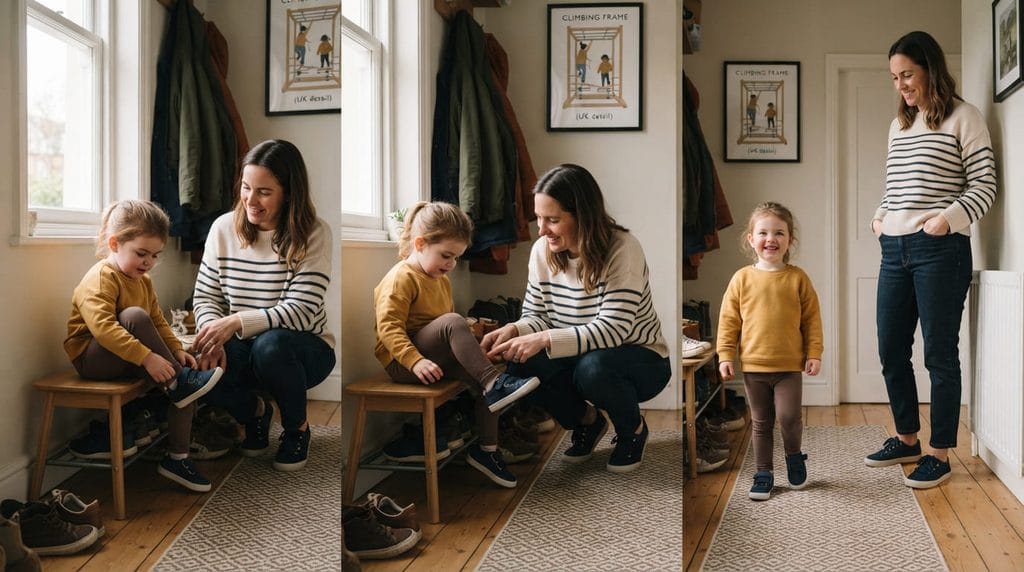
Use three steps for a safe task: invite a first attempt, give the smallest useful clue, then let your child finish. If putting on shoes is difficult, point to the heel opening rather than taking the shoes and completing the job.
Step 1: Let them try
Before helping, ask:
“Would you like to have a go first?”
Give them a reasonable opportunity.
Step 2: Guide rather than take over
If they get stuck, give a small hint.
For example:
“What do you need before you can put your shoes on?”
Instead of putting the shoes on for them.
Step 3: Step back
Once they understand what to do, let them complete the task.
This is important.
If you continue helping after your child has regained control, you may unintentionally take ownership of the task back from them.
The aim is not to provide zero help.
The aim is to provide just enough help.
This fits with early years guidance that adults should support children with appropriate scaffolding rather than automatically doing tasks for them.
7. Create Routines Children Can Follow
Routines can make independence much easier because children do not have to rely on an adult remembering every step for them.
For example, a morning routine might be:
- Get dressed.
- Put pyjamas away.
- Brush teeth.
- Have breakfast.
- Put the bowl in the kitchen.
- Put shoes on.
- Check the school bag.
For younger children, a visual checklist with pictures can be helpful.
Instead of repeatedly saying:
“Have you brushed your teeth?”
You can ask:
“What’s next on your morning list?”
Put the checklist where the task happens—for example, a three-picture ‘dress, breakfast, bag’ list near the bedroom door. Ask your child to point to the next step before offering a reminder. For related routines, see our daily learning habits at home.
8. Give Children Age-Appropriate Chores
Chores are not just about getting household jobs done.
They can give children opportunities to practise responsibility and contribute to family life.
Start with manageable tasks.
Younger children might:
- put toys away
- put clothes in the laundry basket
- help set the table
- put books on a shelf
- help feed a pet with supervision
Older children might:
- unload part of the dishwasher
- prepare a simple snack
- organise their school belongings
- tidy their bedroom
- help with laundry
- take responsibility for a regular household task
The important distinction is between helping and owning a task.
Compare:
“Can you help me tidy the table?”
with:
“Putting your cup and plate in the kitchen is your job after dinner.”
The second gives the child clearer ownership.
Step back gradually: The next four techniques help children practise decisions and problem-solving while keeping adult reassurance available. Match each task to the child, not to a fixed timetable.
9. Let Children Try Before You Step In
This can be one of the hardest changes for parents.
You may know exactly how to solve the problem.
Your child may take three times as long.
You may be tempted to say:
“Give it to me.”
But if the situation is safe, pause.
Ask:
“Do you want help, or would you like another minute to try?”
Sometimes children simply need time.
That extra time can be where independence develops.
A useful rule
If your child can probably do it but is taking longer than you would, give them time.
If your child does not yet have the skill, teach or guide them.
If your child is unsafe or genuinely distressed, step in.
10. Teach Children How to Make Decisions
Independence involves more than physical tasks.
Children also need opportunities to practise making decisions.
Start with everyday situations.
Ask:
“What do you think we should take with us?”
“Which job would you like to do first?”
“What could you do if you can’t find your pencil?”
“Which clothes would be suitable for today?”
As children get older, gradually allow them to make decisions with greater consequences.
You can still discuss the decision with them.
For example:
“What are the two choices?”
“What might happen with each one?”
“Which option do you think would work best?”
For a small decision, name two safe options, ask what might happen with each and let your child choose. Afterwards, ask what worked; avoid turning every ordinary choice into a test.
11. Teach Problem-Solving Instead of Giving Immediate Answers
Children will eventually encounter problems when you are not there to solve them.
So instead of always giving the answer, teach a simple problem-solving process.
Try the 4-question method:
1. What is the problem?
“Your school bag is missing a book.”
2. What have you already tried?
“I looked in my bedroom.”
3. What else could you try?
“Check the table and your school bag.”
4. Who could help if you still cannot solve it?
For a missing school book, a child might check their desk, then ask a teacher where lost items are kept. Practise the words ‘I checked my bag and desk. Could you help me look?’ Asking for appropriate help is part of independence.
Knowing when and how to ask for help is itself an important life skill.
12. Celebrate Progress Without Taking Over
When your child finally completes something independently, celebrate the achievement without immediately making it about yourself.
Instead of:
“See, I told you that you could do it!”
Try:
“You worked that out yourself.”
Or:
“You kept trying until you figured it out.”
Or simply:
“You managed that independently.”
The message should be:
“You are becoming capable.”
Not:
“You succeeded because I made you do it.”
Warm, supportive relationships are an important part of children’s development and can support confidence and independence.
Independence Skills by Age
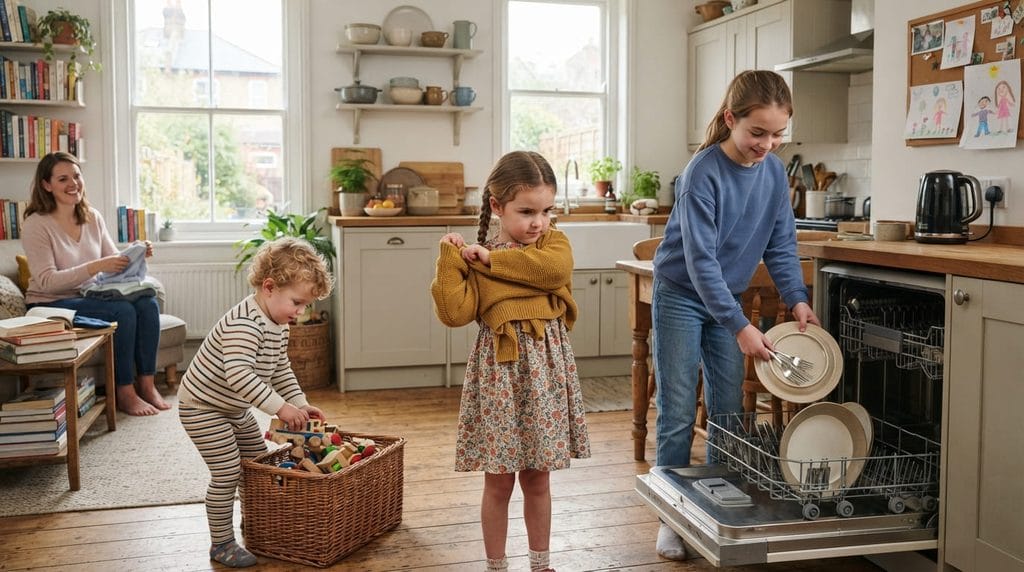
Every child develops differently, so these examples should be treated as general guidance rather than deadlines.
| Age | Possible independence skills | Parent’s role |
|---|---|---|
| 2 to 3 years | Put toys away, choose between two options, help with simple tidying | Demonstrate and give simple prompts |
| 3 to 4 years | Help dress themselves, put belongings away, follow simple routines | Guide and gradually reduce help |
| 4 to 5 years | Tidy toys, help set the table, complete simple self-care routines | Supervise and encourage |
| 5 to 7 years | Pack parts of a school bag, manage simple routines, complete regular chores | Remind less and check afterwards |
| 7 to 9 years | Organise belongings, complete more complex chores, solve simple problems | Monitor rather than constantly direct |
| 9+ years | Manage more personal responsibilities, organise tasks, make more decisions | Provide guidance while increasing ownership |
These are not developmental requirements. Children develop at different rates, and expectations should reflect the individual child, the task, safety and the amount of support they need.
The current Early Years Foundation Stage (EYFS) statutory framework supports confidence, perseverance and increasing independence in early childhood. Use the age table as practical guidance, not a pass-or-fail checklist.
How to Teach Independence at Home
Start with one task you currently do for your child and transfer it gradually over days or weeks. You do not need a complicated parenting system.
Look around your normal day and find tasks that your child currently depends on you to complete.
Then ask:
“Could my child reasonably learn to do this themselves?”
If the answer is yes, choose one task.
For example, suppose you currently pack your child’s school bag every morning.
Instead of suddenly expecting them to do everything, try this:
Week 1
Pack the bag together.
Week 2
Let your child put the items in while you provide reminders.
Week 3
Give your child a checklist.
Week 4
Let them pack independently and check the bag afterwards.
This gradual transfer of responsibility is much more realistic than expecting immediate independence.
How to Teach Kids Independence at School
How do you teach a child to be independent at school? Start with one repeatable school-day task, such as putting a coat away, unpacking a bag or asking for help. Practise the steps at home, agree with the teacher on an appropriate classroom cue, then reduce reminders only when the child is ready. The goal is safe participation, not doing everything without adult support.
At school, start with the arrival routine. A younger child can practise ‘coat on hook, bag in place, ask if unsure’; an older child can check the day’s timetable and prepare one lesson’s materials. Ask the teacher which steps fit that classroom and whether picture prompts, extra processing time or other agreed support are needed.
A simple home-to-school handover
- Choose: Agree on one safe, manageable job. Avoid adding several new expectations at once.
- Practise: Use the same two- or three-step checklist at home for a few days. Try pictures for younger children.
- Hand over: Ask “What comes next?” instead of silently doing the job. Adults remain responsible for medicines, road safety and other high-stakes needs.
- Review: After school, ask what worked. Simplify the task or coordinate with the teacher if it remains too difficult.
Check whether the handover is working: after a few school days, ask whether the child completes one extra step or needs fewer reminders. If not, shorten the checklist or restore a prompt; do not remove agreed accommodations. Adults remain responsible for safeguarding, supervision and medical needs.
The American Academy of Pediatrics’ school-routine guidance recommends consistent routines, a regular place for school belongings and communication with teachers. Pair this approach with our printable kids’ morning checklist or kid-friendly study-space guide.
Adapt the support: Children with disabilities, sensory differences or anxiety may need visual prompts, more time or agreed school accommodations. Independence should not mean withdrawing necessary support or leaving children to handle unsafe situations alone.
The Independence Checklist
You can use this checklist to identify where your child is ready for more responsibility.
Can my child…
- Put toys away?
- Put dirty clothes in the laundry basket?
- Choose between two appropriate options?
- Get dressed with age-appropriate help?
- Brush their teeth with appropriate supervision?
- Put belongings in their usual place?
- Follow a simple morning routine?
- Help prepare a simple snack?
- Pack some or all of their school bag?
- Complete an age-appropriate household task?
- Try to solve a problem before asking for help?
- Explain when they need help?
- Make a simple decision and explain why?
- Correct a safe mistake?
You do not need to work on all of these at once.
Choose one skill that your child is nearly ready to manage independently.
That is usually a better starting point. UNICEF’s independent-play guidance explains how safe, supervised play can help children practise problem-solving. For ideas, see our indoor activities for kids.
When Should Parents Step In?
Step in for safety risks or genuine distress; give a hint when a child is stuck; allow more time when the task is safe and manageable. Teaching independence does not mean leaving children to deal with everything themselves.
Parents still have an important role in providing safety, guidance and emotional support.
Step in when:
- your child is in danger
- the task requires an ability they do not yet have
- your child is genuinely distressed
- the situation has become too overwhelming
- your child needs instruction before they can continue
- the consequences could be serious
Give them more space when:
- they are simply taking longer
- they are making a safe mistake
- they are trying different approaches
- they are mildly frustrated but still engaged
- they already know how to complete the task
A useful question is:
“Does my child need help, or do I simply want to make this quicker?”
That question can stop us from stepping in too early.
How to Build Confidence in a Child Who Is Afraid of Making Mistakes
Some children avoid independent tasks because they worry about mistakes, need extra processing time, or find multi-step instructions overwhelming. Start with one step, offer a picture checklist or a short break, and adapt the task to the child’s abilities. For more calming language, see our guide to helping children handle big feelings.
In these situations, focus less on the final result and more on trying.
You could say:
“You don’t have to know how to do it yet.”
“Let’s see what happens when you try.”
“You can have another go.”
“What did you learn from that attempt?”
“Would you like a small clue?”
Avoid making every mistake into a lesson.
Sometimes a calm:
“That’s okay. Let’s try again.”
is enough.
The aim is to help your child understand that making a mistake does not mean they are incapable.
What Parents Should Avoid When Building Independence
Even with the best intentions, some common habits can make independence harder.
Doing everything because it is faster
It may save five minutes today but gives your child fewer opportunities to practise.
Giving too much help
If you complete most of the task, your child may not actually get the chance to learn it.
Expecting independence overnight
Children need practice.
Comparing siblings
Avoid:
“Your brother can do this already.”
Children develop differently.
Giving responsibility that is too difficult
Independence works best when the challenge is realistic.
Turning every task into a battle
Not every moment needs to become a lesson in independence.
Choose your priorities.
Removing emotional support
Independence does not mean children should never need parents.
A child can be independent and still need reassurance, comfort, guidance and connection.
What to Say to Build Confidence and Independence
Sometimes changing the words we use can change how much responsibility children take.
| Instead of saying… | Try saying… |
|---|---|
| “Give it to me.” | “Would you like to try first?” |
| “You can’t do that.” | “Which part feels difficult?” |
| “I’ll do it.” | “What could you try?” |
| “You’re doing it wrong.” | “Have another look. What do you notice?” |
| “Hurry up.” | “What do you need to do next?” |
| “You forgot again.” | “What could help you remember next time?” |
| “That’s easy.” | “It may take a few tries.” |
| “Let me fix it.” | “What could you change?” |
| “You need my help.” | “Do you want a clue or another try?” |
| “Well done, you’re so clever.” | “You kept trying until you worked it out.” |
You do not need to use these phrases word for word.
The principle is simple:
Ask questions that encourage thinking before giving answers.
Making Independence Practice Accessible
Adapt the task to the child, not the other way around. For a child who finds spoken multi-step directions difficult, show two pictures—’shoes’ and ‘bag’—and let them point to each completed step. Easy-open containers, extra time or adult assistance may also be appropriate. Making a choice or asking for help can count as progress.
A Simple 7-Day Independence Challenge
If you are not sure where to start, try this one-week approach.
Day 1: Choose one task
Pick something your child currently needs help with but could reasonably learn.
For example:
Putting toys away.
Day 2: Demonstrate
Show your child exactly what you expect.
Keep it simple.
Day 3: Do it together
Let your child take responsibility for as much of the task as possible.
Day 4: Let your child lead
Ask:
“What do you need to do first?”
Try not to give every instruction.
Day 5: Reduce reminders
Let your child remember the task themselves where appropriate.
Day 6: Give ownership
Make the task part of the child’s normal routine.
For example:
“Putting your toys away before bedtime is your job.”
Day 7: Reflect
Ask:
“How did you find doing that yourself?”
Review one observable change: did your child remember a step, use the picture prompt or ask for help more clearly? Keep practising the same task if it is still hard; only add a new step when the current one feels manageable.
The goal is not perfection.
The goal is to gradually move from:
Parent does it → Parent helps → Child does it with reminders → Child does it independently.
How to Teach Kids Independence Without Making Them Feel Unsupported
Check progress by looking for one fewer reminder, one additional step completed or a calmer request for help. If the routine is still difficult, simplify the task before adding responsibility.
Keep support explicit: tell your child they can try first and still ask for help. This is one of the most important parts of the process.
Independence should not communicate:
“You are on your own.”
Instead, it should communicate:
“I know you are capable, and I am here if you need me.”
There is a big difference.
Your child should know that asking for help is acceptable.
You can say:
“Have a try first. If you get stuck, I’m here.”
That gives your child both things they need:
space to develop independence and reassurance that support is available.
Frequently Asked Questions
How do I raise a confident child?
Give children regular opportunities to make age-appropriate choices, attempt manageable challenges, solve problems and learn from mistakes. Focus your encouragement on effort, persistence and progress rather than constantly praising ability.
How can I teach my child to be more independent?
Start with one everyday task your child is nearly ready to manage. Demonstrate it, practise it together, gradually reduce your help and eventually transfer ownership of the task to your child.
At what age should children become independent?
There is no single age when a child suddenly becomes independent. Independence develops gradually from early childhood through everyday activities, choices, routines, self-care and responsibilities. Developmental guidance should be treated as a range rather than a strict timetable.
How can I encourage independence without making my child feel unsupported?
Let your child try tasks independently while making it clear that you are available if they need help. Encourage attempts without expecting them to manage situations that are unsafe or beyond their current abilities.
What are good independence skills for toddlers?
Toddlers can gradually practise simple tasks such as putting toys away, choosing between two options, helping with dressing, carrying appropriate items and following simple routines. Keep expectations realistic and provide supervision where needed.
How can I make my 3 or 4 year old more independent?
Choose small everyday tasks such as putting belongings away, helping with dressing, tidying toys, following a simple routine or helping with household activities. Demonstrate the task first, then gradually reduce the amount of help you provide.
What if my child refuses to try a new responsibility?
First check whether the task is too difficult, unclear or arriving at a stressful time. Offer one smaller step or two acceptable choices, demonstrate it without pressure, and try again when your child is calm. A child who needs help or extra time is still learning independence; keep safety and connection ahead of completing a chore.
How can I help my child be independent at school?
Choose one school-day routine—hang up a coat, unpack a bag or check a picture schedule—and practise the same two or three steps at home. Agree on a cue with the teacher and review whether the child needs fewer prompts after several days. Keep adult supervision, medical care and necessary accommodations in place.
Should I let my child struggle?
Some manageable frustration can be part of learning, but children should not be left without support when they are unsafe, genuinely distressed or facing a task beyond their current ability. A useful approach is to provide the smallest amount of help that allows the child to continue.
Final Thoughts
Teaching children independence is not about rushing them to grow up. Choose one safe, age-appropriate responsibility, show the steps, let your child practise, and offer help when needed. Notice progress rather than perfection: a child who packs one item, asks for help clearly or remembers a routine with fewer prompts is building a useful skill.
Three things to remember: Start small, stay available and adjust the task when it becomes overwhelming. Children can become more capable while still knowing their parents and caregivers will guide and encourage them.
The next time your child says, “I can’t do it,” you do not always have to answer with, “I’ll do it for you.”
Sometimes, try:
“Have a go. I’m here if you need me.”
Today, pick one safe task, demonstrate its first step and let your child attempt the next one. Check back after a few days: more independent steps or a clearer request for help are both meaningful progress.