
Attention span is the time a child stays engaged with a task; it varies with interest, energy, age and context. Children do not all develop attention in the same way. One child might happily spend 20 minutes building a tower, while another loses interest after a few minutes. This can be completely normal, especially when an activity is difficult, unfamiliar or simply not very interesting. Activities to improve attention span in kids can help children practise important skills such as listening, concentration, memory, problem-solving and self-regulation. Simple games and play-based activities at home can give children opportunities to focus without making learning feel like a formal lesson.
Everyday play gives children opportunities to practise attention-related skills without turning games into tests. You do not need expensive equipment or complicated exercises. Many useful activities use things you already have at home, including memory matching, puzzles, Simon Says, I Spy, sorting, building challenges, storytime listening games, treasure hunts, freeze dance and drawing or pattern activities. These give children opportunities to practise sustained attention, listening, working memory, problem-solving, self-regulation and persistence through play.
Most games use familiar household materials. Choose a version that suits your child’s interests, abilities and need for adult support, and stop when play is no longer enjoyable.
Quick takeaway: Start with one short game your child enjoys, reduce distractions, and add one challenge when they are ready. Memory matching, Simon Says, puzzles and treasure hunts are flexible starting points. Attention practice is play, not a timed test.
Which attention activity should you try first?
Choose by interest and skill: Start with a short, familiar game rather than a long worksheet. These play ideas are not a test or treatment.
| Child’s interest | Activity | First step |
|---|---|---|
| Pictures and quiet play | Memory cards or puzzles | Try three pairs or a small puzzle. |
| Movement | Freeze dance or Simon Says | Use one stop-and-go rule. |
| Stories | Interactive storytime | Ask one question about a favourite page. |
| Exploring | I Spy or treasure hunt | Give one easy clue. |
How to use the chooser: Pick one activity that matches your child’s interest and adapt it as needed. For preschoolers, try one round of Simon Says, a two-object picture hunt or three pairs of matching cards. Switch activities if your child loses interest; the aim is enjoyable practice, not a fixed attention-time target.
Why Do Some Children Struggle With Attention and Focus?
Children can lose focus for many different reasons. Their age and stage of development matter, but so do tiredness, hunger, distractions, the difficulty of an activity and how interested they are.
Young children are still developing the ability to focus their attention, remember information, manage impulses and shift their attention from one activity to another. The Department for Education’s Development Matters guidance describes these abilities as part of developing self-regulation and executive function.
A child may also find it harder to concentrate when:
- The television or radio is playing in the background.
- There are lots of toys or other visual distractions nearby.
- Instructions are too long or complicated.
- The activity is much too easy or difficult.
- They are tired, hungry or uncomfortable.
- They have been sitting still for too long.
- An adult interrupts while they are already concentrating on another task.
- They do not understand what they are expected to do.
This is why improving attention is not simply about asking a child to “focus harder”. The environment, activity and adult support can all make a difference.
10 Activities to Improve Attention Span in Kids
1. Memory Games to Improve Attention and Concentration
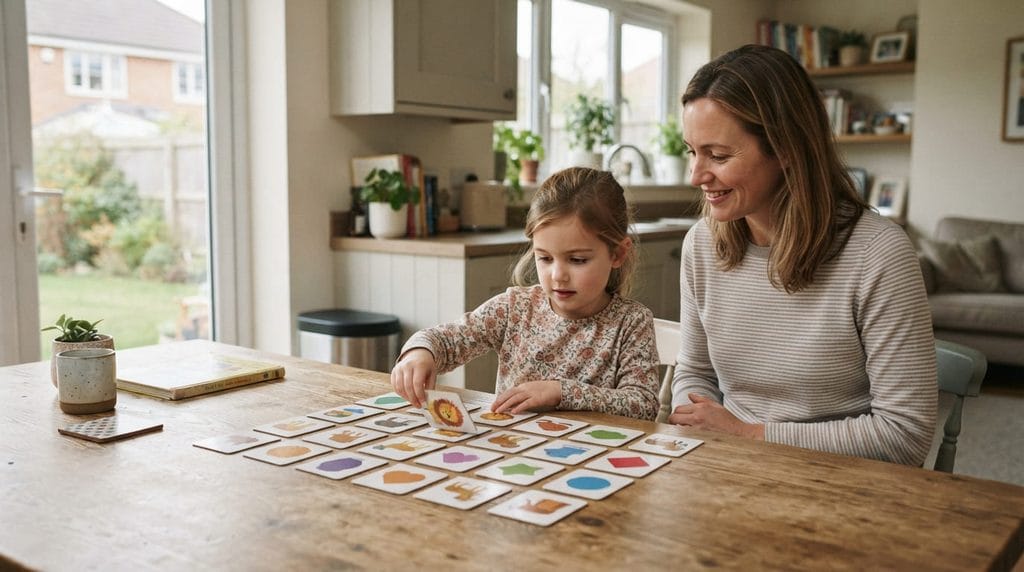
Memory matching games are simple to set up and can be adapted for different ages. You can use a traditional matching-card game, make your own cards or use pairs of familiar objects. Memory matching is one of the easiest activities to improve attention span in kids, especially when children enjoy games involving pictures or familiar objects.
How to play
Place several pairs of cards face down on a table.
Let your child turn over two cards at a time. If they match, they keep the pair. If they do not match, turn them face down again and let the next player have a turn.
Encourage your child to remember where they saw each picture.
What it practises
Memory matching games can give children opportunities to practise:
- Working memory
- Visual attention
- Remembering locations
- Turn-taking
- Concentration
- Patience
Make it easier
Start with two or three familiar pairs and leave the cards face up first. Turn them over only when the child understands the game; pointing to a match is fine if turning cards is difficult.
Make it harder
Add more pairs or ask your child to remember a sequence of several cards.
Suitable ages
This activity works particularly well for preschoolers and school-age children, but you can simplify it for younger children.
2. Try Simple Puzzles
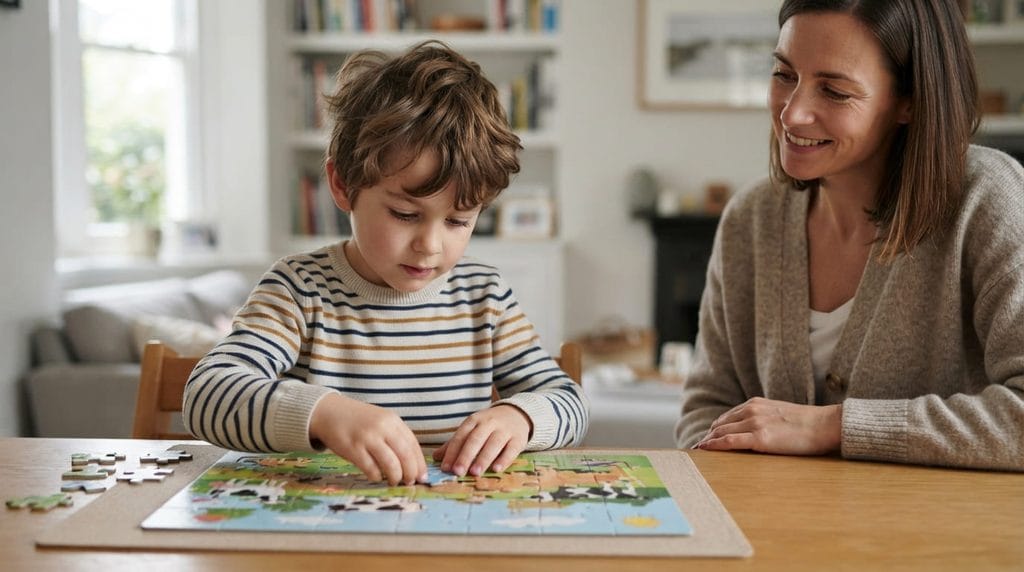
Puzzles encourage children to stay with one task while they look for clues, compare pieces and solve a problem.
Choose a puzzle that provides some challenge without being so difficult that your child becomes frustrated.
How to play
Put the puzzle pieces on the table and encourage your child to look at the completed picture.
Instead of finding every piece for them, ask questions such as:
“Which piece do you think might fit here?”
or:
“What colour are you looking for?”
Give your child time to try before stepping in.
What it practises
Puzzles can support:
- Sustained attention
- Visual discrimination
- Problem-solving
- Persistence
- Planning
- Attention to detail
Make it easier
Choose a small puzzle with a familiar picture and easy-to-grip pieces. Offer a picture guide or help position the first piece; a child can point to the next piece if handling it is difficult.
Make it harder
Use a larger puzzle or ask your child to complete a section without help.
Suitable ages
Use simple puzzles for toddlers and preschoolers, then increase the complexity as your child develops.
3. Play Simon Says and Listening Games
Simon Says is one of the easiest games for practising attention and listening.
One person becomes Simon and gives instructions such as:
“Simon says touch your nose.”
Your child should only follow the instruction when you say “Simon says”.
What it practises
Simon Says can help children practise:
- Auditory attention
- Listening
- Following instructions
- Impulse control
- Self-regulation
- Remembering rules
Start with simple actions such as clapping, jumping or touching their head.
Once your child understands the game, introduce instructions without saying “Simon says”.
NHS children’s speech and language guidance specifically recommends Simon Says as an activity for developing attention and listening skills. Listening games such as Simon Says give children opportunities to practise listening carefully, remembering instructions and responding appropriately. The NHS provides additional attention and listening activities for children.
Make it easier
Demonstrate one action while giving the instruction. Use a clear gesture or picture cue alongside speech when listening or language processing is difficult; allow time to respond.
Make it harder
Give two-step instructions, such as:
“Simon says touch your nose and then clap your hands.”
Suitable ages
This works particularly well with preschoolers and school-age children.
4. Spy Games for Better Focus and Visual Attention
I Spy encourages children to look carefully and search for a particular object or feature.
For younger children, keep the clues simple.
For example:
“I spy something red.”
Your child then searches the room for something that matches.
For older children, introduce clues based on colour, shape, size, position or function.
What it practises
I Spy can support:
- Visual attention
- Selective attention
- Observation
- Attention to detail
- Listening
- Vocabulary
Make it easier
Give an obvious clue and limit the search to one small area. For a child who cannot rely on visual clues, try a sound, texture or familiar-object guessing game instead.
Make it harder
Give two or three clues before your child starts searching.
Suitable ages
Use simple clues for toddlers and preschoolers, then introduce more detailed clues for older children.
You can also take the activity outdoors and ask your child to find something round, something yellow, three different leaves or a particular type of sound.
5. Sort and Categorise Everyday Objects
You do not need specialist educational resources for this activity. Everyday household objects can become a simple concentration game.
Try using:
- Toy cars
- Building blocks
- Socks
- Plastic animals
- Large, age-appropriate stacking cups
- Large soft blocks or fabric squares
- Coloured objects
How to play
Ask your child to sort the objects according to one feature.
For example:
“Can you put all the red blocks together?”
Once they understand the idea, change the rule.
“Now put the big blocks together.”
Later, ask your child to sort objects using two characteristics, such as colour and size.
What it practises
This activity can encourage:
- Selective attention
- Comparing
- Categorising
- Following instructions
- Flexible thinking
- Observation
Sorting everyday objects also fits with the play-based learning and thinking skills described in Development Matters.
Make it easier
Sort objects using one obvious feature, such as colour.
Make it harder
Change the sorting rule and ask your child to work out what has changed.
Suitable ages
This can be adapted for toddlers, preschoolers and younger school-age children.
6. Try Building and Copying Challenges
Building games are particularly useful for children who enjoy hands-on activities.
Use age-appropriate building blocks or construction toys. Follow the age guidance on packaging, and keep small pieces away from children who might put them in their mouths. The U.S. Consumer Product Safety Commission’s toy-safety guidance recommends checking age labels and keeping toys with small parts away from children under three.
Build a small structure and ask your child to copy it.
For example, you could make a tower using:
- Two red blocks
- One blue block
- Two yellow blocks
Then ask your child to recreate it.
What it practises
Building and copying can encourage:
- Visual attention
- Working memory
- Following sequences
- Planning
- Problem-solving
- Concentration
Make it easier
Keep your model visible while your child copies it. Use fewer large blocks or let the child direct you to place pieces when gripping or stacking is difficult.
Make it harder
Let your child look at the model for a few seconds, hide it and ask them to recreate it from memory.
Suitable ages
Use simple structures for preschoolers and increasingly complex designs for school-age children.
7. Turn Storytime Into a Listening Game
Storytime does not have to be passive. You can turn a favourite book into a simple attention and listening activity.
Pause at different points and ask questions such as:
- “What do you think will happen next?”
- “Where did the dog go?”
- “What was the boy looking for?”
- “What happened first?”
- “Which character did we meet at the beginning?”
You can also give your child a listening challenge.
For example:
“Every time you hear the word ‘dog’, give me a thumbs up.”
What it practises
Interactive stories can encourage:
- Listening
- Memory
- Comprehension
- Sustained attention
- Prediction
- Recall
GOV.UK guidance highlights shared books, stories, songs and rhymes as valuable opportunities for children to develop attention, language and communication.
Make it easier
Use a familiar favourite book with repeated phrases and simple pictures. Let the child point, gesture, choose between two pictures or use their usual communication method instead of requiring a spoken answer.
Make it harder
Ask your child to remember several details from the story after you finish reading.
Suitable ages
This can be adapted from toddlerhood through to the early school years.
8. Go on a Treasure Hunt
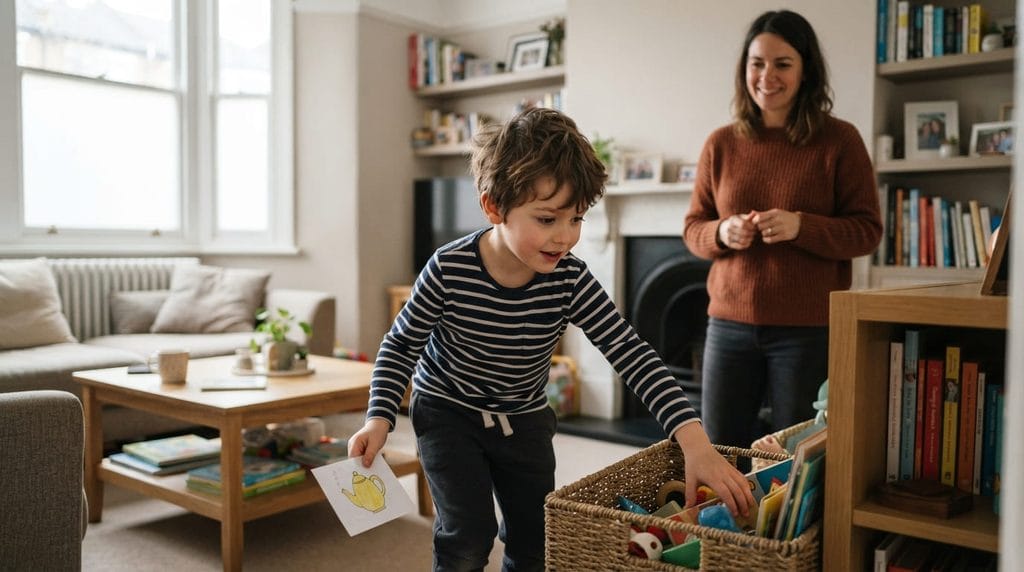
A treasure hunt combines movement with listening, memory and problem-solving.
Hide a toy or another safe object somewhere in the house.
Then give your child a clue.
For example:
“Look under something soft.”
For older children, create several clues that must be completed in order.
What it practises
Treasure hunts can encourage:
- Listening
- Following instructions
- Working memory
- Visual search
- Problem-solving
- Persistence
Make it easier
Give one clue at a time and hide objects at an easy-to-reach height. For children with limited mobility, let them direct an adult’s search or choose between two picture clues; keep routes clear.
Make it harder
Give two or three pieces of information in one instruction.
You can also turn this into a shopping game. Ask your child to find two or three objects around the house and bring them back in a particular order.
NHS children’s resources use similar everyday games involving finding and remembering objects to support attention and listening.
Suitable ages
Treasure hunts work particularly well for preschoolers and school-age children.
9. Play Freeze Dance and Movement Games
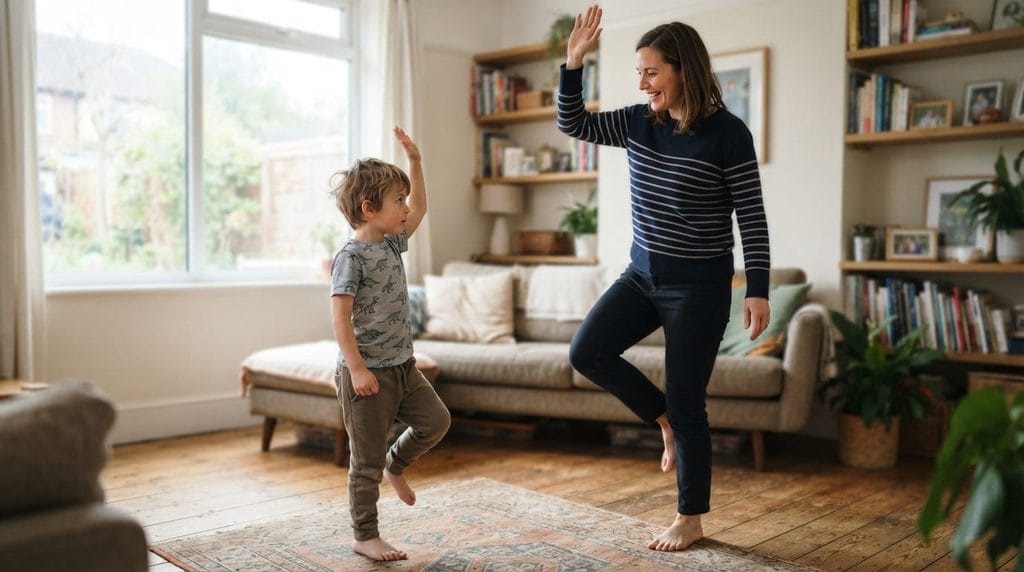
Some children find it easier to engage with attention activities when movement is involved.
Put on some music and let your child dance. Stop the music and ask them to freeze.
Once they understand the game, introduce different rules.
For example:
- Freeze when the music stops.
- Jump when you hear a particular sound.
- Touch your head when the music starts.
- Freeze in a particular position.
What it practises
Movement games can encourage:
- Listening
- Stopping and starting
- Impulse control
- Self-regulation
- Shifting attention
NHS guidance recommends balancing table-top activities with active activities and providing movement opportunities when supporting children’s attention and listening. Movement can also be incorporated into attention activities, particularly when children find it difficult to remain still for long periods. The NHS recommends a range of activities to support children’s listening skills.
Make it easier
Use one simple stop-and-go rule. Replace music with a visual cue if sound is uncomfortable, or play seated freeze dance with hand and arm movements if standing is difficult.
Make it harder
Add a second rule that your child needs to remember.
Suitable ages
Adapt the rules for toddlers, preschoolers and older children.
10. Drawing Activities to Build Concentration and Focus
Give your child paper and pencils, crayons or felt-tip pens.
Start with a simple repeating pattern:
circle, square, circle, square
Ask your child to continue it.
For older children, introduce more complicated patterns or ask them to copy a simple picture.
You can also give a short drawing challenge.
For example:
“Draw a house with two windows, a door and a tree beside it.”
What it practises
Drawing and pattern activities can support:
- Visual attention
- Memory
- Sequencing
- Following instructions
- Concentration
- Attention to detail
Make it easier
Use two shapes or colours in a simple repeating pattern.
Make it harder
Add more elements or give several instructions for your child to remember.
Suitable ages
Use simple patterns for preschoolers and more detailed challenges for school-age children.
Quick Safety and Setup Checklist for Attention Games
Make play safe and comfortable before choosing a challenge. The aim is enjoyable participation, not completing a fixed number of rounds.
- Choose age-appropriate toys and keep small pieces away from children who may put them in their mouths.
- Clear tripping hazards before treasure hunts or movement games.
- Use visual cues or quiet signals instead of loud music when noise is uncomfortable.
- Demonstrate one instruction at a time and allow extra response time.
- Offer breaks and stop if your child is distressed or no longer enjoying the game.
Follow the CPSC toy-safety guidance and product age labels when choosing materials.
Attention-Building Activities by Age
Children develop attention at different rates, so age ranges should be treated as general guidance rather than strict expectations. When choosing activities to improve attention span in kids, consider your child’s age, interests and current ability to concentrate.
| Age | Activities to try |
|---|---|
| Toddlers | Action songs, simple matching, Ready, Steady, Go games, copying actions and object searches |
| 3 to 4 years | Simon Says, simple puzzles, I Spy, sorting games and interactive stories |
| 5 to 7 years | Memory games, pattern challenges, treasure hunts, construction tasks and story recall |
| 8 years and older | More complex puzzles, multi-step instructions, strategy games, memory challenges and detailed drawing tasks |
Young children may find it easier to focus on activities they choose themselves. As they develop, they gradually become better able to shift their attention to an adult-directed activity. GOV.UK guidance describes this development as a gradual process rather than a fixed progression that happens at exactly the same age for every child.
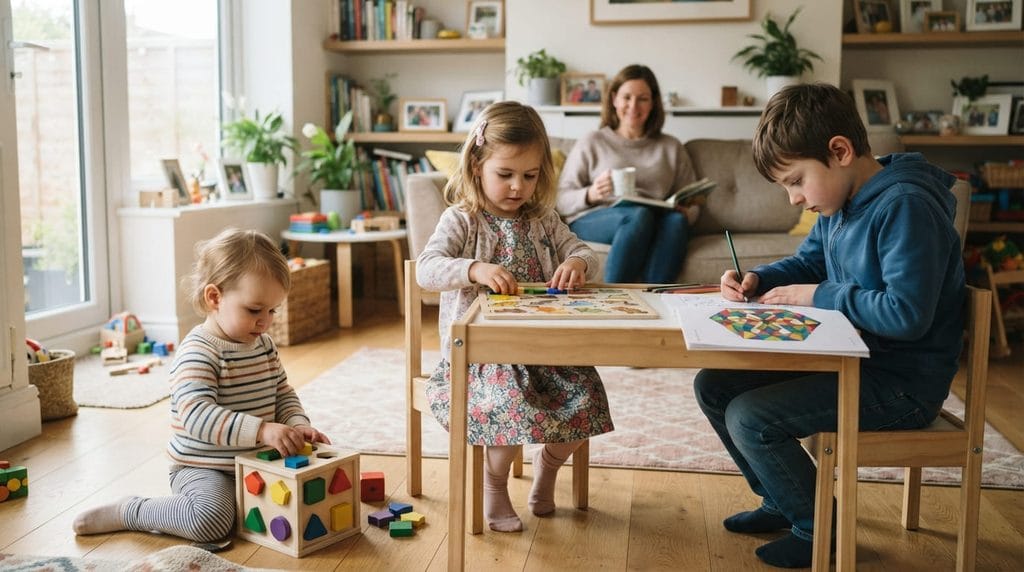
Preschool Attention Games: A No-Pressure Starter Plan
For preschoolers, start with one familiar game and one simple rule. Picture matching, I Spy, Simon Says and freeze dance offer different ways to practise looking, listening, remembering or taking turns. These are play choices, not a treatment or a test of how long a child can sit still. Pick an activity that suits your child’s interests, communication style and comfort with movement.
| Game | Use what you have | First round | Easy adaptation |
|---|---|---|---|
| Picture matching | Three pairs of large picture cards | Find one pair with cards face up | Point to matching pictures instead of memorising hidden cards |
| I Spy | Familiar objects in one room | Find one red or round object | Offer two visible choices or a picture cue |
| Simon Says | No equipment | Copy one action, such as clapping | Demonstrate the action before adding the verbal rule |
| Freeze dance | Clear floor and music or a hand signal | Move, then stop on one cue | Use a quiet visual cue, seated movement or slower actions |
How long should a preschool attention game last?
There is no required number of minutes. Start with one enjoyable round, then stop or repeat according to your child’s interest. A brief game that ends positively can be more useful than a longer activity that becomes a struggle. These examples are not developmental targets.
What if spoken instructions are difficult?
Show the action instead of repeating a long explanation. Try pointing to two picture choices, modelling a clap, or using a quiet hand signal. Allow time to respond; children can participate by pointing, moving, choosing or speaking. Adjust the game rather than demanding one form of response.
What if your child becomes frustrated or walks away?
Pause and change one thing. Turn memory cards face up, reduce the number of clues, or switch from a seated game to a movement game. Avoid comparing siblings or using a timer as a score. For calmer ways to offer choices and notice effort, see our positive parenting techniques guide.
- Offer a choice between two games.
- Show one step and let your child take a turn.
- Stop, repeat or simplify based on their response.
- Notice what was enjoyable rather than recording a concentration score.
Evidence note: The NHS attention and listening resource describes age-responsive play, reducing background noise and activities such as Simon Says. Choose age-appropriate materials and follow the maker’s safety guidance, especially where small parts could be a choking hazard.
Three Ready-to-Play Attention Activities for Different Needs
Choose a version that fits your child’s interests and abilities. These examples are starting points, not developmental tests.
For a School-Age Child Who Likes Challenges
Arrange four large blocks in a colour pattern and invite your child to copy it. If they enjoy the challenge, briefly cover the model or add one block. Let them decide when to stop. Ask which colour came first and let them explain their strategy. If the sequence becomes frustrating, uncover the model again instead of insisting they finish.
For Siblings With Different Abilities
Play I Spy with different roles: one child spots a colour, another finds the object, and another gives the next clue. Pointing, speaking or moving can all count. The goal is shared play, not identical performance.
For Preschoolers Who Prefer Movement
Hide a familiar toy in a safe, uncluttered area and give one clue. Offer a picture or gesture if spoken clues are difficult. Keep the object large enough to be safe for the youngest child present. Let your child hide the toy for you next; celebrate the search, not speed.
A Flexible Starter Routine: Choose, Play and Adjust
Example, not a target: If your child enjoys matching games, spend about two minutes choosing cards, five minutes playing with three pairs, and three minutes talking about a favourite match or taking a movement break. Stop sooner if they are tired or frustrated. Another child may prefer a two-minute Simon Says game; follow their interest instead of enforcing a timer.
- Set up: Clear a small space and offer a choice of two activities.
- Play: Give one instruction at a time and notice effort, not speed.
- Adjust: End positively; add one card, clue or instruction next time if your child is ready.
A Flexible Seven-Game Play Week
Use these as optional ideas, not a timed programme or a test. Repeat favourites, change the order, or stop whenever your child needs a break.
- Picture pairs: Start with three matching pairs; turn them face up if remembering is frustrating.
- Simon Says: Demonstrate one action before introducing a listening cue.
- Treasure hunt: Hide one familiar toy and offer a simple clue.
- Storytime: Pause on one page and invite a prediction or pointing response.
- Sorting: Group large blocks or socks by colour; invite a new rule if ready.
- Freeze dance: Use a stop-and-go signal, with a quiet hand cue if sounds are uncomfortable.
- Child’s choice: Repeat whichever game your child enjoyed most.
Example: A child who finds memory cards frustrating may prefer matching two face-up pictures. Another child may enjoy moving around to find a toy rather than sitting at a table. Both are useful opportunities for playful engagement.
How to Adapt the Games for Your Child
Offer a choice between two games, demonstrate instructions with gestures, and allow extra time for a response. For children who dislike loud music, use a quiet hand signal instead of freeze dance. If sitting is uncomfortable, try a movement-based treasure hunt. Follow your child’s interest rather than treating the games as a test.
See also our practical guide to kids’ independence for everyday choices.
How to Make Attention Activities More Effective
The activity itself is only part of the picture. The way you introduce and structure it can also affect how easily your child engages. Consistent routines can also make it easier for children to know what to expect and prepare themselves for focused activities. You can also use daily habits that help kids learn faster at home to support learning and concentration.
Reduce unnecessary distractions
Turn off the television or radio when you want your child to listen. Put unrelated toys away and keep the activity area reasonably clear. See our kid-friendly study space checklist for a practical setup.
NHS children’s services recommend reducing background noise and visual distractions when supporting attention and listening.
Get your child’s attention first
Avoid giving an instruction while your child is deeply involved in another activity.
Move closer, use their name and wait for them to notice you before giving the instruction.
For example:
“Ella.”
Wait for her to look or respond.
Then give the instruction.
This approach is recommended in NHS guidance on supporting children’s attention and listening.
Keep instructions short
Young children may struggle to remember a long list of instructions.
Instead of saying:
“Go upstairs, find your blue jumper, bring it downstairs and put it on the chair.”
Start with:
“Go and find your blue jumper.”
Once your child completes that step, give the next instruction.
Start with something your child enjoys
A child who loves dinosaurs may pay much more attention to a dinosaur treasure hunt than to an unfamiliar worksheet.
Use your child’s interests to make activities more engaging.
GOV.UK guidance also recognises the importance of children’s interests in supporting learning and exploration.
Give movement opportunities
Children do not need to sit still for every attention-building activity.
Alternate quieter activities with movement when appropriate. Freeze dance, treasure hunts and action games can all combine physical activity with listening and responding.
Increase the challenge gradually
When an activity becomes easy, change one thing rather than making it dramatically harder.
You could:
- Add another card.
- Add another instruction.
- Increase the search area.
- Use a more complicated puzzle.
- Introduce a second rule.
- Ask your child to remember something for longer.
Praise effort and persistence
Be specific about what your child did well.
Instead of simply saying:
“Well done.”
Try:
“You kept looking even when the first piece didn’t fit.”
Or:
“You listened carefully and waited until I said Simon Says.”
Specific praise tells children exactly which behaviour you noticed.
How Long Should Kids Practise Focusing?
There is no single number of minutes that every child should be able to concentrate.
Attention can vary according to age, development, interest, tiredness, the environment and the difficulty of the activity.
A child might concentrate for much longer on a favourite construction project than on an adult-directed activity they find boring.
The NHS attention and listening guide recommends age-responsive activities and reducing background noise. Begin with a manageable game and adapt it to the child rather than using a rigid timer.
Instead of focusing on a fixed number of minutes, start with your child’s current ability.
If your child can comfortably engage with an activity for five minutes, aim to make those five minutes positive and successful. As the activity becomes familiar, you can gradually introduce a little more challenge.
The goal is not to make your child sit still for as long as possible.
Notice Small Changes During Play
Look for small, everyday changes: following a familiar rule with fewer reminders, returning to a game after a break, or choosing another round. Avoid treating a stopwatch result as a measure of your child’s abilities.
If frustration is the main barrier, our guide to helping an emotional child offers supportive scripts for difficult moments.
Use Attention Games in Everyday Routines
Playful attention practice can fit into ordinary family routines without adding a separate lesson. A successful memory game does not guarantee that concentrating on schoolwork will become easier, so adapt each real-life task to your child. Choose one manageable step and notice which instructions, surroundings and supports help.
- Getting dressed: Ask your child to find socks and a jumper, or show two picture cues.
- Tidying up: Sort large toys into two baskets, then invite a different sorting rule.
- Reading: Listen for one repeated word or point to a familiar character.
- School preparation: Use a short picture checklist for bag, bottle and coat.
How to Reduce Distractions When Your Child Needs to Focus
If your child regularly loses focus, look at the environment before assuming they simply need to try harder.
Try these simple changes:
- Turn off background television.
- Reduce unnecessary noise.
- Put unrelated toys away.
- Use one activity at a time.
- Give instructions when your child is ready to listen.
- Use pictures or gestures when helpful.
- Keep materials organised.
- Use a simple visual timer when appropriate.
- Give your child a clear beginning and end to the activity.
Visual supports can also help some children understand what they need to do and what will happen next. NHS guidance includes visual timetables, first and then boards, timers and other visual prompts as ways to support attention. If your child needs a change of environment, try moving the activity to a quieter space and choosing fun indoor activities for kids that encourage active play without too many distractions.
What If My Child Keeps Losing Interest?
Do not automatically respond by making the activity longer.
Instead, consider what might be getting in the way.
Is the activity too difficult?
Try fewer puzzle pieces, demonstrate the first step, or play together before asking your child to continue. Stop if the activity becomes frustrating.
Is it too easy?
Offer one optional extra card, clue or rule, and ask whether your child wants to try it. If the game already feels enjoyable, repeating the familiar version is fine too.
Is your child tired or hungry?
Pause for food, rest or reassurance rather than asking your child to push through. Return when they feel ready, even if that means trying on another day.
Are there too many distractions?
Turn off background television, move unrelated toys out of view and try a smaller play area. Some children focus better with a little movement or a visual cue, so ask what helps.
Does your child simply dislike the activity?
Offer a choice that practises a similar skill in another way: use I Spy instead of memory cards, a movement hunt instead of a seated puzzle, or pointing instead of spoken answers.
Attention-building activities work best when children have a genuine reason to engage. Let your child’s interests guide some of your choices.
Choose play materials that fit your child’s interests and abilities, and invite them back gently if they become distracted. Children’s attention, self-regulation and ability to manage themselves develop gradually. The UK government’s Development Matters guidance provides further information about children’s development and learning.
When Should Parents Seek Extra Support?
Occasionally losing focus is part of childhood. However, if attention difficulties are persistent and significantly affect your child’s everyday life, learning, communication, relationships or participation in activities, it is worth discussing your concerns with an appropriate professional.
Depending on your child’s circumstances, this might include:
- A GP
- Health visitor
- Teacher
- SENCO
- Another relevant health or education professional
For readers outside the UK: A GP is a primary-care doctor, a health visitor is a UK community health professional supporting families with young children, and a SENCO is a school’s special educational needs coordinator. Elsewhere, start with your child’s paediatrician or other primary-care clinician and their teacher or school support team. Avoid trying to diagnose the cause yourself. Note when the difficulty happens, what helps, and whether it affects more than one setting. A professional can consider your child’s wider development and circumstances.
Frequently Asked Questions
What activities help children concentrate?
Memory games, puzzles, Simon Says, I Spy, sorting games, building challenges, interactive stories, treasure hunts, movement games and pattern activities can all give children opportunities to practise concentration, listening, memory and persistence.
How can I improve my child’s attention span?
Give your child regular opportunities to practise attention through enjoyable activities. Reduce unnecessary distractions, use clear instructions, choose manageable challenges and gradually increase the difficulty as your child becomes more comfortable.
What games increase attention span in kids?
Memory matching, Simon Says, I Spy, musical statues, treasure hunts and copying games can practise different aspects of attention, including listening, visual search, working memory and impulse control.
What activities improve attention span in toddlers?
Toddlers can try simple matching games, action songs, copying games, Ready, Steady, Go games, object searches and short interactive stories. Preschoolers can try Simon Says with one rule, a picture hunt or three matching pairs. Keep the activities simple and follow your child’s interests.
How can I help my child focus without forcing them to sit still?
Include movement in attention-building activities. Treasure hunts, action songs, Simon Says and freeze dance allow children to move while listening and responding. Alternating quieter and active activities can also provide useful variety.
What exercises are good for children’s attention?
Listening games, memory activities, visual searches, puzzles, movement games and activities involving instructions can all provide opportunities to practise attention. Choose activities that match your child’s age and current abilities.
How long should a child be able to concentrate?
There is no single attention time that applies to every child. Age, development, interest, tiredness, the environment and the difficulty of the task all matter. Focus on gradual progress rather than comparing your child with another child.
Final Thoughts
The best activities to improve attention span in kids can be simple, enjoyable games rather than formal lessons. A memory game, puzzle, treasure hunt, story or round of Simon Says can give your child opportunities to listen, remember, wait, follow instructions and stay with a task.
Start with something your child enjoys. Keep the first attempts manageable, reduce distractions and increase the challenge gradually.
Most importantly, focus on progress rather than perfection. A child who returns to an activity after becoming distracted, listens to one extra instruction or persists with a difficult puzzle is already practising valuable attention skills.
You do not need expensive resources. A few minutes of purposeful play, repeated regularly, can become a useful part of your child’s everyday routine. These activities to improve attention span in kids work best when they are treated as enjoyable opportunities to practise focusing rather than tests of how long a child can sit still.