
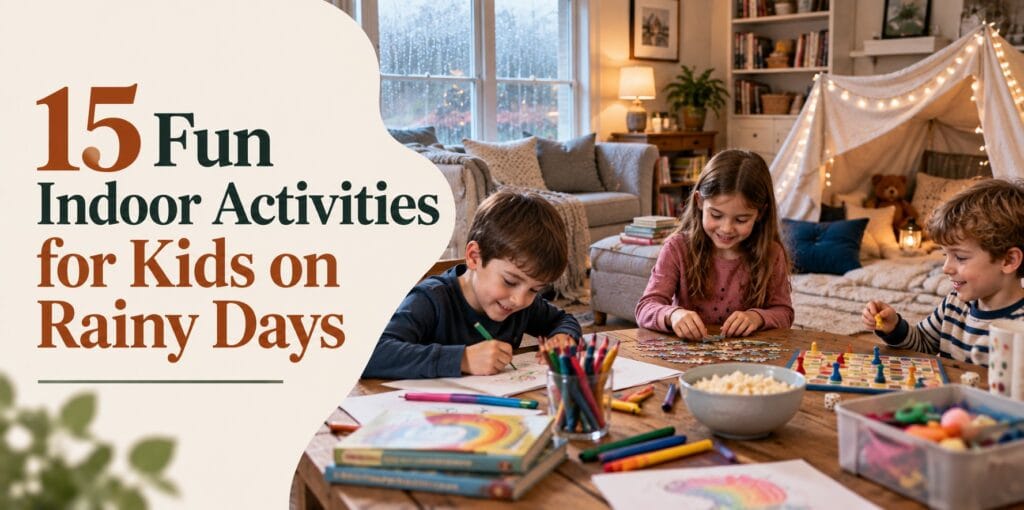
Quick takeaway: The best indoor activities for kids on rainy days mix movement, creativity, quiet focus, and family connection. Choose two or three activities that fit your child’s age, energy level, and the space you have, then let them help set up and lead the play. You can start with paper, cushions or other supplies already at home; choose materials and supervision for the youngest child who can reach them.
Rainy days do not have to become long stretches of screen time. Simple indoor activities can give children a safe way to move, create, solve problems, practise everyday skills, and spend meaningful time with family.
This list is designed for parents and caregivers looking for low-prep rainy-day ideas for preschoolers and school-age children. Most use ordinary household materials, and you can simplify or extend them for different ages.
Why Indoor Play Matters
Rainy-day play gives children opportunities for movement, creativity, language and cooperation. The American Academy of Pediatrics explains how different types of play support development. Alternate active and quiet activities according to your child’s needs. The CDC’s physical activity guidance recommends active play throughout the day for ages 3–5 and at least 60 minutes of daily activity for ages 6–17.
How to Choose a Rainy-Day Activity
Start with what your child needs right now. If they are restless, choose movement. If they are tired, try drawing, puzzles, or storytelling. For siblings or mixed ages, pick an activity with flexible roles so everyone can join without competing at the same level.
- High energy: dance party, indoor bowling, treasure hunt.
- Creative mood: crafts, drawing challenges, role-play.
- Quiet time: puzzles, stories, board games.
- Family time: baking, indoor camping, movie day.
Rainy-Day Activity Chooser: Time, Space and Supervision
Pick an activity based on your available space, time and the youngest child’s abilities. These are approximate setup times, not developmental benchmarks.
| Situation | Good first choice | Setup and supervision |
|---|---|---|
| Five minutes, small room | Story-building or drawing | Paper and pencils; adult introduction |
| Ten minutes, clear floor | Freeze dance or soft-ball bowling | Remove breakables; supervise movement |
| Mixed-age siblings | Treasure hunt or pretend shop | Picture and written clues; check hiding places |
| Adult available for 20–30 minutes | Baking or simple science | Adult handles heat, sharp tools and materials |
| Quiet play, little space | Puzzles or puppet show | Choose age-suitable pieces and supplies |
| Sensitive to noise or crowded spaces | Drawing, picture stories or a tabletop sorting game | Offer a quiet corner, a choice of materials and breaks without a timer |
A Five-Minute Setup Plan
- Clear the floor and remove breakables.
- Offer one active and one quiet choice.
- Gather the materials before starting.
- Try 10–15 minutes, then follow the child’s interest.
- Put supplies away together before switching games.
15 Easy Indoor Activities for Kids on Rainy Days
Start with one manageable activity. Shorten, repeat or simplify it as needed; enjoyable play matters more than completing every idea.
1. Indoor Treasure Hunt
Setup: Gather paper clues and choose five safe hiding places before starting.
Hide five clues in easy-to-reach places such as beside a book or under a cushion, never near stairs, appliances or cleaning products. Give younger children picture clues and let older children write simple riddles. Try it: Draw a sofa, table and bookshelf on three cards, hide them in that order and finish with a favourite book rather than a bought prize. Count and collect every clue when the game ends. For children who cannot move easily around the room, place picture clues on a reachable tabletop and let them direct a partner to each clue.
2. DIY Arts & Crafts Station
Set a washable tray on a stable table with paper, large pre-cut shapes, chunky crayons and a few reusable scraps. Offer one open prompt—make an animal, design a postcard or build a paper town—rather than a complicated craft with a fixed result. Let children choose the materials and show their work if they want. An adult should handle cutting when needed, keep small items away from younger siblings and finish with a two-minute tidy. If glue, paint or sticky textures are uncomfortable, offer a dry collage with large pre-cut shapes or a simple drawing option instead.
Try it: Give each child one sheet of paper and three large pre-cut shapes. Ask them to make an imaginary animal, name it and describe where it lives. An adult should handle cutting for children who cannot safely use scissors; use washable supplies and clear the table together afterward.
3. Story-Building Game
Start with one sentence and let each person add the next part. Add simple rules—every character needs a name, a problem, and a solution—to give older children more challenge. Younger children can draw a picture of the story afterwards. Children who prefer not to speak can point to picture cards, draw the next event or use their usual communication support to choose what happens.
Try it: Begin with “A small cat found a mysterious key.” Take turns adding one sentence. After five turns, ask what the character wanted and how the problem was solved. Children who are not writing yet can tell or draw their part.
4. Pillow Fort Building
Try it: Place two sturdy, low chairs a short distance apart, drape a lightweight sheet over them, and add a cushion and favourite book. Keep the structure away from heaters, cords and windows, with a clear exit and no heavy objects overhead. Ask your child to turn the den into a reading nook, pretend campsite or storytelling corner. For a room too small for a fort, make a cosy floor reading spot instead. Check that chairs cannot tip, do not let children climb on the structure, and use a table-based pretend den if floor seating is uncomfortable or inaccessible.
5. Baking Together
Try it: Make a no-cook fruit-and-yogurt bowl. An adult washes hands and food-preparation surfaces, washes and cuts the fruit into age-appropriate pieces, checks allergies and choking risks, and sets out ingredients. Children can count spoonfuls, layer ingredients and explain the steps in order. If you bake something warm instead, let children measure and stir while an adult handles the oven, knives and hot surfaces. The useful part is practising a real task together, not producing a perfect snack.
6. Indoor Bowling
Use six empty plastic bottles as pins and mark a rolling line with removable tape. Clear breakables and keep the lane away from doors and other people. Let children move the line closer, count fallen pins or take turns resetting the bottles. Small-space option: Roll a soft ball along a hallway-sized mat from a seated position instead of throwing; choose a quiet activity if there is no safe clear lane. If rolling is difficult, a child can arrange the pins, keep score or choose the next target while a partner rolls.
Try it: Set up six empty plastic bottles at the end of a clear room and roll a soft ball from a marked line. Count the pins together, reset and let the child adjust the distance. Keep the ball away from glass, pets and anyone crossing the play area.
7. Drawing Challenges
Give children a choice of two playful drawing prompts, such as “invent a superhero animal” or “design a tiny house.” Put a few pencils and one sheet of paper on the table, then invite them to describe their picture rather than judging the result. For a mixed-age group, one child can draw while another tells the story. Skip the timer for children who find countdowns stressful; the prompt is an invitation, not a test.
Try it: Write three prompts on paper—an animal, a place and a silly object—and let each child pick two to combine in one drawing. Ask them to explain their creation rather than grading it. For a five-minute version, use one prompt and no timer.
8. Educational Games Time
Make a quick offline game with cards, paper or large safe household objects. For preschoolers, place four coloured items on a tray and ask which match; for school-age children, write five clues that lead to objects around the room. Let children invent the next round so they practise explaining rules as well as solving them. Use larger pieces around young children, and stop after a few enjoyable turns rather than stretching the game into a lesson.
9. Family Movie Day or Puppet Show
For a screen-free option, start with a sock-puppet show: draw two characters on paper, give each a simple problem and act out a three-minute story. If your family chooses a movie instead, let children make paper tickets, arrange cushions and talk about a favourite scene afterwards. Keep snacks age-appropriate and avoid making screen time the automatic choice for every rainy afternoon. If you choose a film, pick suitable content, use captions when helpful and let children opt for the quieter puppet-show alternative.
10. Dance Party
Move chairs and breakables out of a small clear area, then try three short rounds: move to a song, freeze when it stops, and copy one person’s slow movements. Use nonslip footwear and keep children away from furniture edges. In a flat where noise is a concern, play quiet seated copy-the-leader or hand-motion games. Let a child opt out of loud music and choose a calmer activity.
Try it: Choose three songs: move freely for the first, play freeze dance for the second, and slow down for the third. Clear the floor and avoid slippery socks. If noise or movement is difficult, try seated arm movements or a quiet copy-the-leader game instead.
11. Puzzle Time
Choose a puzzle with pieces appropriate for the youngest child who can reach it, and put the pieces on a tray so they do not scatter. Start by matching colours or building one edge together; then let the child try a section independently. If frustration grows, reduce the number of pieces or show the picture reference. Older siblings can create a large-piece drawing puzzle for younger children, with an adult handling any cutting. For children who find tiny pieces or busy pictures difficult, try high-contrast, easy-grip pieces or complete a picture together with fewer pieces.
Try it: Put the puzzle on a tray, sort pieces by colour or edge and complete one small section together. Offer fewer pieces or a picture reference if frustration rises. Older children can explain their strategy or design a simple cut-paper puzzle for someone else.
12. Indoor Camping
Create a low reading den with a lightweight sheet, cushions and battery-powered lights, keeping the opening clear and the setup away from heaters, cords and windows. Give children a pretend packing list—book, soft toy and water bottle—then invite them to tell a campsite story. Skip a freestanding fort if the furniture is unstable; a floor picnic and a torch-lit story can create the same atmosphere with less setup.
Try it: Make a low blanket shelter with a clear opening, bring two books and use only battery-powered lights. Pretend to pack a campsite bag and tell a story. Avoid candles, space heaters, dangling cords and heavy objects supporting the shelter; keep adults able to see and reach children.
13. Simple Science Experiments
Try it: Fold two strips of paper into different bridge shapes, rest each across the same gap, and add large age-appropriate blocks one at a time. Ask your child which bridge will hold more, test the idea, and talk about what changed. Keep the gap and type of block the same for each test so the child can compare the bridge shapes. Other low-prep options include mixing washable colours or testing whether large safe objects float. An adult should supervise, keep small parts away from young children, and never mix household cleaners or unknown chemicals.
14. Board Games Tournament
Choose two short games with simple rules and explain one practice round before keeping score. Rotate who starts, and praise taking turns or helping another player rather than only winning. If children are different ages, pair an older child with a younger one or try a cooperative challenge where everyone works toward a shared goal. Stop or switch games if competition becomes upsetting. For children who cannot read the cards or track points easily, use picture-based rules, a partner who reads aloud or a cooperative game without a countdown.
Try it: Choose two short games and give everyone a turn explaining a rule. Keep a scorecard for teamwork or kind turns as well as points. If competition causes tension, stop keeping score and work toward a shared goal, such as completing a puzzle together. Skip countdowns if they add pressure.
15. Role-Play Games
Turn one table into a pretend shop or café with paper signs, empty cups and a few age-appropriate props. Let children choose roles such as customer, shopkeeper or menu writer, then swap after a few minutes. Older children can write orders while younger children point to picture menus. Keep hot drinks and sharp items out of the play area.
Try it: Set up a pretend café with paper menus, empty cups and a few large safe props. One child takes orders, another prepares pretend food and a third draws signs; swap roles after five minutes. No real hot drinks or small loose items are needed. If a child finds spoken role-play difficult, they can point to a picture menu, draw a sign or arrange the pretend shop while others handle dialogue.
Choose by Age, Time and Space
Preschoolers: try picture-clue treasure hunts, large-piece puzzles, pretend shops or short freeze-dance rounds with close supervision. School-age children: try written riddles, collaborative stories, paper-bridge challenges and scoring games. For mixed-age siblings, give each child a different role rather than expecting identical skills.
Short on time? For 5–10 minutes, try drawing or storytelling. For 10–15 minutes with floor space, try freeze dance or soft-ball bowling. For 20–30 minutes with an adult, plan a treasure hunt or bake together. Children with sensory or communication differences may prefer visual instructions, quieter games and extra time to respond. A child who dislikes loud music could lead silent charades rather than a dance party. For limited mobility, try seated movement or a tabletop game. Offer the option to watch before joining.
Rainy-Day Play With Mixed-Age Siblings
Choose an activity with different roles rather than expecting children of different ages to complete the same task. For a treasure hunt, a younger child can follow picture clues while an older sibling writes the next clue. In a pretend shop, one child can arrange objects while another makes signs or counts pretend purchases. If someone needs a break, offer a quiet activity nearby instead of forcing everyone to stay in the same game.
Indoor Play Safety: A Quick Parent Check
Choose supplies suitable for the youngest child who can reach them. The U.S. Consumer Product Safety Commission’s toy-safety guidance highlights choking hazards from small parts, balloons, small balls, magnets and button batteries. Keep these away from young children, supervise activities involving heat or sharp tools, and make sure blanket forts do not block exits.
What Can Kids Do While a Parent Works Nearby?
Choose a familiar activity that fits your child’s abilities and your capacity to supervise. A school-age child who understands the rules might draw from a picture prompt, read or complete an age-appropriate puzzle while a caregiver stays available and checks in. Young children and children needing closer support require active supervision; a timer is never a substitute for watching them.
Put one tray of safe supplies on a stable table and agree on how the child can ask for help. Save baking, cutting, experiments and energetic games for a time when an adult can supervise directly. If you have only paper and a pencil, invite the child to draw a three-scene story.
Build a Simple Rainy-Day Activity Kit
Keep a small box of reusable supplies ready for wet afternoons. Paper, chunky crayons, washable markers, a soft ball, picture books and large building pieces can support several of the activities above. Store scissors, glue and any small parts separately, out of reach of younger children. You do not need to buy a new kit: rotate a few familiar materials to make setup easier and reduce clutter.
Three Quick Ways to Use the Kit
- Five-minute quiet reset: Ask your child to draw a new animal, give it a name and tell you one thing about it.
- Ten-minute movement break: Arrange empty plastic bottles as pins, roll a soft ball and take turns counting the pins.
- Fifteen-minute family game: Create paper puppets and act out a story with a beginning, problem and ending.
Put out only the materials needed for one game. Invite children to help tidy before changing activities; a short, repeatable routine is more useful than preparing every idea at once.
Examples for Small Apartments and Mixed-Age Families
Small apartment, low noise: Start with a five-minute story-building game at the table, spend ten minutes on drawing prompts, then finish with a large-piece puzzle. Keep supplies in one tray so the room can return to normal quickly.
Family home, mixed ages: Start with soft-ball bowling in a cleared area, then let an older child write treasure-hunt clues while a younger child follows picture hints. End with a shared puppet show. Adapt the plan for the youngest child and supervise all movement and small props.
Quick Rainy-Day Activity Checklist
- Choose an activity that matches your child’s current energy level.
- Clear a safe play area and remove breakable objects.
- Gather materials before inviting children to start.
- Give simple instructions, then allow room for their own ideas.
- Switch between active and quiet activities during a long indoor day.
- Stop while the activity is still enjoyable rather than forcing it to continue.
Frequently Asked Questions
What can kids do indoors without toys or craft supplies?
Try storytelling, freeze dance, charades, pretend shops, or drawing prompts. Paper, pencils, and a clear floor are enough for several of these ideas.
Which rainy-day activities work in a small apartment?
In a small apartment, start with a tabletop story game, large-piece puzzle, paper craft or sock-puppet show. Keep supplies on one tray and leave the door and walking route clear. For movement, try seated copy-the-leader or gentle freeze poses rather than hard-ball games. Skip blanket forts if they would block exits or require unstable furniture.
What are easy indoor activities for kids when parents are busy?
Choose a familiar, age-appropriate tabletop activity that the child can use safely while you remain available, such as drawing from two picture prompts, reading or a suitable puzzle. Set out the materials in advance, explain how to ask for help and check in regularly. Younger children and children needing close support require active supervision; save baking, scissors and energetic games for when an adult can participate directly.
How do I keep kids active indoors on a rainy day?
Use short movement activities such as freeze dance, indoor bowling, an obstacle-free treasure hunt, or follow-the-leader. Rotate active play with quieter activities so children have natural changes of pace.
What can siblings of different ages do together?
Fort building, storytelling, baking, role-play, and collaborative art are flexible because each child can take a different role. Give younger children simple jobs and older children planning or leadership tasks.
What are good rainy-day activities for toddlers?
Choose short, closely supervised activities with large, age-appropriate materials: chunky crayons, picture books, simple pretend play, or a gentle follow-the-leader game. Avoid small parts, balloons, magnets and any materials a toddler could swallow.
How can I keep kids entertained indoors for 30 minutes?
Try a flexible 30-minute sequence: five minutes to choose and clear the space, ten minutes of soft-ball bowling or seated movement, ten minutes of drawing or storytelling, and five minutes to tidy. Swap the active part for a puzzle if the room is too small or a child needs quiet. The times are suggestions, not targets—let children stay longer with a game they enjoy.
More Ideas for Kids at Home
For another low-screen activity list, explore these screen-free summer activities for kids. For learning routines between play sessions, see daily habits that help kids learn at home. You can also use these activities to improve attention span in kids when you want a more focused option.
For smoother transitions between activities, try these positive parenting techniques for offering choices and setting calm limits. For a repeatable morning routine, see our kids morning routine printable checklist.
Parallel Play When Siblings Have Different Energy Levels
One child may need movement while another needs quiet, predictable play. Set up two nearby options that you can supervise safely. For example, an older child can roll a soft ball toward plastic-bottle pins while a younger child sorts large, age-appropriate blocks at a table. Keep the bowling lane away from the table, glass and walkways. If there is not enough room for both, take turns: one child draws a scoreboard while the other bowls, then swap.
For children who find noise or spoken instructions overwhelming, offer a picture choice, quieter materials, seated movement or a break. Do not require eye contact or participation on a timer. For difficult transitions, see these practical ways to help an emotional child.
Choose a 10-, 30- or 60-Minute Rainy-Day Plan
Start with the time and attention you actually have. These are flexible examples, not targets children must meet. The youngest child’s safety and interest matter more than finishing a schedule.
| Time available | Easy activity sequence | Adjust for your home |
|---|---|---|
| 10 minutes | Two minutes to choose and clear a spot; six minutes of storytelling or drawing; two minutes to tidy. | Use a table or tray when floor space is limited. |
| 30 minutes | Five minutes to set up; ten minutes of freeze dance or soft-ball bowling; ten minutes of puppets or drawing; five minutes to tidy. | Swap noisy movement for seated copy-the-leader or a puzzle. |
| 60 minutes | Ten minutes to choose and prepare; fifteen minutes of active play; twenty minutes of a story, art or pretend shop; fifteen minutes for books, puzzles and cleanup. | Let a child stay with a favourite game instead of interrupting for the clock. |
Example for a small apartment: Begin with a story at the table, add drawing prompts, then finish with a large-piece puzzle; keep supplies in one tray. Example for mixed ages: Let an older child write treasure-hunt clues while a younger child follows picture hints, then make a shared puppet show. If anyone is overwhelmed, shorten the plan and offer a quiet break.
What If an Indoor Activity Is Not Working?
Change one thing before preparing an entirely new game. If a treasure hunt feels too difficult, use picture clues and fewer hiding places. If a craft becomes frustrating, switch to free drawing. If siblings argue over turns, give them different roles or a shared goal. If a child seems tired or overwhelmed, offer a quiet break. The best rainy-day plan is one your family can adjust, not a checklist everyone must finish.
Final Thoughts
Start here today: Pick one movement game and one quiet game from the chooser, gather their materials in five minutes, and let your child choose which comes first. Keep the next activity in reserve rather than trying to fill every minute.
A good rainy-day plan does not need expensive supplies or a packed schedule. Keep a small mix of movement, creative play, practical tasks, and quiet activities ready, then let your child choose what fits their mood. The aim is not simply to fill time—it is to make indoor time feel playful, connected, and manageable for the whole family.